
International entrepreneur and fashion personality Hofit Golan and global business leader, investor and author Vinay…
Prof. Mike Chan: Brain-Specific Stem Cells Unlock the Brain’s Regenerative Intelligence
Source: University of Queensland. Nature Neuroscience (2025). Definitive evidence of lifelong human hippocampal neurogenesis. Brain Science – 🧠💡 Australian researchers discovered… | Facebook
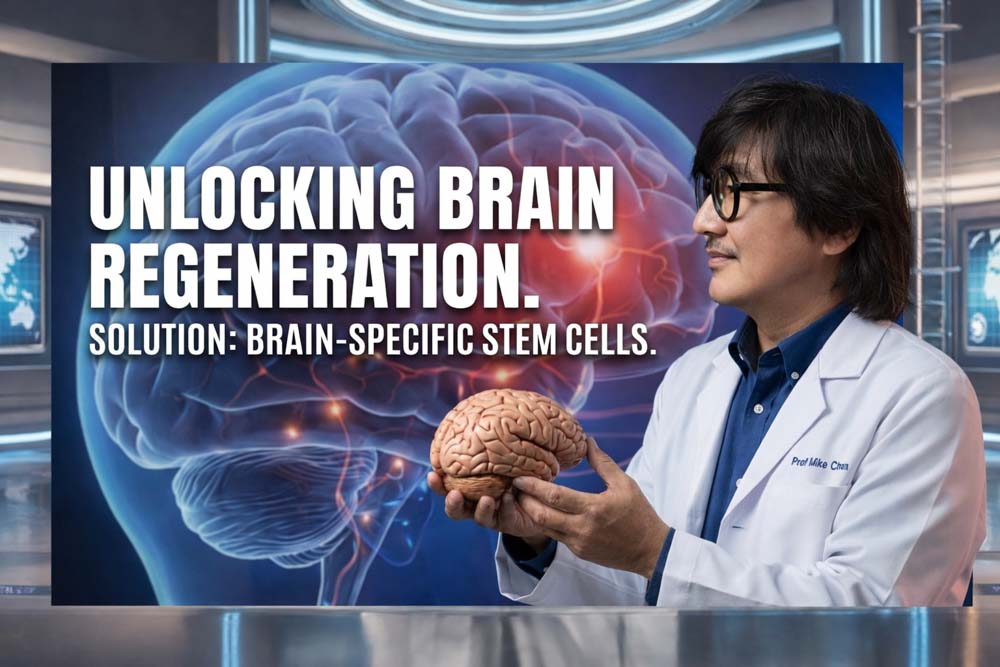
Recently, Australian scientists have overturned one of neuroscience’s oldest beliefs. Researchers at the University of Queensland have confirmed that the human brain continues to generate new neurons throughout the entire lifespan — even into the 90s.
By providing definitive evidence of ongoing neurogenesis in the hippocampus, this landmark discovery dismantles decades of dogma that brain cells cannot regenerate. More importantly, it reframes how we understand brain aging, lifelong learning, and neurodegenerative disease.
Cognitive decline is no longer seen as inevitable loss, but as a biological process with regenerative potential — opening the door to new solutions for dementia, memory disorders, and brain repair.
“All 67 brain stem cells and cells can regenerate — but only if you give it the right, specific brain cells.” — Prof. Mike Chan
The confirmation that humans grow new brain neurons throughout their entire lifespan is a scientific breakthrough. But discovery alone does not heal patients.
The real question is no longer whether the brain can regenerate — it is how to activate and sustain that regeneration. According to Prof. Dato’ Sri Dr. Mike Chan, the answer lies in one principle: solution-driven, brain-specific stem cells.
The University of Queensland study proves lifelong neurogenesis exists. Prof. Chan’s work defines the biological solution required to make it clinically meaningful.
Innovation Description: From Proof to Precision Solution
The Nature Neuroscience (2025) study demonstrates that the hippocampus produces approximately 700 new neurons per day, even in elderly individuals. These neurons integrate into functional circuits, supporting memory, learning, and emotional regulation.
However, the study also reveals an important limitation: neurogenesis slows with age, stress, inflammation, and disease.
“That is true — the brain can generate new neurons throughout life. However, after the age of 40, we lose approximately 10,000 neurons every day, and the overall brain volume gradually shrinks. The hippocampus alone declines by about 5% per decade after 40. This is why continuous, targeted brain regeneration is essential.” — Prof. Dato’ Sri Dr. Mike Chan
He added: “Neuroplasticity can outpace degeneration only when we actively support the brain with the right biological inputs. Without precision intervention, natural regeneration is simply not enough to counter long-term brain loss.”
This is where brain-specific stem cell therapy becomes essential — not as replacement, but as biological reinforcement of the brain’s natural regenerative system.
Research Approach and Modality
The Australian researchers used advanced molecular markers, radiocarbon dating, and high-resolution hippocampal analysis to confirm neuron birth across ages 20–90+.
Their work answers the existence question. Prof. Chan’s bioregenerative protocols answer the application question:
Which cells delivered how, to which brain region, under what biological conditions?
“Discovery tells us the brain can regenerate. Precision stem cells tell us how to make it happen.” — Prof. Mike Chan
Precision Stem Cell Matching Principle: The Solution Framework
Prof. Chan’s A1–B6–Z10 Precision Stem Cell Matching Principle defines why brain-specific stem cells are the solution — and why generic approaches fail.
The brain contains 52 lobes and 67 different cell types. Each region requires its own biological language.
To stimulate hippocampal neurogenesis, one must use:
- Hippocampal-matched neuronal precursor cells
- Brain-specific peptides and exosomes
- Correct delivery pathways that allow cellular homing
Anything less is biologically incompatible.
5 Key Scientific Insights Reframed as Solutions
- The Hippocampus Requires Targeted Repair
The UQ study identifies the hippocampus as the neurogenic hub. Prof. Chan’s solution is direct: treat the hippocampus with hippocampal precursor cells, not generalized therapy. - Aging Needs Cellular Support, Not Stimulation Alone
Exercise and lifestyle help, but aging brains lose cells daily. Brain-specific stem cells provide the biological building blocks needed to sustain neurogenesis. - Generic Stem Cells Are the Wrong Tool
Mesenchymal stem cells cannot differentiate into complex neuronal subtypes. As Prof. Chan explains:
“You cannot use a liver cell for the heart — or a generic stem cell for the brain.” - Correct Delivery Is Part of the Solution
Intravenous delivery traps up to 90% of cells in the lungs. Prof. Chan’s protocols use deep intramuscular delivery, enabling stem cells to home toward inflamed or damaged brain regions. - The Brain Regenerates Only in a Clean Environment
Brain-specific stem cells require low inflammation, healthy mitochondria, and a balanced gut-brain axis. Detoxification and metabolic repair are integral parts of the solution.
The Hippocampus as a Precision Target
The hippocampus governs memory, emotional balance, learning, and stress resilience. When depleted, patients experience depression, anxiety, cognitive decline, and neurodegeneration.
Prof. Chan emphasizes solution-based intervention:
“When emotions and memory fail, the hippocampus is exhausted. That is where we intervene.”
The University of Queensland study confirms this region never loses its regenerative potential — making it ideal for brain-specific stem cell therapy.
Why This Changes Medicine
This research shifts neurology from observation to intervention. Neurodegenerative and neuropsychiatric conditions are no longer viewed as irreversible — but as states of insufficient regeneration.
The solution is not symptom suppression.
The solution is cellular precision.
European Wellness Brain-Specific Stem Cell Protocols
European Wellness Biomedical Group translates this science into real-world solutions through:
- Brain-region-specific precursor stem cell therapy
- Hippocampal-targeted peptides and exosomes
- NAD+ and mitochondrial brain support
- MRI-guided precision regenerative protocols
- Gut-brain detoxification to enable neurogenesis
These protocols do not force regeneration. They restore the brain’s ability to regenerate itself.
“The brain already knows how to heal. Brain-specific stem cells simply give it the correct tools.” — Prof. Mike Chan
Global Research Footprint
European Wellness Biomedical Group leads precision bioregenerative medicine through research and clinical programs across Switzerland, Germany, Greece, Thailand, and Southeast Asia.
Learn how brain-specific stem cell solutions can support memory, emotional balance, and lifelong cognitive vitality.
📍 European Wellness Biomedical Group
🌐 https://www.european-wellness.com
📧 info@european-wellness.com
Discovery proves the brain can regenerate. Precision stem cells make it possible.
Follow European Wellness:



Follow European Wellness Academy:
Follow Prof. Dato’ Sri Dr. Mike Chan:

Related Posts