
European Wellness is elated to announce our participation in the 31st Macao International Trade and…
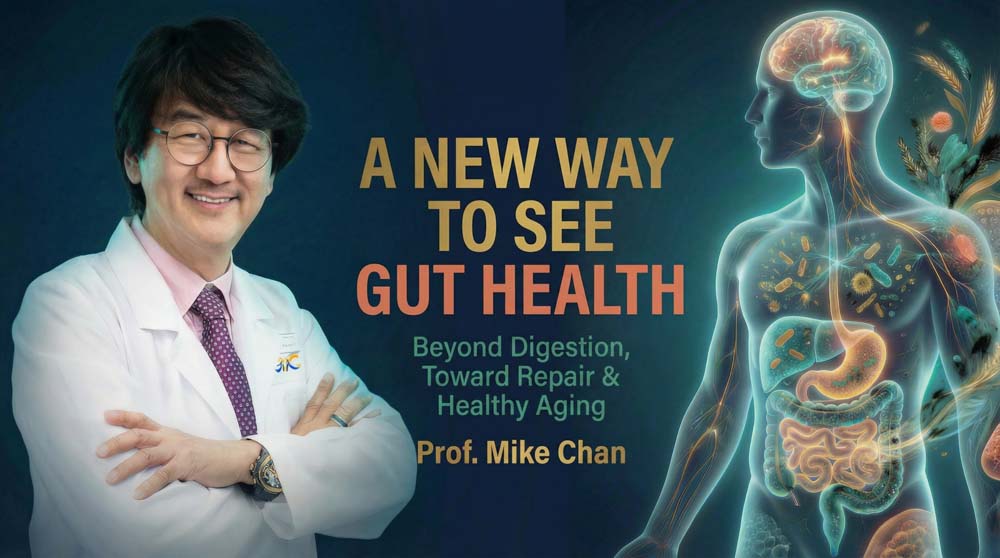
Gut Health Beyond Digestion: Repair, Resilience, and Healthy Aging
Prof. Dato Sri Dr. Mike Chan presents gut health as one of the most overlooked foundations of human well-being. In his account of the findings gathered on gut health, the digestive system is not treated as a narrow subject limited to constipation, bloating, or food sensitivity. Instead, it is understood as a major regulator of whole-body function, affecting comfort, mood, stress response, immunity, and daily quality of life. Prof. Mike Chan’s central argument is that people often dismiss gut symptoms for too long because they are embarrassed, confused, or persuaded that irregular digestion is normal. Yet the body is often sending useful signals long before symptoms become serious.
The Gut as a Communication System
Prof. Mike Chan explains that the gut should be respected as a highly active communication system. The gastrointestinal tract does far more than move and process food. It contains extensive nerve networks, communicates constantly with the brain, and helps explain why emotional distress can alter bowel habits and why digestive problems can influence mood and mental comfort. This gut-brain relationship matters because it changes how people should think about digestive complaints. Bloating, constipation, abdominal discomfort, bowel urgency, and stool changes are not merely small inconveniences. They may reflect broader dysfunction in the way the gut is moving, signaling, or reacting to food, stress, and environment.
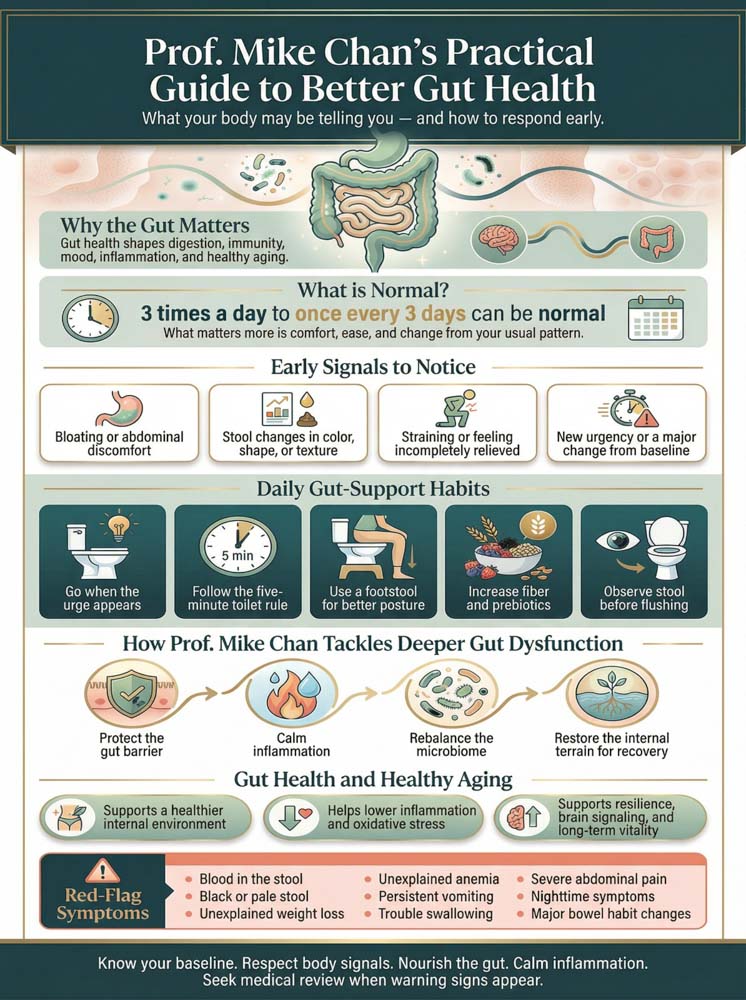
A major part of Prof. Mike Chan’s presentation is the correction of myths around what is considered normal. Many people assume that healthy digestion should follow a strict daily pattern, but the findings show that normal bowel frequency can range from three times a day to once every three days, provided the pattern is comfortable and stable for the individual. For Prof. Mike Chan, the more important questions are whether bowel movements are painful, whether excessive straining is necessary, whether the person feels fully relieved afterward, and whether the pattern has changed meaningfully from the usual baseline. In other words, normal health is not measured by comparison with other people alone. It is measured by stable function, comfort, and awareness of change.
Prof. Mike Chan also draws attention to the importance of stool observation. One of the clearest practical lessons in the source material is the advice to look before flushing. Stool color, shape, texture, and ease of passage can provide useful clues about hydration, fiber intake, transit time, and possible bleeding. Brown shades are generally expected, while red, black, or pale stool may indicate problems that should not be ignored, especially when accompanied by fatigue, weight loss, pain, or changes in appetite. Prof. Mike Chan treats this not as an alarming ritual but as a basic act of body literacy. People who learn to observe small changes early are in a stronger position to respond before those changes develop into larger medical concerns.
Everyday Habits That Shape Digestive Health
In discussing bowel habits, Prof. Mike Chan emphasizes that routine behavior has a major effect on gut function. Repeatedly ignoring the urge to go can retrain the body in harmful ways, making constipation more likely over time. When a person delays bowel movements again and again, the muscles involved in elimination may begin to resist the natural process rather than support it. By contrast, regular timing and prompt response to bodily urges help the gut work with greater ease. Prof. Mike Chan presents this as one of the simplest but most important ways to protect gut health: respect the body’s signals instead of postponing them.
Another strong point in Prof. Mike Chan’s article is the warning against poor toilet habits. Long periods on the toilet, especially while using a smartphone, are identified as behaviors that can worsen strain and contribute to hemorrhoids. The practical answer is the five-minute rule. If a bowel movement does not happen within about five minutes, the better approach is to get up, move on, and return later instead of remaining seated and forcing the process. Prof. Mike Chan also supports the use of a small footstool to raise the knees above the hips, creating a body position that makes elimination easier and more natural. These are modest adjustments, but they illustrate a broader principle in his teaching: daily habits matter as much as diagnosis.
Diet is another pillar of the article. Prof. Mike Chan places particular emphasis on fiber and prebiotics as practical ways to support healthier digestion and a stronger microbiome. Fiber helps shape stool, improves bowel movement quality, and provides nourishment for beneficial gut organisms. Rather than focusing first on marketed supplements, the article encourages people to begin with what feeds the gut well: fiber-rich foods, fruits, vegetables, and fermented foods when tolerated. Psyllium is presented as a realistic tool for people who struggle to meet fiber needs consistently through food alone. Prof. Mike Chan’s approach is notable for being simple and sustainable. It does not depend on expensive products. It depends on repeatable habits that improve gut conditions over time.
How Prof. Mike Chan Tackles Deeper Gut Dysfunction
Beyond day-to-day symptom management, Prof. Mike Chan describes a more advanced way of approaching persistent gut problems: rebuild the internal environment rather than chase symptoms one by one. In this view, gut healing requires attention to the intestinal lining, immune balance, microbial harmony, blood supply, and cellular energy. When the gut barrier has been weakened by chronic inflammation, surgery, medical treatment, toxic burden, or prolonged dysbiosis, the goal is to restore the body’s ability to repair itself. Prof. Mike Chan presents this as a biological repair strategy that begins with identifying what has broken down in the gut wall and then supporting the tissues that need to recover.
A central part of this approach is the idea that effective gut care must protect barrier integrity. Prof. Mike Chan explains that the gut wall should remain selective and resilient. When it becomes irritated or permeable, inflammation rises, microbial imbalance becomes harder to control, and symptoms may spread beyond digestion alone. His solutions therefore focus on calming harmful inflammation, supporting tissue repair, improving the microbial environment, and restoring the energy systems that allow intestinal cells to recover. In practical terms, this means treating the gut as living tissue that needs nourishment, regulation, and healing conditions rather than constant suppression.
Prof. Mike Chan also links gut recovery to the broader health of the whole organism. He describes the gut as a foundation for immune tolerance, neurological steadiness, and regenerative resilience. A healthier gut environment may improve how the body responds to restorative therapies because inflammation and oxidative stress become easier to control. In his framework, deeper gut treatment follows a sequence: assess the terrain carefully, reduce the burdens that are disturbing the microbiome, repair the lining, support microbial balance, and only then expect higher-level regenerative strategies to work well. This is why he treats gut health not as an isolated complaint but as the ground on which wider recovery depends.
Prof. Mike Chan again emphasized the close relationship between the gut, the brain, and the immune system. He expressed the point in a direct formulation that helps clarify his broader view of digestive health:
Prof. Mike Chan:
“Your gut has more brain cells than your brain, so you can imagine how important your gut health is for the immune system, apart from the thymus gland.”
This statement reinforces his view that gut recovery should not be reduced to bowel comfort alone. It should be understood as part of a wider biological network in which digestive integrity, neurological signaling, and immune regulation influence one another continuously.
Prof. Mike Chan also added another layer to this restorative framework. He notes that deeper therapeutic support may include targeted brain-and-organ-specific precursor stem cells and peptides of the intestinal mucosa and placenta. Within the logic of the article, this point extends his earlier view that repair requires more than symptom control. It involves supporting damaged terrain, improving tissue recovery, and creating conditions in which higher-level regenerative strategies can work more effectively.
Gut Microbes, DNA Protection, and Healthy Aging
Prof. Mike Chan’s write-ups also extend the meaning of gut health far beyond digestion. He argues that the microbiome influences how the body ages by shaping inflammation, oxidative stress, nutrient absorption, immune tolerance, and even the protection of DNA. In this model, an unhealthy microbiome does not simply cause bloating or irregular bowel habits. It creates a more hostile internal environment, one that may accelerate wear on tissues and reduce the body’s regenerative capacity over time.
This is why Prof. Mike Chan places such importance on restoring gut microbes early. A more balanced microbiome helps reduce inflammatory signaling, supports the intestinal lining, and creates conditions more favorable for long-term health. He presents the gut as one of the first terrains that must be stabilized before more advanced restorative work can succeed. If the internal environment remains toxic or inflamed, recovery becomes less efficient. If the gut is repaired first, the body is in a better position to absorb nutrients, regulate immunity, and maintain healthier function with age.
The practical lesson is that gut care should be approached as a longevity discipline as well as a digestive one. For Prof. Mike Chan, protecting the microbiome, reducing chronic inflammation, improving the gut environment, and restoring digestive efficiency are not separate goals. They are connected parts of the same strategy. A healthier gut supports clearer signaling between the gut and brain, lowers systemic burden, and gives the body a more stable platform for repair.
Recognizing When Symptoms Need Closer Attention
At the same time, Prof. Mike Chan warns against oversimplified diagnostic language. Terms such as “leaky gut” may describe real physiological processes in some contexts, but they are often used too broadly and can mislead people into self-diagnosis without proper evaluation. The article instead encourages careful assessment of real causes such as constipation, IBS, food intolerance, altered motility, inflammation, or bleeding. This approach respects patient symptoms without turning every discomfort into a fashionable label. It also helps preserve a key balance in gut care: people should take symptoms seriously, but they should also pursue evidence-based interpretation rather than internet slogans.
Prof. Mike Chan’s strongest warning concerns red-flag symptoms. Blood in the stool, black stool, pale stool, unexplained weight loss, iron deficiency anemia, persistent vomiting, trouble swallowing, severe abdominal pain, nighttime symptoms, or major changes in bowel habits should not be normalized. These signs may indicate conditions that require screening, testing, or specialist attention. For Prof. Mike Chan, this is where gut awareness becomes a matter of health protection rather than lifestyle preference. The lesson is not to panic at every symptom, but to recognize when the body is asking for timely medical attention.
The Practical Direction of Gut Recovery
The overall message of the article is clear. Prof. Mike Chan presents gut health as a discipline of observation, routine, nourishment, repair, and respect for warning signs. The most effective solutions are often layered together: know your baseline, respond to bowel urges, improve posture, reduce toilet strain, increase fiber, feed the microbiome, calm inflammation, protect the gut barrier, and seek care when symptoms move beyond what is normal for you. In that sense, better gut health is not built through one miracle product or one single theory. It is built through consistent attention to how the body functions every day and by strengthening the internal conditions that allow healing to take place.
| Core Gut-Health Issue | Prof. Mike Chan’s Explanation | Practical Response |
|---|---|---|
| Gut symptoms being ignored | Common symptoms may be meaningful body signals rather than minor inconveniences. | Pay attention early instead of dismissing changes. |
| Confusion about what is normal | Normal bowel patterns vary widely from person to person. | Track your own stable baseline for comfort, frequency, and stool pattern. |
| Missing stool-based warning signs | Stool appearance can reveal useful health information. | Look before flushing and notice color, shape, and ease of passage. |
| Constipation worsened by delay | Ignoring the urge to go can retrain bowel function in unhealthy ways. | Go when the urge appears and support a regular routine. |
| Hemorrhoids and toilet strain | Long toilet sitting and phone use increase pressure and strain. | Use the five-minute rule and leave the phone outside. |
| Difficult elimination posture | Body position affects how easily stool passes. | Use a footstool to improve alignment. |
| Weak microbiome support | Gut microbes need nourishment, not only supplements. | Increase fiber, prebiotics, and diverse plant intake. |
| Overreliance on probiotics or trendy labels | Not every symptom needs a marketed explanation or supplement. | Use evidence-based evaluation and practical dietary habits first. |
| Gut barrier weakness | A damaged intestinal lining can intensify inflammation and broader dysfunction. | Prioritize barrier repair, reduce irritation, and support tissue healing. |
| Chronic inflammation in the gut | Persistent inflammatory signaling can impair healing and worsen symptoms. | Calm inflammatory burden and address underlying triggers early. |
| Microbial imbalance and poor internal terrain | Dysbiosis can affect digestion, immunity, and healthy aging. | Rebalance the microbiome and improve the gut environment before expecting deeper recovery. |
| Reduced regenerative readiness | The body responds better to restorative treatment when the gut and immune terrain are stabilized. | Repair the gut first, then build on that foundation for broader recovery. |
| Red-flag symptoms | Certain changes may point to serious disease. | Seek prompt medical review when warning signs appear. |
Further Reading & References
- Chan, M.K.S., Wong, M. B. F., Casazza, K., Jenkins, I, & Lakey, J. R. T. (2025). Rebuilding the Barrier: Peptide-Based Strategies for Intestinal Regeneration. American Journal of Biomedical Science & Research; 26(6), 2025.
- Chan, M.K.S., Wong, Jenkins, I, Wong, M. B. F., Casazza, K., Klokol, D., & Lakey, J. R. T. (2025). Restoring Immune Balance and Intestinal Integrity in Crohn’s Disease: A Framework for Targeted Regenerative and Immunomodulatory Therapies. American Journal of Biomedical Science & Research; 27(4), 2025
- Handbook of Anti-Aging Medicine
Trukhanov, A., & Chan, M. K. S. (Eds.). (2022). European Wellness Academy.
https://european-wellness.eu/product/handbook-of-anti-aging-medicine
Includes a dedicated chapter on the gut-associated immune system, covering leaky gut, the microbiome, immune function, and links to age-related disease. - Autism Spectrum Disorder: Bioregenerative Medicine with Stem Cell Therapy
Chan, M. K. S., Nalapko, Y., Yartseva, S., & Wong, M. B. F. (2023). European Wellness Academy.
https://european-wellness.eu/product/autism-spectrum-disorder-bioregenerative-medicine-with-stem-cell-therapy
Examines the microbiota-gut-brain axis and how gut inflammation and microbial imbalance affect brain function, behavior, and neurodevelopment. - Stem Cells in Regenerative Medicine: Carpe Diem – Carpe Vitam!
Chan, M. K. S., & Klokol, D. (2019). Troubador Publishing Ltd.
https://european-wellness.eu/product/stem-cells-in-regenerative-medicine-carpe-diem-carpe-vitam
Highlights the gut-brain connection, noting the intestine’s role in neurotransmitter activity and its relevance to neurodegenerative conditions such as Parkinson’s disease. - A Comprehensive Guide to Biological Medicine and Wellness
Chan, M. K. S., & Klokol, D. (2019). Troubador Publishing Ltd.
https://european-wellness.eu/product/a-comprehensive-guide-to-biological-medicine-and-wellness
Outlines the DDRR model and emphasizes detoxification and intestinal health as preparation for regenerative therapies.
Follow European Wellness:



Follow European Wellness Academy:
Follow Prof. Dato’ Sri Dr. Mike Chan:

Related Posts