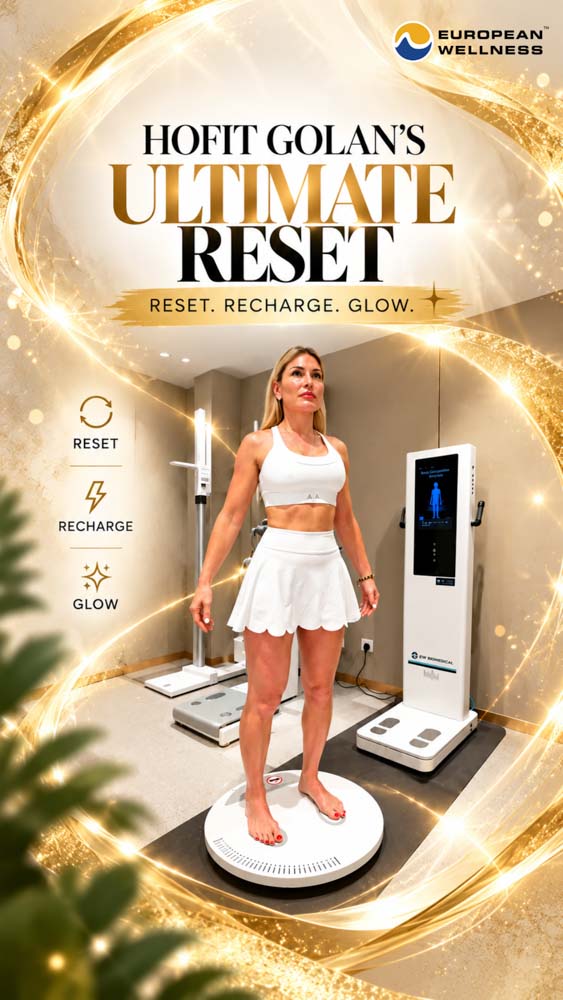
International entrepreneur and fashion personality Hofit Golan and global business leader, investor and author Vinay…
Cristiano Ronaldo’s Hamstring Injury Puts Spotlight on Precision in Sports Regenerative Medicine and through Prof Mike Chan’s Scientific Approach
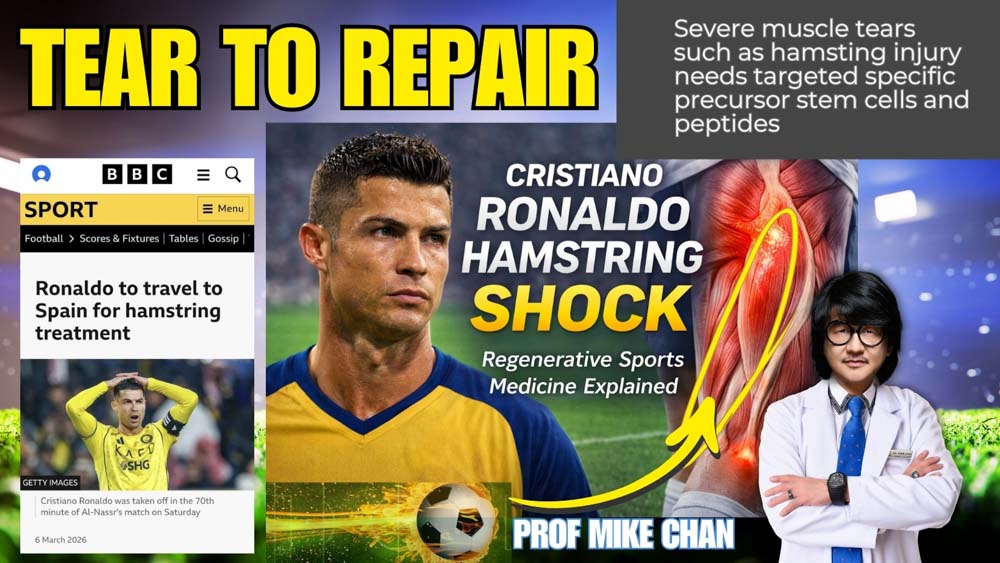
MADRID, Spain (March 6, 2026) — Cristiano Ronaldo’s latest injury setback has drawn attention not only to the extraordinary career of one of football’s greatest players, but also to a growing field of medicine that aims to repair sports injuries at their biological roots.
The 41-year-old Portugal captain is set to travel to Spain for treatment after scans revealed his hamstring injury is “more serious” than initially expected, according to Saudi Pro League club Al-Nassr.
Ronaldo was substituted in the 70th minute of Saturday’s 3-1 win over Al-Fayha after appearing to struggle with discomfort in the back of his thigh. The veteran striker had earlier missed a penalty in the match.
Al-Nassr coach Jorge Jesus confirmed the five-time Ballon d’Or winner would undergo specialist treatment in Madrid.
“In the last game, Cristiano left with a muscle injury. After the tests he underwent, it became clear that it is a more serious injury than we were expecting,” Jesus said.
“He will need rest and recovery. We hope he will return soon to help the team.”
It remains unclear whether Ronaldo will be fit for Portugal’s upcoming friendlies against Mexico and the United States later this month.
With 965 career goals already to his name, Ronaldo has publicly stated that he hopes to reach the milestone of 1,000 goals before retiring — making recovery from injuries like this particularly crucial.
The Science behind a Hamstring Injury
Hamstring injuries are among the most common muscle injuries in professional sport, particularly in football where explosive sprints and sudden directional changes are routine.
The hamstrings are a group of muscles at the back of the thigh that allow athletes to run, jump and accelerate. When overstretched or subjected to intense force, the muscle fibres can tear, causing sharp pain, swelling and reduced strength.
Sports medicine specialists note that hamstring injuries can be especially challenging because the muscles endure high mechanical stress during recovery. In elite athletes, a return to competition too quickly can increase the risk of re-injury.
As athletes age, healing becomes even more complex.
“The body’s ability to regenerate tissues and to recover gradually declines with age,” said Prof. Mike Chan, chairman and founder of the European Wellness Biomedical Group and a pioneer in regenerative medicine.
“Longevity depends on brainspan and healthspan, which rely on our biological age and the health of the many types of cells throughout our organs. We lose our muscles, bones, and cartilage from 30 years old!”
Precision Regenerative Medicine
In recent years, regenerative medicine has emerged as a potential game-changer for sports injuries, focusing on repairing damaged tissues rather than simply managing symptoms.
Prof. Mike Chan says the key principle behind modern regenerative therapy is precision.
“Not all stem cells are alike nor can they treat all diseases,” he explained.
“Cell therapy requires precision, as all 400+ stem cells and cells possess unique blueprints, with different molecules, amino acid sequences and proteins.”
In the case of hamstring injuries, the damage typically involves both skeletal muscle fibres and the tendons that anchor them to bone.
According to Prof Chan, repairing such injuries requires highly specific biological components.
“For muscle tears such as a severe hamstring injury, it needs specific stem cells and peptides of skeletal muscle and tendon apart from placenta,” he said.
This strategy follows the medical concept known as Similia Similibus Curantur, meaning “like treats like.”
“To treat with stem cells and peptides with precision in regenerative medicine, one must aim for accuracy. All darts must hit the bull’s eye, and not all over the place. Precision is the best solution,” Prof Chan said.
Targeting the Injured Muscle
Rather than relying solely on conventional rehabilitation, regenerative medicine seeks to rebuild damaged tissue at the cellular level.
In such protocols, skeletal muscle precursor cells and tendon-specific peptides may help regenerate torn fibres, while placenta-derived cells provide growth factors and anti-inflammatory signals that support healing.
Prof. Chan explained that the human body contains hundreds of specialized cell types that can potentially be harnessed in regenerative therapy.
“We can create over 400 peptides and exosomes from the 400 different types of cells across our organs,” he said.
“I believe many previously untreatable conditions can be addressed if we target the correct progenitor or precursor stem cells for the specific organ or tissue.”
Such targeted treatments are increasingly being explored by researchers working with elite athletes who require faster recovery and stronger tissue repair.
Cristiano Ronaldo: The Athlete Behind the Headlines
Few athletes in modern history command the global influence of Cristiano Ronaldo, widely regarded as one of football’s greatest players.
Born in Funchal, Madeira, Portugal, in 1985, Ronaldo rose from humble beginnings to become a global sports icon through extraordinary discipline, athleticism, and relentless competitiveness.
Over a career spanning more than two decades, Ronaldo has built one of the most decorated résumés in football history:
- Five Ballon d’Or awards, recognizing him as the world’s best player.
- Five UEFA Champions League titles, the most prestigious club trophy in European football.
- European Championship winner with Portugal in 2016, delivering his country’s first major international trophy.
- UEFA Nations League champion with Portugal in 2019.
- Record-breaking goal scorer for both club and country.
Ronaldo currently holds numerous scoring records, including:
- All-time leading scorer in men’s international football
- Top scorer in UEFA Champions League history
- More than 965 career goals, a figure he hopes to extend to an unprecedented 1,000 goals before retirement.
Even at 41 years old, Ronaldo remains one of football’s most productive forwards, currently playing for Saudi Pro League club Al-Nassr, where he continues to score at a remarkable pace. His dedication to fitness, nutrition, and recovery has long been cited by sports scientists as a key factor in his longevity.
Longevity in Elite Sport
Ronaldo’s career itself is often cited as an example of exceptional athletic longevity.
Few outfield players remain among football’s top scorers in their forties, yet the Portuguese star continues to deliver goals at a remarkable pace.
Experts say advances in sports science, including nutrition, biomechanics and recovery technology — are extending the careers of elite athletes.
Regenerative medicine may become another tool in that effort.
By addressing injuries at the cellular level, researchers hope to reduce recovery times and strengthen repaired tissues, potentially helping athletes avoid recurring injuries.
For Ronaldo and his millions of fans worldwide, the hope is that the latest setback will be temporary, allowing the football icon to continue his pursuit of the unprecedented 1,000-goal milestone.
Recommended Reading
For readers interested in exploring the science behind regenerative medicine and advanced sports injury recovery, Prof. Mike Chan’s publications offer deeper clinical insights:
- Bioregenerative Sport Medicine: Precision Healing & Performance Resilience for Modern Athletes — A comprehensive guide on how athletes recover, adapt, and optimize performance using regenerative therapies, with practical applications for injury management and longevity.
- Minimally Invasive Techniques in Daily Practice of Anti-Aging and Regenerative Medicine Practitioner — A clinical reference detailing step-by-step protocols, including the use of stem cells, peptides, and exosomes in modern regenerative treatments.
- The Dawn of New Medicine – Stem Cell Therapy: Old Dogma, New Hope. In this publication, Prof Chan challenges conventional treatment models that rely mainly on rest and symptom control, proposing instead that damaged tissues can undergo active repair, regeneration, or replacement when supplied with the correct cellular tools.
- Mike Chan’s foundational work Stem Cells in Regenerative Medicine, published and available in eight languages worldwide, outlines the scientific basis for using more than 400 types of organ-specific precursor stem cells, reinforcing the principle of Similia Similibus Curantur—“like treats like”—where injured tissues are repaired using their corresponding cellular counterparts.
📚 These publications and related research by Prof Mike Chan are available through:
https://european-wellness.eu/books/
For more information about Prof Mike Chan’s work in regenerative medicine and sports recovery science, visit:
Follow European Wellness:



Follow European Wellness Academy:
Follow Prof. Dato’ Sri Dr. Mike Chan:

Related Posts