Immerse yourself in a glamorous landscape of emerging trends and lucrative opportunities at Cosmoprof Asia…
Neural Stem Cell for Vision Preservation Reinforces Prof Mike Chan’s Regenerative Medicine Breakthrough
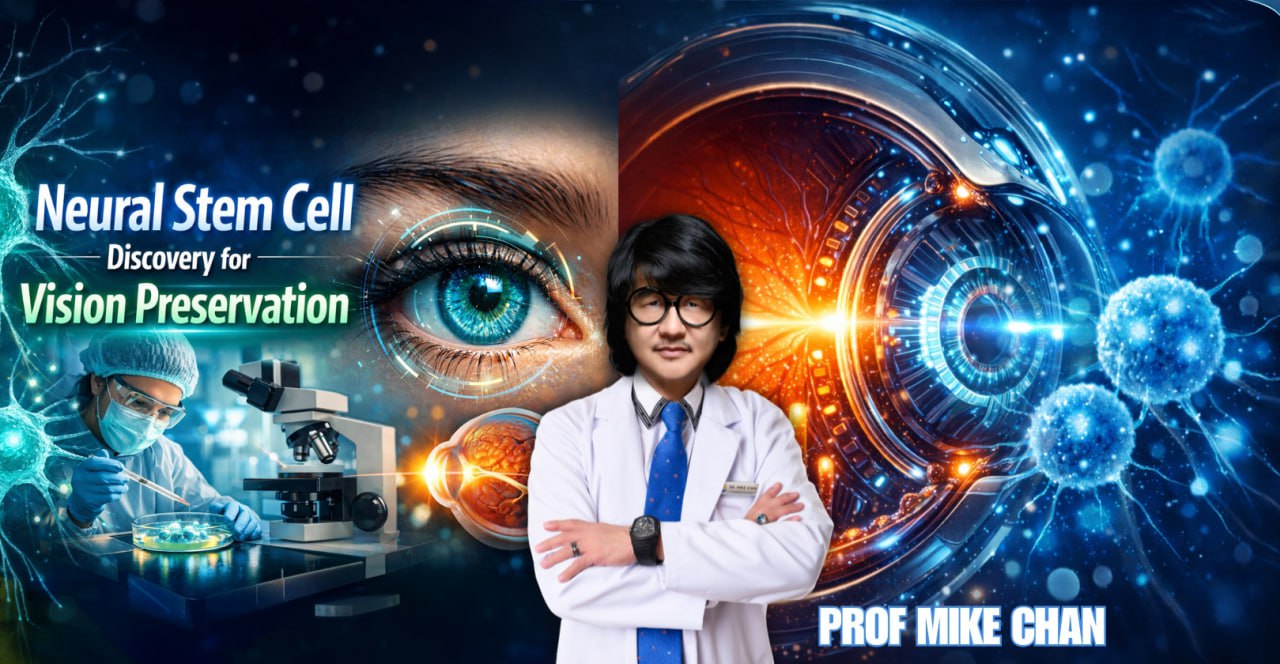
LOS ANGELES, California — March 6, 2026. A new scientific discovery showing that neural stem cells may help preserve vision is strengthening global momentum behind regenerative medicine—an approach long championed by bioregenerative medicine pioneer Prof Mike Chan.
Researchers recently reported that neural stem cells within the retina can release protective biological signals that help preserve photoreceptors, the light-sensing cells responsible for vision. The findings suggest these cells may slow retinal degeneration and potentially delay or prevent blindness in diseases such as age-related macular degeneration and retinitis pigmentosa.
The discovery, highlighted in recent neuroscience research reports, is being hailed as another important step toward regenerative treatments for degenerative eye diseases affecting hundreds of millions of people worldwide.
For Prof Mike Chan, Chairman and Founder of European Wellness Biomedical Group, the findings reinforce principles that have formed the foundation of his work in regenerative medicine for decades.
“Not all stem cells are alike nor can they treat all diseases,” Prof Mike Chan said. “Cell therapy requires precision, because the human body contains more than 400 different types of cells across 78 organs, each with its own biological blueprint.”
According to Prof Mike Chan, regenerative medicine succeeds when therapies precisely target the organ or tissue that has degenerated.
“To treat with stem cells and peptides with precision in regenerative medicine, all darts must hit the bull’s eye,” he explained. “Like treats like—retina cells for retinal diseases, optic nerve cells for neural degeneration, and specific brain cells for neurological disorders.”
Protecting the Cells That Enable Vision
Photoreceptors—rods and cones—are specialized retinal cells that convert light into electrical signals sent to the brain.
In degenerative eye diseases, these cells gradually die, leading to progressive loss of vision and eventual blindness.
The new research indicates that neural stem cells can release protective molecular signals that support the survival of photoreceptors and stabilize the retinal environment.
This mechanism closely mirrors regenerative strategies described in Prof Mike Chan’s publications, which emphasize the use of targeted precursor stem cells for ocular structures including the retina, optic nerve, and occipital lobe to restore visual function.
According to Prof Mike Chan, protecting photoreceptors is one of the most important strategies in preventing vision loss.
“Photoreceptors are the primary sensory neurons of vision,” he said. “When these cells die, the visual signal pathway collapses. If we can protect them—or replace them—we preserve the entire visual system.”
In conditions such as retinitis pigmentosa, glaucoma, and age-related macular degeneration (AMD), therapeutic strategies must be precisely tailored—requiring calibrated doses of targeted stem cells, including placenta-derived sources, alongside bioactive peptides specific to the retina, optic nerve, and higher visual centers such as the occipital and frontal lobes. This precision approach is essential to restore cellular function, support neural survival, and maintain the integrity of visual signaling pathways.
Treating Macular Degeneration and Retinitis Pigmentosa
The recent scientific article suggests that neural stem cell therapies could transform treatment strategies for age-related macular degeneration (AMD) and retinitis pigmentosa, two of the most common causes of blindness worldwide.
Prof Mike Chan’s research has long identified these conditions as primary targets for regenerative medicine.
His publications including Retinal Pigmentosa and Glaucoma confirm that stem cells represent a highly promising source of cellular material for treating retinal diseases involving degeneration of photoreceptors and the retinal pigmented epithelium (RPE).
“Stem cell-derived retinal tissues are being extensively investigated to treat blinding diseases linked to photoreceptor degeneration,” Prof Mike Chan noted.
In the case of retinitis pigmentosa, the disease primarily involves the isolated loss of photoreceptors.
“This makes retinitis pigmentosa an ideal candidate for stem cell-derived photoreceptor transplantation,” Prof Mike Chan explained. “Because photoreceptors form only a single synaptic connection in the subretinal space, they face fewer biological barriers for integration compared with other neurons in the central nervous system.”
Protective Signals and the Retinal Microenvironment
The new research also highlights how neural stem cells release protective signals that help maintain the health of surrounding retinal cells.
Prof Mike Chan’s regenerative medicine protocols describe this phenomenon as a paracrine effect, in which stem cells release neurotrophic factors that support surrounding tissues.
“These cells do not only replace damaged tissue,” Prof Mike Chan said. “They also modify the microenvironment of the retina, providing neuroprotection and supporting the survival of existing neurons.”
His research identifies specific cellular populations—including retinal stem cells and endothelial progenitor cells—that can exert neurotrophic effects to preserve retinal vasculature and neuronal integrity.
According to Prof Mike Chan, early stem cell interventions can significantly improve retinal function by altering the biological environment in which degeneration occurs.
“By modifying the microenvironment of the retina, regenerative therapies can slow disease progression and protect visual neurons from further damage,” he explained.
Regenerating Photoreceptors
While preserving existing photoreceptors is critical, Prof Mike Chan’s work also explores the next frontier: regenerating new photoreceptors.
His publications describe how retinal stem cells can be stimulated to develop into new photoreceptors and retinal neurons.
“Photoreceptor transplantation is one of the most promising strategies for treating broad-spectrum blinding conditions,” Prof Mike Chan said.
Because photoreceptors operate within a relatively simple neural network in the subretinal space, successful integration of transplanted cells is biologically more achievable than many other neural regeneration approaches.
The Role of Retinal and Optic Nerve Peptides
Beyond live stem cells, Prof. Mike Chan’s collaborative research also examines the therapeutic potential of retinal peptide and optic nerve bioregulators.
These biological molecules can influence cellular signaling pathways and support retinal repair.
“Peptides derived from retinal and optic nerve cells can regulate gene expression, cellular differentiation, and signaling molecules involved in visual function,” Prof Mike Chan explained.
His research suggests that targeted retinal peptides may help improve visual function and reduce disease progression in conditions such as age-related macular degeneration, diabetic retinopathy, and retinitis pigmentosa.
A New Era for Vision Restoration
Globally, vision loss is becoming a major public health concern.
Age-related macular degeneration affects more than 200 million people worldwide, while inherited retinal diseases such as retinitis pigmentosa can lead to progressive blindness beginning in early adulthood.
Current treatments remain limited, often focusing only on slowing disease progression.
For Prof Mike Chan, the emergence of neural stem cell discoveries reflects a broader transformation taking place in medicine.
“Longevity depends on brainspan and healthspan, which rely on the biological age of the cells across our organs,” he said. “When we rejuvenate these cells, we restore the function of the organs they support.”
From neurodegenerative diseases to cardiovascular disorders and now retinal degeneration, stem cell science is rapidly redefining medical possibilities.
“Regenerative medicine is centered on repairing diseased cells, reversing degeneration, regenerating lost tissue, and replenishing depleted cell populations,” said Prof. Mike Chan. “This is the future of medicine.”
From a health and economic perspective, vision loss carries profound implications. Insurance frameworks often recognize total vision loss as a life-altering disability, reflecting its impact on independence and quality of life. The eyes are often described as the window to the world—yet biologically, they begin to undergo gradual age-related decline from around the age of 40. This underscores the growing importance of early intervention and regenerative strategies to preserve visual function over time.
References
- Stem Cells in Regenerative Medicine: Carpe Diem – Carpe Vitam!
By Chan, M. K. S., & Klokol, D. (2019). Troubador Publishing Ltd. — Details clinical applications of precursor stem cells for retinal diseases, including the use of stem cell-derived photoreceptors and therapies targeting age-related macular degeneration and retinitis pigmentosa. - Handbook of Anti-Aging Medicine. European Wellness Academy by Trukhanov, A., & Chan, M. K. S. (Eds.). (2022). — Describes the use of retinal peptide bioregulators and cellular factors to correct retinal pathologies such as macular degeneration and retinitis pigmentosa.
- Compendium of Diseases & Disorders. European Wellness Academy.
— Outlines targeted precursor stem cell therapies for ocular diseases including retinal degeneration and visual pathway disorders.
Follow European Wellness:



Follow European Wellness Academy:
Follow Prof. Dato’ Sri Dr. Mike Chan:

Related Posts