An international team of researchers, including Prof. Dato' Sri Dr Mike Chan, has outlined an…
Beyond Hormone Replacement: Scientists Explore New Path to Regenerating Thyroid Tissue in Hashimoto’s Disease
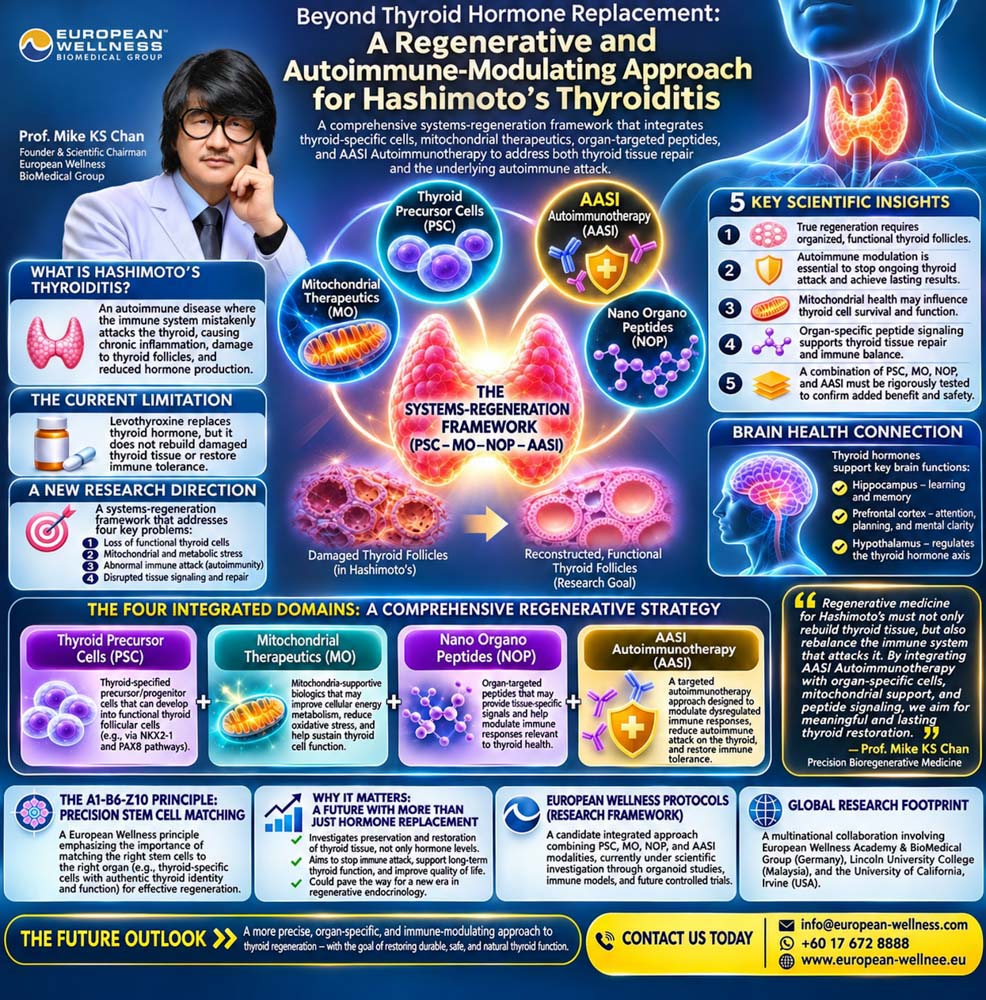
An international team of researchers, including Prof. Dato’ Sri Dr Mike Chan, has outlined an experimental approach combining thyroid precursor cells, mitochondrial therapeutics, and organ-specific peptides to investigate whether damaged thyroid tissue could one day be restored.
SABAH, Malaysia (Nov 3, 2026) — Scientists are exploring a new frontier in the treatment of Hashimoto’s thyroiditis, an autoimmune disease that progressively damages the thyroid gland, raising the possibility that future therapies could do more than replace missing hormones.
In a research review led by Prof. Mike Chan and international collaborators, scientists propose a three-part regenerative strategy aimed at addressing the cellular damage, metabolic stress, and immune dysfunction associated with the condition.
The approach brings together thyroid precursor cells, mitochondrial-directed therapeutics, and organ-specific peptide signaling in what the authors describe as a systems-regeneration framework.
The findings could help guide a new generation of regenerative endocrinology research, although the proposed combination has yet to demonstrate safety or effectiveness in human patients.
The review, titled Systems Regeneration in Hashimoto Thyroiditis: Integrating Thyroid Precursor Cells, Mitochondrial Therapeutics, and Organ-Specific Peptide Signaling, was prepared by researchers affiliated with European Wellness Academy, European Wellness BioMedical Group, Lincoln University College, and the University of California, Irvine.
Its central argument is that restoring thyroid function may require repairing the biological environment that allows thyroid cells to survive, rather than simply replacing the hormones they produce.
A Disease That Gradually Destroys the Thyroid
Hashimoto’s thyroiditis occurs when the immune system mistakenly attacks the thyroid gland, a butterfly-shaped organ located at the front of the neck.
The resulting inflammation can gradually damage thyroid follicles, the microscopic structures responsible for producing hormones that regulate metabolism, energy use and numerous bodily functions.
As thyroid function declines, patients may experience fatigue, weight gain, cold intolerance, constipation, and difficulties with concentration.
The standard treatment for hypothyroidism caused by Hashimoto’s is levothyroxine, a synthetic form of thyroid hormone.
For most patients, the medication effectively corrects hormone deficiency.
However, it does not rebuild damaged thyroid tissue or directly reverse the autoimmune process.
This distinction forms the starting point for the new research.
The authors argue that future regenerative treatments should investigate whether surviving thyroid cells can be protected and whether damaged follicular structures can eventually be reconstructed.
Three Biological Targets, One Regenerative Strategy
The proposed framework addresses three interconnected problems.
The first is the loss of functional thyroid cells.
Researchers are investigating whether thyroid-specific precursor or progenitor cells could provide the cellular foundation needed to reconstruct damaged follicles.
Unlike general stem cells, thyroid-directed precursor cells must demonstrate the molecular characteristics necessary to develop into thyroid tissue.
Two important developmental regulators, known as NKX2-1 and PAX8, help establish thyroid-cell identity.
Earlier laboratory research has shown that human stem cells can be directed to form thyroid organoids, miniature three-dimensional structures that reproduce certain features of thyroid tissue.
In a study published in Nature Communications in 2022, researchers generated human thyroid organoids that restored circulating thyroid hormones after transplantation into mice lacking a functioning thyroid gland.
The result provided proof of principle that functional thyroid tissue could be reconstructed experimentally.
But the challenge in Hashimoto’s is considerably more complex.
Newly generated thyroid cells would still face the immune system responsible for damaging the original gland.
Without controlling that autoimmune attack, regenerated tissue could be destroyed again.
The second target is mitochondrial dysfunction.
Mitochondria are tiny structures within cells that generate much of the energy needed for normal biological activity.
They also help regulate cellular stress responses and survival.
In autoimmune thyroiditis, persistent inflammation and oxidative stress may interfere with the metabolic processes required for healthy thyroid function.
The researchers propose investigating mitochondrial-directed therapeutics, including preparations described as Mito Organelle biologics, to determine whether they can support thyroid-cell resilience.
Such treatments remain experimental in this context.
The authors emphasize that the preparations must first be characterized to establish what they contain and how they affect thyroid cells.
The third target involves organ-specific peptides.
Peptides are short chains of amino acids that can participate in cellular communication and biological regulation.
The review considers preparations described as Nano Organo Peptides, or NOPs, as potential sources of signals that might influence thyroid-cell differentiation, tissue organization or immune activity.
However, the researchers caution that a peptide derived from a particular organ cannot automatically be assumed to act specifically on that organ.
Its biological activity must be demonstrated through controlled experiments.
Why Rebuilding the Thyroid is More Difficult Than Replacing Cells
The research highlights a major obstacle facing regenerative medicine: producing cells with the correct identity does not necessarily mean those cells can restore an organ’s function.
The thyroid depends on a highly organized network of follicles capable of absorbing iodine, processing thyroglobulin, and releasing hormones in response to signals from the pituitary gland.
Regenerated cells would need to perform these functions consistently.
They would also need to survive long-term exposure to the inflammatory conditions associated with autoimmune thyroid disease.
For this reason, the authors propose that laboratory studies measure more than cell growth or changes in blood biomarkers.
Researchers would need to demonstrate actual follicular formation, iodine handling, hormone production, mitochondrial function, and resistance to immune-mediated injury.
The review also calls for studies that examine the proposed therapeutic components separately and in combination.
Such experiments would help establish whether the interventions provide independent, additive, or genuinely synergistic effects.
Precision Medicine at the Organ Level
The proposed strategy reflects a broader concept in regenerative medicine: matching biological interventions to the particular tissues they are intended to support.
Prof. Chan, whose research interests include organ-specific regenerative approaches, is among the authors advocating further investigation of this principle.
In the thyroid, that means identifying cells capable of acquiring authentic thyroid characteristics rather than assuming that any stem cell population can restore thyroid function.
The same principle applies to peptide preparations.
Their tissue specificity must be established through molecular analysis and functional testing.
The authors identify the European Wellness platform as a candidate implementation of the three-domain approach, combining precursor cells, mitochondrial-directed biologics and peptide signaling.
However, the review does not establish that this platform has achieved thyroid regeneration in patients with Hashimoto’s disease.
Instead, it outlines the experimental work required before such a treatment could be considered for clinical investigation.
Potential Implications for Brain Health
The importance of thyroid function extends well beyond metabolism.
Thyroid hormones also influence brain development, cognitive performance and normal neurological activity.
People with insufficient thyroid hormone levels may experience memory difficulties, slower thinking and impaired concentration.
Brain regions involved in learning, attention and endocrine regulation, including the hippocampus, prefrontal cortex and hypothalamus, are particularly relevant to understanding the effects of thyroid hormones.
If future regenerative therapies were able to restore stable thyroid hormone production, researchers could investigate whether they also improve cognitive symptoms and quality of life.
However, the current review does not provide evidence that the proposed treatments regenerate brain tissue or directly improve neurological function.
A Demanding Path Toward Clinical Application
Before the proposed approach can advance toward patient treatment, the researchers say several scientific questions must be answered.
Candidate precursor cells must be tested for thyroid-specific identity, functional capacity and genomic stability.
Mitochondrial preparations must undergo detailed molecular characterization and testing to determine whether they protect thyroid cells under inflammatory stress.
Peptide preparations require equally rigorous investigation to identify their active components and establish whether they produce meaningful, organ-specific effects.
The authors recommend using human thyroid organoids and laboratory systems combining thyroid cells with immune cells.
Promising findings would then need confirmation in animal models of autoimmune thyroiditis.
Only after reproducible evidence of safety and biological benefit should controlled clinical studies be considered.
For patients, the distinction between experimental research and established medical care remains important.
There is currently no evidence in the reviewed manuscript that the proposed PSC–MO–NOP combination can replace levothyroxine, reverse Hashimoto’s thyroiditis, or reliably regenerate thyroid tissue in humans.
A Possible Shift in Regenerative Endocrinology
The significance of the research lies less in an immediate therapeutic breakthrough than in the questions it raises about the future of endocrine medicine.
For decades, the management of thyroid hormone deficiency has largely focused on restoring hormone levels through medication.
The emerging field of regenerative endocrinology is investigating whether damaged hormone-producing tissues could eventually be preserved, reconstructed, or replaced.
The review suggests that achieving this goal in Hashimoto’s thyroiditis will require researchers to address cellular identity, mitochondrial health, and immune regulation together.
It also proposes a more demanding definition of therapeutic success.
Normal thyroid hormone blood tests alone would not be sufficient evidence of regeneration.
Instead, scientists would need to demonstrate lasting restoration of the thyroid gland’s own hormone-producing capacity without worsening autoimmune injury.
If that objective can eventually be achieved, it could represent an important advance in the management of thyroid disease.
For now, the three-domain framework offers a scientific roadmap rather than a proven treatment.
But it points toward a future in which researchers may be able to investigate not only how to replace hormones lost through disease, but how to preserve or restore the organs that produce them.
Find out more about the study over here
Follow European Wellness:



Follow European Wellness Academy:
Follow Prof. Dato’ Sri Dr. Mike Chan:

Related Posts