
Immerse yourself in a glamorous landscape of emerging trends and lucrative opportunities at Cosmoprof Asia…
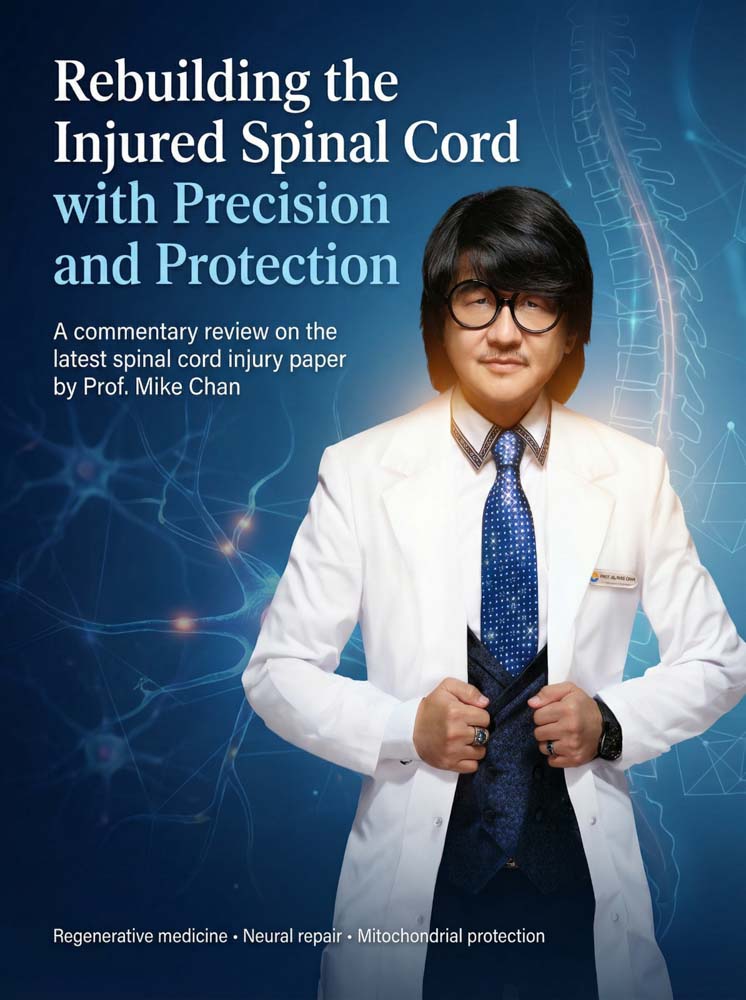
Rebuilding the Injured Spinal Cord with Precision and Protection
This research paper was produced in collaboration with Professor Emeritus Dr. Jonathan R.T. Lakey from the University of California, Irvine (UCI), whose co-authorship adds further translational and biomedical engineering depth to the study.
The latest paper by Prof. Dato Sri Dr. Mike Chan and colleagues offers an ambitious but carefully reasoned view of how spinal cord injury may need to be treated in the future. Rather than arguing for a single miracle intervention, the paper makes the case for a coordinated regenerative platform that works on several problems at once: rebuilding damaged nerve circuits, protecting the injured tissue from metabolic collapse, and reshaping the hostile inflammatory environment that often prevents recovery after spinal cord injury. This is important because spinal cord injury is not a one-step event. The first trauma is devastating, but the damage that unfolds afterward through inflammation, oxidative stress, vascular instability, and mitochondrial failure may be just as consequential.
What makes this study worth close attention is its insistence that recovery depends on timing, biological matching, and combination strategy. Prof. Mike Chan and his co-authors argue that the injured spinal cord cannot be repaired by replacing cells alone. Those cells must be the right kind of neural progenitors, matched to the regional identity of the damaged spinal circuitry, and they must be supported by therapies that keep the surrounding tissue alive enough to accept them. In plain terms, the paper says that if one wants to rebuild a damaged communication highway, one must not only add replacement components but also stabilize the roadbed, restore the power supply, and clear the debris.
| Core issue in spinal cord injury | Why it matters | What the paper proposes |
| Lost neural connections | Signals can no longer travel properly across the injured area | Use regionally specified neural progenitor grafts to form relay circuits |
| Mitochondrial failure | Cells lose energy, produce damaging oxidative stress, and die | Use mitochondria-targeted peptides such as SS-31 to stabilize bioenergetics |
| Hostile injury environment | Inflammation, vascular damage, and scarring block repair | Use placenta–CNS nano-organopeptidic biologics to remodel the immune and vascular niche |
Why This Study Matters Now
The most important contribution of the paper is that it treats spinal cord injury as a systems problem rather than a narrow surgical or pharmaceutical problem. According to the review, neural progenitor grafts can survive inside the injured cord, differentiate into useful cell types, and help create relay pathways that bridge broken segments of the spinal network. Yet the authors are equally clear about the limits of optimism. Grafts do not automatically work simply because they are transplanted. They face inflammation, poor blood supply, oxidative injury, scar-modified tissue, and incomplete integration with the host nervous system.
This point is especially important for lay readers. Many people hear about stem cells and assume that recovery is mainly about putting new cells into damaged tissue. Prof. Mike Chan’s paper argues that this is only one part of the story. A useful analogy is a city after an earthquake. Rebuilding homes is essential, but not enough. Electricity has to be restored, roads have to be reopened, toxic debris has to be removed, and the rebuilt structures must fit the original street plan. In the paper’s framework, the new neural cells are the replacement buildings, mitochondrial protection is the restored power grid, and nano-organopeptidic biologics are the cleanup and infrastructure crews that make the whole city livable again.
A second major strength of the study is its focus on regional identity. The authors explain that neural progenitor cells are not interchangeable. Cells patterned toward spinal identities are more likely to connect appropriately with spinal circuitry than generic neural cells or mismatched cell types 1. This matters because the spinal cord is highly organized. If the goal is to restore useful movement or sensation, the replacement cells must recognize the right signaling cues and connect with the right partners.
“The efficiency of this relay formation appears to depend strongly on developmental matching between graft and host tissue.” — Prof. Mike Chan
For a layman-friendly example, consider trying to repair a railway system. One cannot simply place any track segment anywhere and hope trains will run correctly. The track gauge, direction, and junction design all have to match the rest of the network. In the same way, Prof. Mike Chan’s paper emphasizes that the grafted cells must be biologically compatible with the injured spinal region if they are to support meaningful signal transmission.
Breaking Down Prof. Mike Chan’s Solution
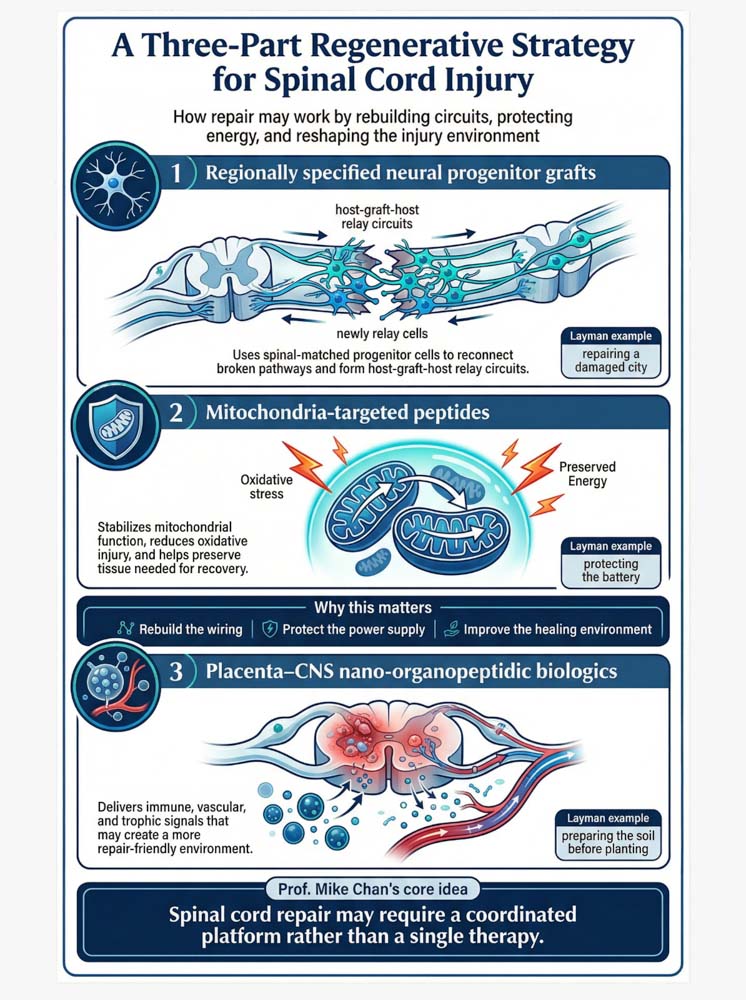
The clearest answer to the question, what is Prof. Mike Chan’s solution based on the PDF document, is that he proposes a three-part regenerative platform. It is not a single drug, a single cell therapy, or a single device. It is a layered strategy designed to address different biological barriers to recovery in a coordinated way.
First, the paper proposes regionally specified neural progenitor grafts. These grafts are intended to replace missing cellular elements and create host–graft–host relay circuits across the damaged region. In practical terms, the goal is not necessarily to regrow every original long nerve tract exactly as before, but to build functional detours that allow signals to cross the injury site again.
Second, the paper proposes mitochondria-targeted peptides, especially cardiolipin-targeted tetrapeptides such as SS-31, as a metabolic shield during secondary injury. The idea here is straightforward but important. After spinal cord injury, mitochondria become dysfunctional, energy production falls, reactive oxygen species rise, and cells enter pathways of degeneration and death. By stabilizing mitochondrial function early, the tissue may preserve more of the structural foundation needed for later repair.
“Collectively, these observations support a mechanistic framework in which early mitochondrial stabilization limits the propagation of secondary injury while preserving the structural and metabolic substrates required for regeneration.” — Prof. Mike Chan
Third, the paper proposes placenta–CNS nano-organopeptidic biologics, including extracellular vesicle-based systems, to reprogram the inflammatory and vascular environment. These biologics are described as vehicles for immunomodulatory, angiogenic, and trophic signaling that may reduce chronic inflammation, support blood vessel stability, and make the injured spinal cord more receptive to graft survival and neural integration.
Put simply, Prof. Mike Chan’s solution is this: rebuild the circuitry, protect the energy system, and improve the neighborhood in which healing must occur. That is the central message of the paper.
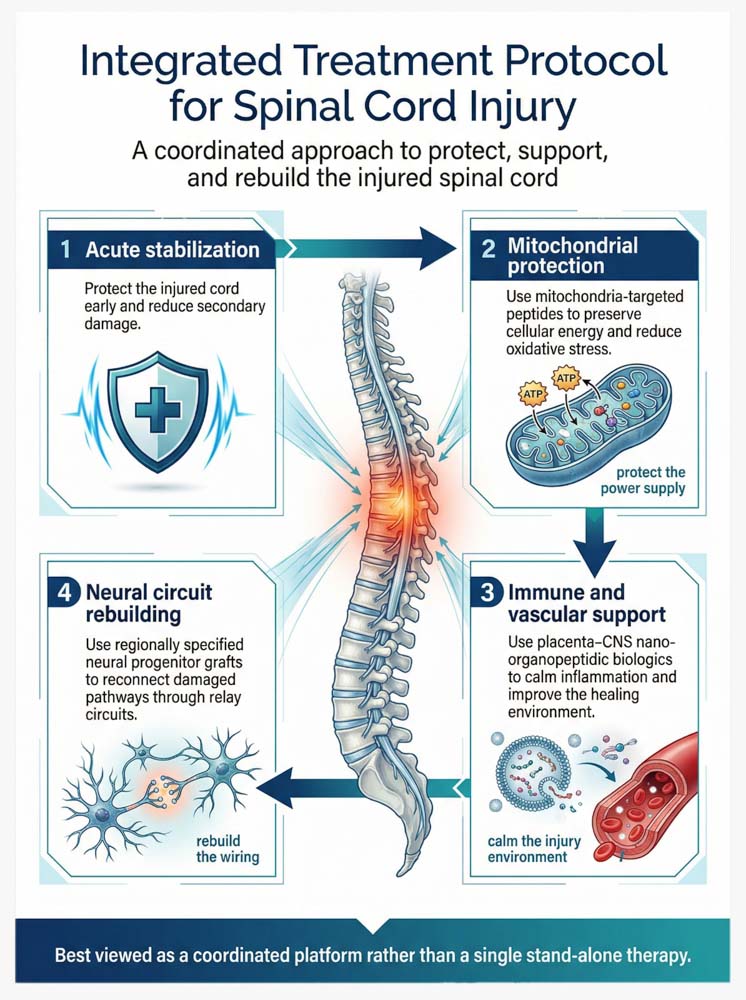
| Part of Prof. Mike Chan’s solution | Main purpose | Layman-friendly example |
| Regionally specified neural progenitor grafts | Reconstruct communication pathways | Installing correctly coded replacement wiring in a damaged control system |
| Mitochondria-targeted peptides | Prevent energy collapse and reduce further damage | Protecting a failing battery system before it destroys the rest of the device |
| Placenta–CNS nano-organopeptidic biologics | Calm inflammation and improve blood supply | Preparing the soil and water system before planting a fragile new crop |
The paper also gives several practical recommendations and translational priorities. It points toward the need for staged intervention, meaning that some therapies should act early during secondary injury, while others are better suited to later phases of circuit rebuilding. It calls for standardized preclinical frameworks using multiple injury models, because improvements from tissue preservation should be distinguished from improvements due to true circuit reconstruction. It also emphasizes biomarker development, including blood and cerebrospinal fluid markers such as neurofilament light chain, inflammatory indicators, endothelial markers, and signatures of mitochondrial stress, so that researchers can track whether therapies are engaging the biology they are supposed to influence.
For general readers, another helpful example is a patient recovering after a major house fire. One team stops the flames and prevents structural collapse. Another repairs the electrical system. A third restores ventilation, plumbing, and internal walls so that the house can be lived in again. The paper argues that spinal cord recovery may likewise require several coordinated forms of repair rather than a single intervention applied in isolation.
What Readers Should Take Away
The study is informative because it does not overpromise. Instead, it explains why spinal cord injury remains so difficult to treat and why a combination platform may be more realistic than simplistic one-variable solutions. In that respect, the paper is strongest when it shows how cell biology, mitochondrial metabolism, inflammation, and vascular repair are deeply interconnected. This integrative view is the reason the article stands out.
“Such frameworks reflect a broader evolution in SCI research, emphasizing integrative experimental design, standardized data structures, and cross-disciplinary therapeutic platforms aimed at restoring neural function after traumatic injury.” — Prof. Mike Chan
From a commentary perspective, the study’s significance lies less in claiming that the final therapy is already ready for routine clinical use and more in presenting a persuasive architecture for future development. Prof. Mike Chan and colleagues are effectively saying that successful spinal cord regeneration will probably depend on precision-matched grafts, metabolic protection, and microenvironmental reprogramming working together. That is a more mature and clinically relevant framework than treating cell transplantation as a stand-alone answer.
For lay readers, the simplest summary is this. The paper suggests that spinal cord injury repair may work best when doctors do three things at once: keep damaged tissue alive, create the right conditions for healing, and insert the right replacement cells in the right place. If future studies validate this strategy, it could help move the field from isolated regenerative ideas toward more coherent therapeutic design.
Readers who would like to explore more about the research paper may also visit the link below:
https://european-wellness.eu/publications/a-multimodal-regenerative-platform-for-spinal-cord-injury/
Follow European Wellness:



Follow European Wellness Academy:
Follow Prof. Dato’ Sri Dr. Mike Chan:

Related Posts