Cellular ageing is often spoken about as though it were a single clock ticking down…
Robert Redford Forever Golden: A Tribute and a Lesson in Longevity
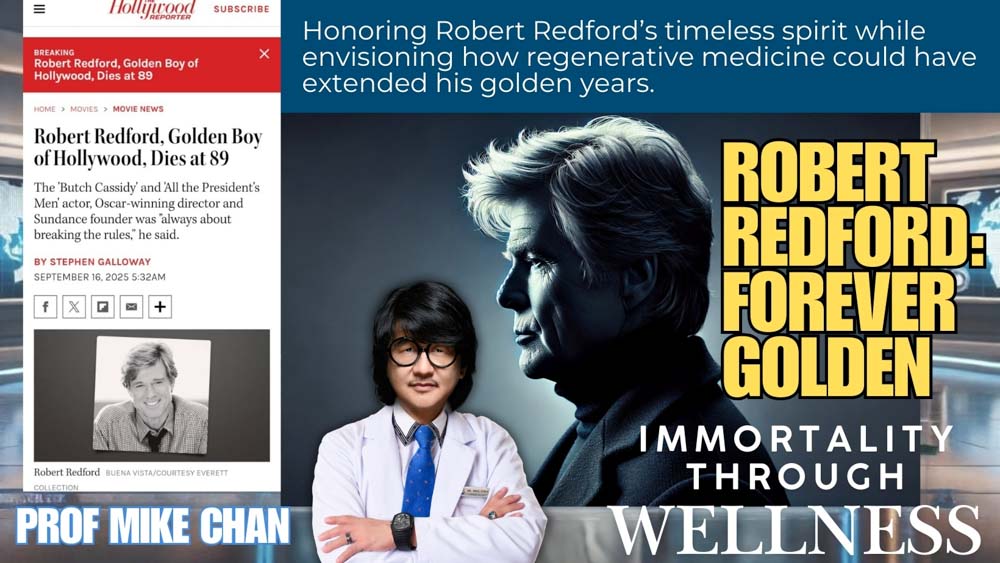
SUNDANCE, Utah (Sept 16, 2025) – Robert Redford, the Hollywood icon whose face and voice embodied the restless spirit of American cinema, has died at 89. He passed away peacefully at his home in Sundance, Utah, “surrounded by those he loved,” his publicist confirmed.
The announcement reverberated across the film world. Tributes poured in from colleagues, co-stars, and admirers who grew up with his movies. Meryl Streep, who starred with him in Out of Africa, called him “one of the lions.” Audiences remembered the rugged charm of Butch Cassidy and the Sundance Kid, the sly charisma of The Sting, the moral conviction of All the President’s Men, and the aching romance of The Way We Were.
Beyond acting, Redford reshaped the industry by founding the Sundance Institute, which became a launchpad for independent cinema worldwide. His artistry earned acclaim on both sides of the camera, with Ordinary People winning him the Academy Award for Best Director and Best Picture in 1980. Even in later works such as All Is Lost (2013) and The Old Man & the Gun (2018), Redford proved his screen presence remained magnetic, marked by quiet resilience and timeless elegance.
The Toll of Time
In his later years, Redford experienced what millions around the world face: slowing energy, fading memory, reduced muscle strength, and the steady erosion of vitality. These changes are not simply the product of “getting old,” but the result of biological aging, the gradual loss of cellular resilience. His peaceful passing reflects the natural course of life, but it also underscores a universal challenge confronting societies everywhere.
According to the World Health Organization, by 2030, one in six people worldwide will be over 60. Many will grapple with geriatric syndromes such as cognitive decline, weakened immunity, cardiovascular fragility, and loss of independence.
Prof. Mike Chan on the Science of Longevity
For Prof. Mike Chan, a pioneer in bioregenerative medicine, aging is not only a demographic reality but also a field of possibility. He views aging not as an inescapable fate but as a biological process that can be understood—and, in part, addressed.
“The hallmark of aging is not just wrinkles or weaker bones, but the failure of cells to repair and regenerate,” Prof. Chan explains. “By using targeted precursor stem cells, we can stimulate the body’s own blueprint for renewal.”
His approach distinguishes between lifespan—the number of years lived and healthspan—the quality of those years. “We do not aim to add years at the end,” he says. “We aim to improve the years people are living right now.”
Restoring Quality of Life
At European Wellness, Prof. Chan and his team focus on organ-specific rejuvenation, applying precursor stem cells, peptides, and exosomes to restore function. This principle of “like heals like” targets decline at its source rather than masking symptoms.
Examples include:
- Brain precursor cells to support memory, focus, and cognition.
- Cardiac-specific cells to strengthen the heart and restore vascular health.
- Mesenchymal cells to reduce chronic inflammation, a driver of degenerative disease.
- Skeletal muscle cells to rebuild strength, balance, and independence.
- Adrenal cortex cells to stabilize hormones and boost energy.
Unlike conventional treatments that primarily manage decline, regenerative medicine seeks to rebuild cellular vitality.
“We cannot stop the clock,” Prof. Chan says, “but we can wind it back at the cellular level, reviving energy, memory, and resilience people thought were lost forever.”
Redefining Aging
As populations age, the burden of geriatric conditions will strain families, healthcare systems, and economies. Prof. Chan sees this as a defining challenge and a chance for science to make a profound difference.
“Bioregenerative medicine gives us the tools to protect brainspan and healthspan, not just lifespan,” he explains.
By addressing the roots of decline, regenerative therapies can help preserve independence, dignity, and quality of life.
Prof. Chan’s work draws on research into more than 400 types of precursor and progenitor stem cells across the body’s 78 organs. Each cell type carries a unique blueprint. Applied with precision, these cells can restore functions once thought irreversibly lost.
“Precision is everything,” he emphasizes. “Brain cells for brain health, cardiomyocytes for the heart, adrenal cells for hormonal balance. This is how we move beyond managing decline to redefining aging itself.”
This vision is not about chasing immortality but about achieving wellness. For Prof. Chan, true immortality lies in the ability to live fully, contribute meaningfully, and inspire others, values embodied throughout Redford’s life.
A Timeless Spirit
Redford’s passing marks the end of an era but leaves behind a lasting legacy. His characters—rebellious, tender, principled, or weary, still resonate across generations. His activism for independent cinema and the environment continues to influence and inspire.
For Prof. Mike Chan, Redford remains a symbol of vitality and grace.
“Robert Redford was timeless,” he reflects. “His films captured youth, rebellion, and elegance, but his later years reflected wisdom and serenity. Forever Golden is not just about cinema, it is about the spirit of vitality we strive to preserve in every person.”
Redford’s story is one of artistry, conviction, and grace. He entertained and inspired, leaving behind a golden legacy that will endure for generations. His passing also reminds us of the universal journey of aging—a journey that science, through the pioneering work of experts like Prof. Mike Chan, is beginning to reimagine.
As the world celebrates Redford’s life, we also glimpse a future where vitality does not fade so quickly, where wellness grows alongside wisdom, and where the golden years can truly remain golden.
Follow European Wellness:



Follow European Wellness Academy:
Follow Prof. Dato’ Sri Dr. Mike Chan:

Related Posts