African swine fever and swine influenza may both threaten pigs, but they are not the…
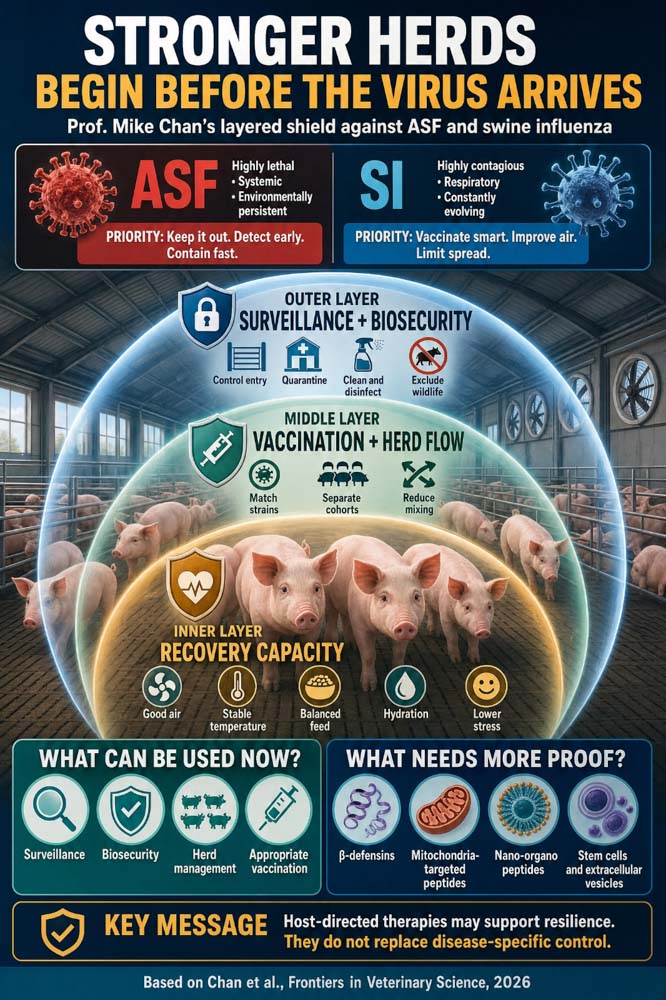
Stronger Herds Begin Before the Virus Arrives
African swine fever and swine influenza may both threaten pigs, but they are not the same enemy. One can tear through a herd as a lethal, environmentally persistent emergency. The other behaves more like a recurring respiratory storm, spreading quickly, reducing growth and opening the door to secondary bacterial disease. Treating them as if they require one universal answer is precisely the mistake this new meta-review urges the swine sector to avoid.
Published in Frontiers in Veterinary Science, the review led by Prof. Mike Chan brings together evidence on surveillance, vaccines, biosecurity, herd management, supportive care, nutrition and emerging regenerative science. Its most important contribution is not a claim that one new therapy will solve everything. It is a practical hierarchy showing what has strong field support now, what works only in certain settings and what remains an important research possibility.
This distinction matters. A promising laboratory mechanism is not yet a farm-ready solution. Commercial usefulness also depends on safety, cost, dosing, regulation, storage, staffing and whether an intervention can be delivered consistently to an entire herd. Prof. Mike Chan’s paper is strongest when it keeps these levels of evidence separate.
“The most powerful immune intervention may be the one that prevents the animal from being overwhelmed in the first place.” — Prof. Mike Chan
Two Viruses Expose two different weak points
African swine fever, or ASF, is the emergency at the gate. In severe outbreaks, mortality can approach 100 per cent. The virus can travel through infected animals, contaminated pork products, vehicles, equipment, clothing and wildlife interfaces, and it can persist in the environment. Once it is established, ordinary supportive care is unlikely to reverse the herd-level outcome. The immediate priorities are exclusion, early detection, movement restriction, carcass management and rapid containment.
A simple example is a livestock vehicle that visits several farms. If its wheels, loading ramp or tools are contaminated, that one vehicle can become a bridge between herds. Disinfection, controlled access and dedicated equipment are therefore not paperwork. They are physical barriers that can stop a catastrophe before it starts.
Swine influenza, or SI, is a different test. It usually causes lower mortality but very high morbidity, meaning many animals can become ill at once. Repeated respiratory outbreaks reduce feed efficiency and growth, increase treatment needs and may invite bacterial complications. The virus also changes through antigenic drift and reassortment, so yesterday’s vaccine match may not provide ideal protection tomorrow.
Think of SI as a smoke problem in a crowded room. Vaccination can reduce the size of the fire, but poor ventilation, dust, ammonia, unstable temperatures and close mixing still determine how much smoke every animal breathes. That is why the review combines vaccination with strain surveillance, environmental control and herd-flow management rather than presenting the vaccine as a complete answer.
The paper also gives a balanced reading of vaccine progress. Whole inactivated SI vaccines already have strong field use and can reduce disease and shedding when the vaccine and circulating virus are reasonably well matched. Their limits include antigenic mismatch, interference from maternal antibodies and, in some mismatched settings, vaccine-associated enhanced respiratory disease. For ASF, gene-deleted live attenuated vaccines have produced strong protection against closely matched challenge viruses in pigs, but breadth, safety, regulation, DIVA capability and field deployment remain unresolved. In short, ASF vaccine development is a major advance, not yet a universal substitute for biosecurity.
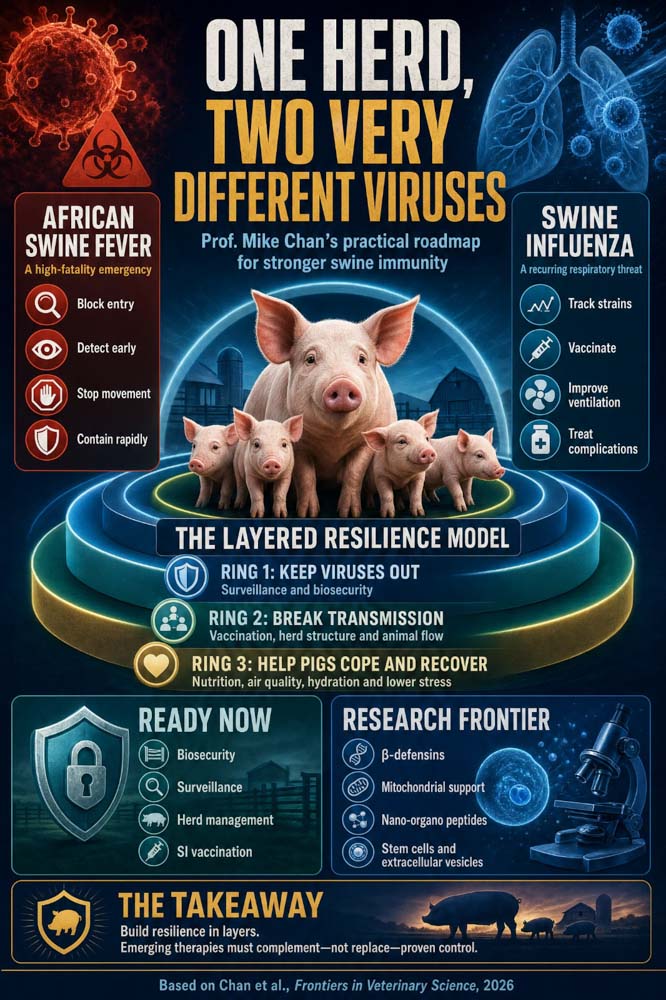
Prof. Mike Chan’s layered shield for healthier herds
What, then, is Prof. Mike Chan’s solution based on the review? It is not a single product. It is an integrated, three-layer resilience framework.
The outer layer keeps danger away and detects it early. Surveillance and biosecurity reduce the chance that a virus reaches the herd and shorten the time between introduction and action. The paper supports movement control, perimeter security, quarantine of new animals, cleaning and disinfection, farm-specific clothing and equipment, wildlife exclusion and all-in/all-out production.
For a farm manager, this could mean giving newly arrived pigs a separate quarantine period, preventing delivery drivers from entering animal areas, assigning tools to one barn instead of sharing them and recording visitors and vehicle movements. Small routines become a network of barriers.
The middle layer interrupts transmission. Vaccination where appropriate, herd structure and controlled animal flow reduce the number and intensity of infectious contacts. For SI, that means matching vaccine strategy to local strains as closely as possible, monitoring viral change and reducing unnecessary mixing between age groups. For ASF, any authorized vaccine should be used only within the relevant regulatory and epidemiological context and must complement—not weaken—outbreak controls.
The inner layer protects the animal’s capacity to cope and recover. Balanced feed, sufficient micronutrients, hydration, good air quality, temperature stability, lower stocking stress, intact respiratory barriers and veterinary treatment of bacterial complications can materially improve SI recovery. They are useful foundations of health in ASF-risk areas too, but they must never be misrepresented as treatment for an acute ASF outbreak.
“Resilience is not an immune booster in a bottle; it is the result of lower infection pressure, better immune balance and stronger recovery capacity working together.” — Prof. Mike Chan
This layered view makes “immune resilience” easier to understand. Consider a house during a storm. The fence reduces exposure, the locked doors slow entry and the solid roof and drainage system limit damage if rain gets in. No single layer is perfect, but together they change the outcome. In the same way, a herd is more resilient when fewer pathogens enter, transmission is interrupted and animals are physiologically better prepared to recover.
The most actionable recommendations from the review are therefore straightforward.
- Make surveillance routine by testing quickly, recording respiratory patterns and watching for changing strains or unusual mortality.
- Treat biosecurity as a daily operating system with controlled entry, quarantine, cleaning, disinfection, dedicated clothing and equipment, wildlife exclusion and disciplined animal movement.
- Match intervention to disease biology by prioritizing exclusion and containment for ASF, and adaptable vaccination plus respiratory management for SI.
- Improve the barn environment through ventilation, dust and ammonia control, stable temperatures, appropriate stocking density, dependable hydration and balanced nutrition.
- Manage complications early with veterinary oversight, especially bacterial respiratory disease during SI outbreaks.
- Test future therapies properly in commercial production settings using standardized products, dose-response studies, controlled challenge trials and independent replication.
Promising science deserves patient proof
Prof. Mike Chan’s distinctive forward-looking contribution is the exploration of host-directed and regenerative strategies. These approaches aim not only at the virus but also at the animal’s energy balance, inflammatory control, immune signalling and tissue repair.
The review discusses four promising directions. Porcine beta-defensin 2 has shown disease-specific proof of concept in pigs with SI, reducing clinical signs and lung viral titres in an experimental setting. Mitochondria-targeted approaches, including the proposed Mito Organelle or MO concept, seek to support cellular energy and redox balance because both ASF and SI can disturb mitochondrial and inflammatory pathways. Nano-organo peptides or NOPs are proposed as low-molecular-weight, organ-directed bioregulators. Precursor stem or progenitor cell products and extracellular vesicles may support anti-inflammatory signalling and tissue repair; notably, extracellular vesicles from swine bone-marrow stromal cells have reduced influenza-related acute lung injury in a pig model.
These signals are scientifically interesting, but the review does not show that MO, NOP, precursor cell products or extracellular vesicles already prevent ASF deaths or control SI across commercial herds. For most of these technologies, practical readiness is rated very low. Important questions remain about product consistency, sterility, dose, route of administration, cold-chain needs, cost, food-chain regulation and herd-scale delivery.
That caution is a strength, not a weakness. The correct next step is not to market possibility as proof. It is to run standardized, independently replicated pig studies and then test the most credible candidates under real production conditions. Outcomes should include viral load, transmission, mortality, clinical severity, immune markers, recovery time and production performance.
“Regenerative biology should be developed as a complement to vaccination, biosecurity and antiviral control—not advertised as their replacement.” — Prof. Mike Chan
The paper is a meta-review rather than a new clinical trial, so its conclusions depend on the quality and relevance of the studies it assembles. Evidence is especially uneven in the regenerative sections, where some support comes from cell systems, mice, horses or non-infectious models rather than commercial pig herds. Readers should also note that Prof. Mike Chan and colleagues have authored several of the cited papers on mitochondria, nano-organo peptides and precursor cells. That does not invalidate the ideas, but it makes independent validation especially important.
The enduring message is practical. Strong herds are not created after an outbreak begins. They are built beforehand through fewer opportunities for viral entry, faster detection, sensible vaccination, cleaner animal flow, better air, lower stress and adequate nutrition. Emerging host-directed technologies may eventually strengthen that inner layer. Today, however, Prof. Mike Chan’s most defensible solution is a disciplined sequence: first block exposure, then interrupt spread, then support recovery—and require promising science to earn its place through proof.
Read further
To explore the study in more detail, visit the publication page.
Follow European Wellness:



Follow European Wellness Academy:
Follow Prof. Dato’ Sri Dr. Mike Chan:

Related Posts