Cellular ageing is often spoken about as though it were a single clock ticking down…
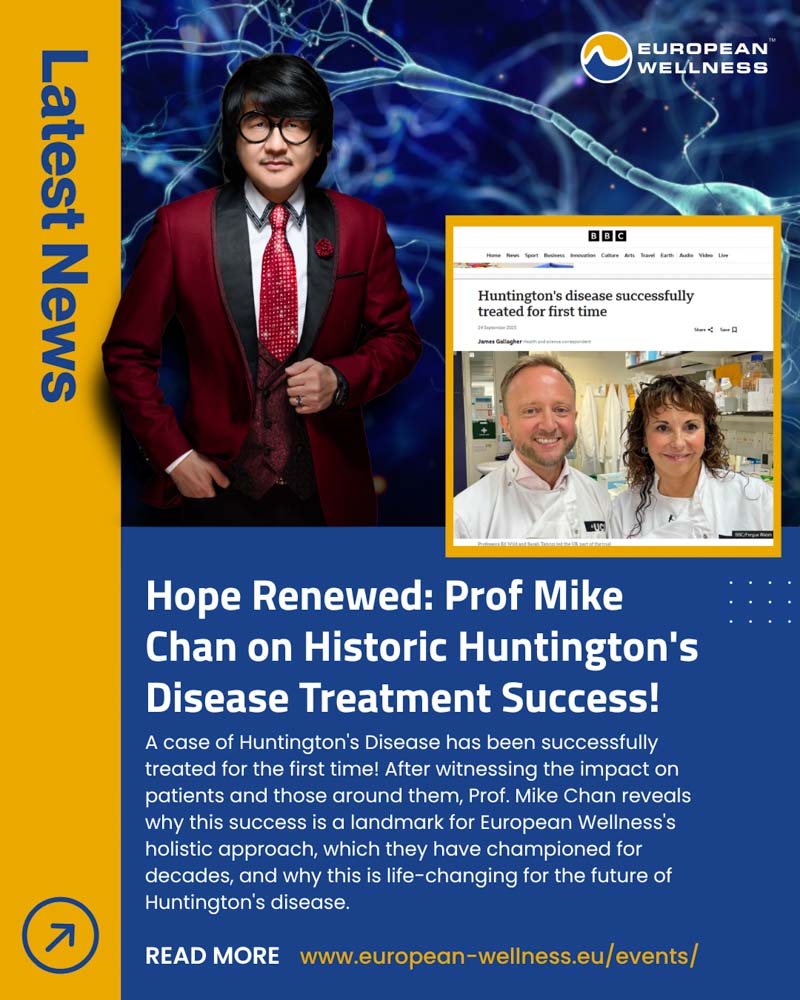
Hope Renewed: Prof. Mike Chan on Historic Huntington’s Disease Treatment Success
On September 24, 2025, the medical world witnessed a historic moment when researchers announced that Huntington’s disease had been successfully treated for the first time. The BBC reported that an emotional research team, led by Professors Sarah Tabrizi and Ed Wild, became tearful as they described how their gene therapy trial achieved a remarkable 75% slowing of disease progression in patients. This means that the decline typically expected in one year would now take four years after treatment, offering patients decades of “good quality life.” The trial involved 29 patients who underwent 12 to 18 hours of delicate brain surgery to receive the gene therapy, with results showing that three years post-surgery, patients experienced dramatic improvements in cognition, motor function, and daily living abilities.
Professor Mike Chan, the Chief Scientist at European Wellness and a pioneer in regenerative medicine, was delighted to hear about this development. Having traveled around the world treating celebrities, heads of state, sports athletes, and highly influential individuals, Prof. Chan has witnessed firsthand the devastating impact of neurodegenerative diseases on patients and their families. The news from the UK trial resonated deeply with his own philosophy of targeting disease at its cellular and genetic roots.
Prof. Mike Chan expressed his enthusiasm for the findings, noting that this success validates the approach that European Wellness has championed for years. The BBC report highlighted that one patient who had been medically retired has now returned to work, while others in the trial are still walking despite being expected to need wheelchairs. These tangible outcomes demonstrate the life-changing potential of advanced therapeutic interventions, a principle that has guided Prof. Chan’s work in biological medicine for decades.
Understanding Huntington’s: A Layman’s Guide
Huntington’s disease is a genetic condition that can be likened to a faulty instruction in the body’s intricate instruction manual, our DNA. Often described as a devastating mixture of dementia, Parkinson’s, and motor neuron disease, it is considered one of the worst genetic disorders known to medicine. The inheritance pattern is particularly cruel: if you inherit the gene from either parent, there is a 100% certainty that you will develop the disease. When couples have a child, there is a 50/50 chance that the faulty gene will be passed on, creating a shadow of uncertainty that hangs over families for generations.
For the person on the street, imagine a computer program with a single line of bad code that slowly corrupts the entire system. That’s what happens in the brain of a person with Huntington’s. The disease typically develops in middle age, often when people have just had their children and are in the prime of their lives. The symptoms are a cruel combination of motor-skill decline, memory loss, and psychiatric challenges. Once symptoms emerge, the disease typically takes 10 to 20 years to run its course, during which patients gradually require full-time care. This creates not only an emotional burden but also a significant financial cost to families and society. In the UK alone, approximately 7,000 people are currently living with this condition, with thousands more carrying the gene and awaiting their fate.
A New Dawn for Huntington’s Patients
The recent study has shown that a novel gene therapy can slow the progression of the disease by a remarkable 75% over three years. This is not a cure, but it represents the first time in the history of Huntington’s disease that researchers have convincingly slowed its progression. For decades, trial after trial ended in disappointment, with doctors only able to manage symptoms rather than address the underlying disease process. This new approach changes everything.
The therapy involves a one-off treatment where an inactivated virus is injected deep into six parts of the brain, specifically targeting a region called the striatum. This is a long and complex neurosurgical procedure that requires significant upfront work and carries inherent risks. However, once the gene therapy has been delivered, it remains in the brain permanently. The virus enters the neurons and injects a piece of DNA that essentially reprograms the neuron to become a “factory for its own cure.” While the neuron continues to produce the harmful huntingtin protein, it simultaneously produces a molecule that halts the production of that toxic protein. This dual action means less harm is occurring at the cellular level, and the disease progresses more slowly.
The three-year data from the 29 patients showed improvements across multiple measures, including cognition, movement, and the ability to lead an independent life. Given that Huntington’s typically takes 10 to 20 years to kill someone once symptoms emerge, this 75% slowing could potentially give patients decades more of healthy, productive life. Even more exciting is the possibility that individuals who carry the gene but have not yet developed symptoms could receive treatment and never experience the disease at all. This represents a shift from merely slowing disease progression to potentially preventing it entirely.
Prof. Mike Chan commented on the importance of this study, stating, “This is a pivotal moment for everyone involved in the fight against neurodegenerative diseases. It validates the principle that by targeting the root cause at a genetic and cellular level, we can make a tangible difference in patients’ lives. It gives us a glimpse of a future where we can not just manage symptoms, but actively intervene in the disease process.”
European Wellness’ Multi-Dimensional Treatment Strategy
While the new gene therapy offers a targeted approach, Prof. Mike Chan and European Wellness have long championed a comprehensive, holistic strategy for managing complex diseases like Huntington’s. Their approach is not about a single magic bullet, but about supporting the body’s own healing and regenerative capabilities from multiple angles. This philosophy is grounded in the understanding that a disease as complex as Huntington’s requires a multi-faceted treatment plan that addresses the whole person, not just the symptoms.
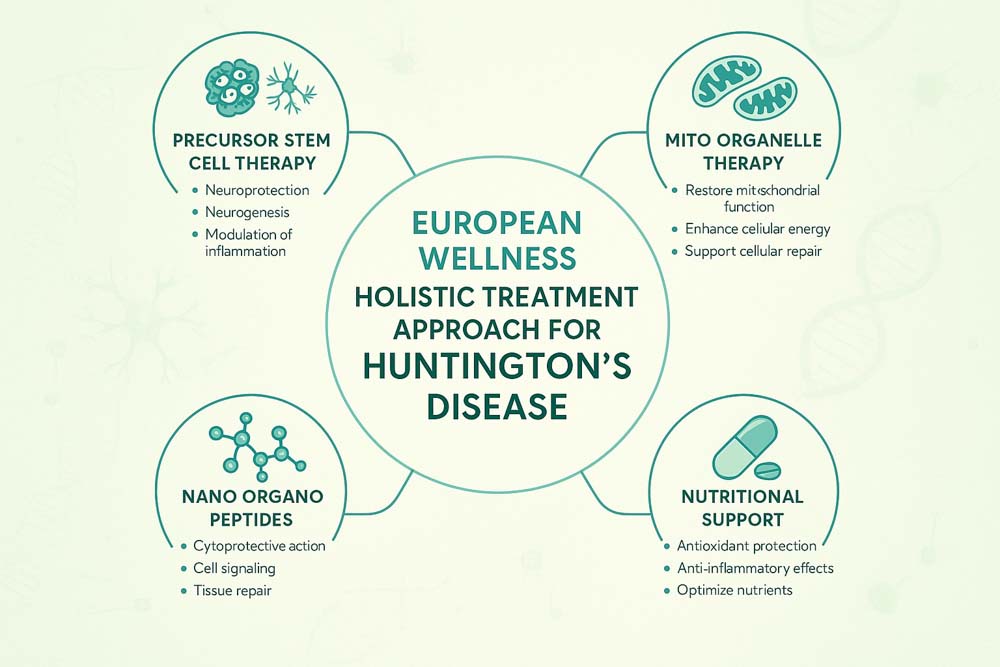
At the core of European Wellness’s approach is the use of cutting-edge biological medicine, including targeted organ-and-brain-specific precursor stem cell therapy, nano organo peptides, and mito organelle therapy. These treatments are designed to repair and regenerate damaged tissues, improve cellular function, and support the body’s overall health. For Huntington’s disease, this means not only targeting the brain and nervous system but also bolstering the musculoskeletal system, cognitive function, and emotional well-being.
Here is a summary of some of the key holistic therapies offered by European Wellness:
| Therapy Type | Description | Key Benefits for Huntington’s |
|---|---|---|
| Precursor Stem Cell Therapy | Uses organ-and-brain-specific precursor stem cells to repair and regenerate damaged tissues. | Targets brain and nervous system for cellular repair. |
| Mito Organelle (MO)™ Therapy | Supports mitochondrial health to improve cellular energy production. | Boosts brain cell energy and reduces oxidative stress. |
| Nano Organo Peptides (NOP) | Delivers bioactive molecules to promote tissue repair and regeneration. | Supports nervous system function and cellular health. |
| Placenta HP | Contains growth factors and peptides to revitalize the body. | Improves overall vitality, sharpens the mind, and reduces inflammation. |
| MF3 AlfaPlaqx & ColleGems | Softgels that support brain function, memory, and cellular health. | Provides essential nutrients for brain health and cognitive function. |
Prof. Mike Chan explains the philosophy behind this approach: “We believe in a synergistic approach. It’s like tending to a garden. You don’t just water one plant; you enrich the soil, provide the right nutrients, and ensure the entire ecosystem is healthy. Similarly, with a disease like Huntington’s, we must support the entire body’s cellular environment to give it the best possible chance to heal and regenerate.”
European Wellness’s Comprehensive Treatment Framework
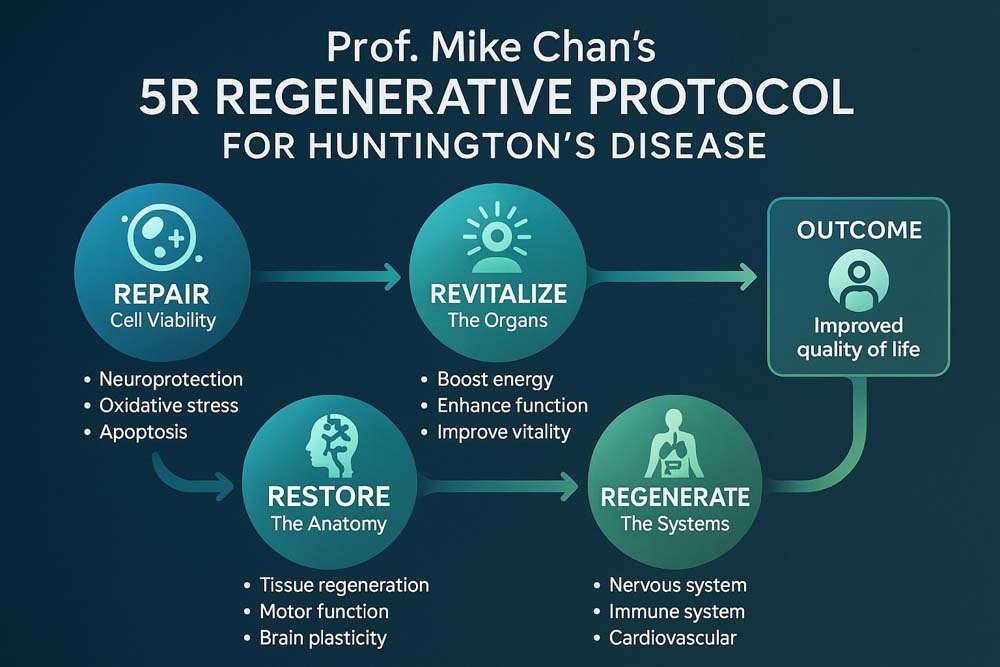
The following infographics illustrate how Prof. Mike Chan and European Wellness approach Huntington’s disease treatment through a multi-layered strategy that addresses the disease from various angles.
Looking to the future, Prof. Chan is optimistic. “The field of regenerative medicine is constantly evolving. With each new discovery, we are getting closer to a future where diseases like Huntington’s are no longer a death sentence, but a manageable condition. Our goal at European Wellness is to continue to be at the forefront of this evolution, offering our patients the most advanced and comprehensive care possible.”
References
- Gallagher, J. (2025, September 24). Huntington’s disease successfully treated for first time. BBC News. Retrieved from https://www.bbc.com/news/articles/cevz13xkxpro
- The Guardian. (2025, September 24). Huntington’s disease treated successfully for first time in UK gene therapy trial. The Guardian. Retrieved from https://www.theguardian.com/science/2025/sep/24/huntingtons-disease-treated-successfully-for-first-time-in-gene-therapy-trial
- European Wellness. (n.d.). Huntington’s Disease [PDF document].
Follow European Wellness:



Follow European Wellness Academy:
Follow Prof. Dato’ Sri Dr. Mike Chan:

Related Posts