Cellular ageing is often spoken about as though it were a single clock ticking down…
Phil Collins’ Health Decline Spotlights Urgent Role for Regenerative Medicine in Age-Related Neuromuscular Disorders
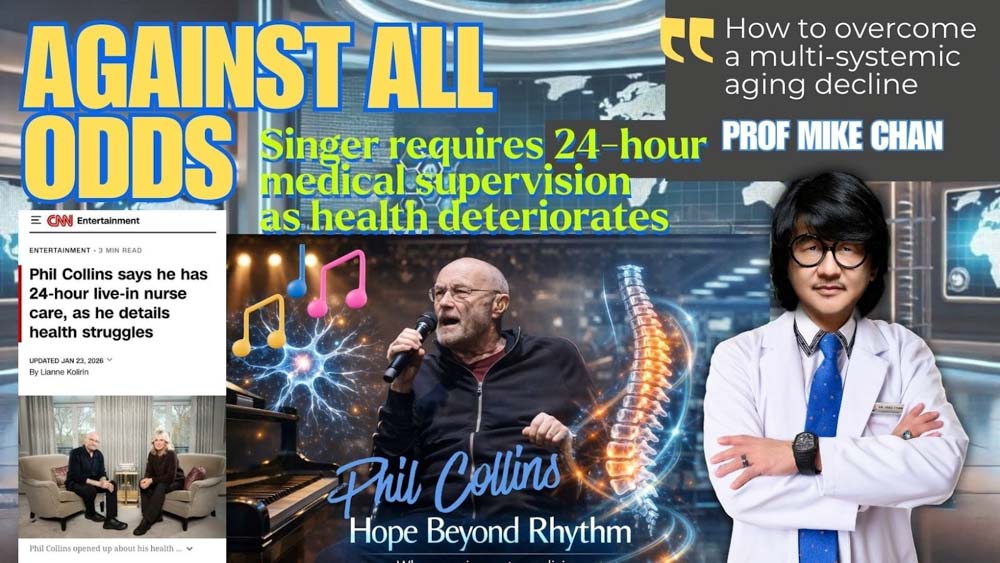
Source: AFP / Fox News — Phil Collins now requires 24-hour medical care following years of mounting health issues
MIAMI, Florida (Jan 30, 2026) — Rock legend Phil Collins is now under 24-hour medical supervision, following years of progressive spinal injuries, nerve damage, and loss of mobility. The beloved Genesis frontman, aged 73, has become a symbol of age-related neuromuscular degeneration—an urgent medical frontier where experts are now turning to regenerative technologies for answers.
While traditional approaches provide symptom relief, experts such as Prof. Dato’ Sri Dr. Mike Chan, Chairman of European Wellness Biomedical Group (EWBG), emphasize that the body’s ability to repair itself diminishes with age—necessitating more advanced, biologically precise interventions.
“By age 18, only 45% of our original stem cells remain. By 30, it drops to 25%. And by 60, you’re left with just 5%,” Prof. Chan explains.
The Biology of Breakdown: Why the Body Stops Repairing
Phil’s physical decline—marked by nerve dysfunction (“drop foot”), spinal deterioration, and frailty—is a classic result of organ-specific aging. According to Prof. Chan, this decline is accelerated by stem cell exhaustion, where aging tissues lose the biological “currency” needed to regenerate. Crucially, older cells produce older proteins, and therapies relying on these aged cells often fail to reverse damage.
The Innovation: Organ-Specific Precursor Stem Cell Therapy
EWBG offers a revolutionary modality based on Targeted Organ-Specific Precursor (Progenitor) Stem Cells. Unlike generic cell therapy, which uses one-size-fits-all mesenchymal cells, this approach is grounded in the principle of Similia Similibus Curantur—“like treats like.”
“You cannot use an eye cell for the liver or a liver cell for the heart,” Prof. Chan states. “Precision is everything. Every organ ages. Every organ needs its own regenerative strategy.”
For a patient like Collins, this multi-systemic degeneration demands a comprehensive and organ-targeted approach.
The EWBG Protocol: What the Regenerative Strategy Involves
In conditions involving mobility loss, EWBG’s multi-targeted treatment includes:
- Spinal Cord & Neural Precursor Cells – To regenerate damaged nerves and improve signal transmission, particularly for conditions like “drop foot.”
- Cartilage, Synovia, Bone & Muscle Precursor Cells – To restore joint flexibility, rebuild musculoskeletal support, and counteract early-onset tissue loss that begins as early as age 20.
- Placenta Precursor Cells – Rich in bioactive compounds, these support systemic anti-inflammatory activity and cellular rejuvenation.
- Adrenal & Pituitary Precursor Cells – To restore hormonal balance, support metabolism, and regulate energy and immune resilience.
- Any Other Targeted Organ Precursors as Needed – Based on diagnostic findings, additional organ-specific therapies are introduced, as every aging organ requires tailored biological repair.
The DDRR Paradigm: More Than Just Cell Therapy
Prof. Chan emphasizes that regenerative success doesn’t come from cell therapy alone—it requires environmental optimization, known as the DDRR model: Diagnose, Detox, Repair, Rejuvenate.
“You must clean the coral reef before you introduce new fish,” he explains. “We detoxify the body first—removing heavy metals and inflammatory triggers—then deliver targeted precursor cells that home to damaged organs, allowing repair and regeneration to take place naturally.”
Expert Perspective
“Phil Collins’ condition reflects the widespread need for integrative regenerative solutions tailored to aging-related decline,” says Prof. Chan. “By leveraging the science of organ-specific precursor stem cells, we can offer hope where few options existed before—helping patients regain function, mobility, and dignity.”
🎵 A Look Back: The Musical Legacy of Phil Collins
From leading Genesis to dominating solo charts, Phil Collins has sold over 100 million albums worldwide. His timeless classics—“In the Air Tonight”, “Against All Odds”, and “You’ll Be In My Heart”—earned him:
- 8 Grammy Awards
- 1 Academy Award
- Induction into the Rock & Roll Hall of Fame
His contributions shaped a generation. Now, his health battle highlights a growing need for medical innovation in aging populations.
The Broader Significance
With global populations aging rapidly, Collins’ condition is not isolated—it represents a coming wave of similar challenges. EWBG’s regenerative methods are redefining how medicine views aging, shifting from symptomatic care to curative intent grounded in cellular science.
“Regenerative medicine offers a second chance,” says Prof. Mike Chan. “And the future is not only hopeful—it’s already here.”
Key Reading List: Aging, Longevity & Regenerative Medicine
- Biological Wellness
Prof. Mike Chan’s master reference outlining the DDRR paradigm (Damage–Defense–Repair–Regeneration), forming the scientific foundation of modern longevity medicine. - Handbook of Anti-Aging Medicine
A foundational text covering molecular aging, preventive strategies, and clinical anti-aging practice. - Handbook on Longevity Medicine: The Road Map
A comprehensive, systems-based guide to extending healthspan through integrative and regenerative medicine. - Proactive Ageing: Comprehensive Strategies for Healthy Longevity
Longevity lifestyle principles combined with regenerative insights for aging well and preserving vitality. - Insomnia & Enhancing Memory: Integrative Approaches to BrainSpan and Longevity
Focused on aging brain health, sleep optimization, and cognitive resilience. - Longevity for the Heart: Cardiac Inflammaging & Regenerative Strategies
Organ-specific approaches addressing cardiovascular aging and inflammation. - Stem Cells in Regenerative Medicine
A foundational guide to precursor (progenitor) stem cells and their role in tissue repair and rejuvenation. - The Dawn of New Medicine
A paradigm-shifting work challenging the belief that neural damage is irreversible.
For more scientific references and treatment options, visit: European Wellness Publications
Follow European Wellness:



Follow European Wellness Academy:
Follow Prof. Dato’ Sri Dr. Mike Chan:

Related Posts