Cellular ageing is often spoken about as though it were a single clock ticking down…
The Spinal Cord Needs More Than a Single Fix
Spinal cord injury is often described as if it were a damaged electrical cable: the injury interrupts the messages travelling between the brain and the body, and paralysis follows. The image is useful, but it is incomplete. A spinal cord injury is not only a broken connection. It is also a crisis of energy, blood flow, immune balance, tissue structure, and cellular communication.
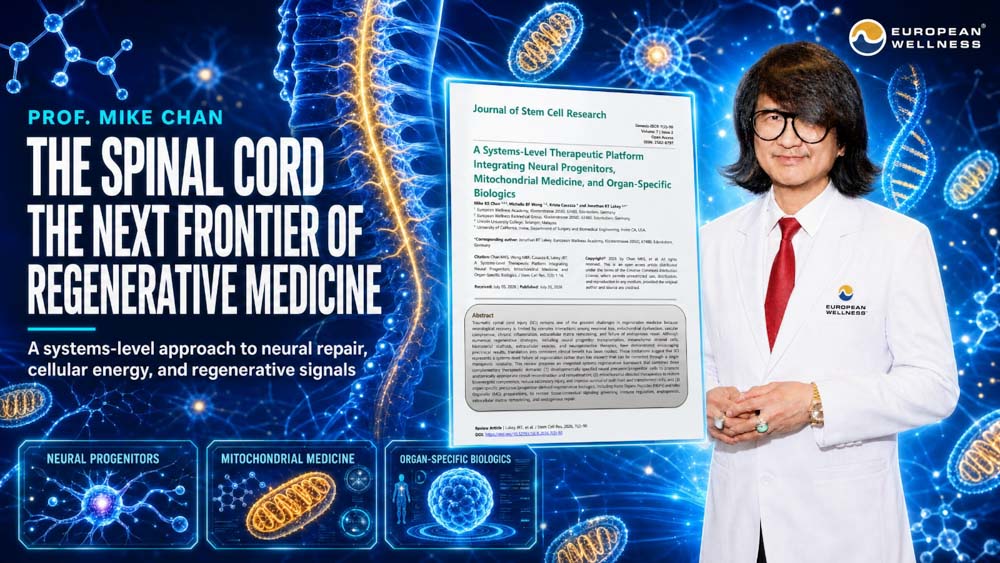
That wider view is the central contribution of the review article A Systems-Level Therapeutic Platform Integrating Neural Progenitors, Mitochondrial Medicine, and Organ-Specific Biologics. The paper argues that the disappointing record of many regenerative treatments may not mean that regeneration is impossible. It may mean that researchers have often tried to repair one part of a damaged biological system while leaving the other parts hostile to recovery.
The paper does not present a clinically proven cure. Instead, it presents a testable, hypothesis-driven framework associated with the European Wellness regenerative platform. Its proposed solution combines three areas: developmentally specified neural progenitor cells, mitochondrial-directed therapeutics, and organ-specific regenerative biologics such as Nano Organo Peptides and Mito Organelle preparations.
Why Spinal Cord Injury is Not Just a Broken Wire
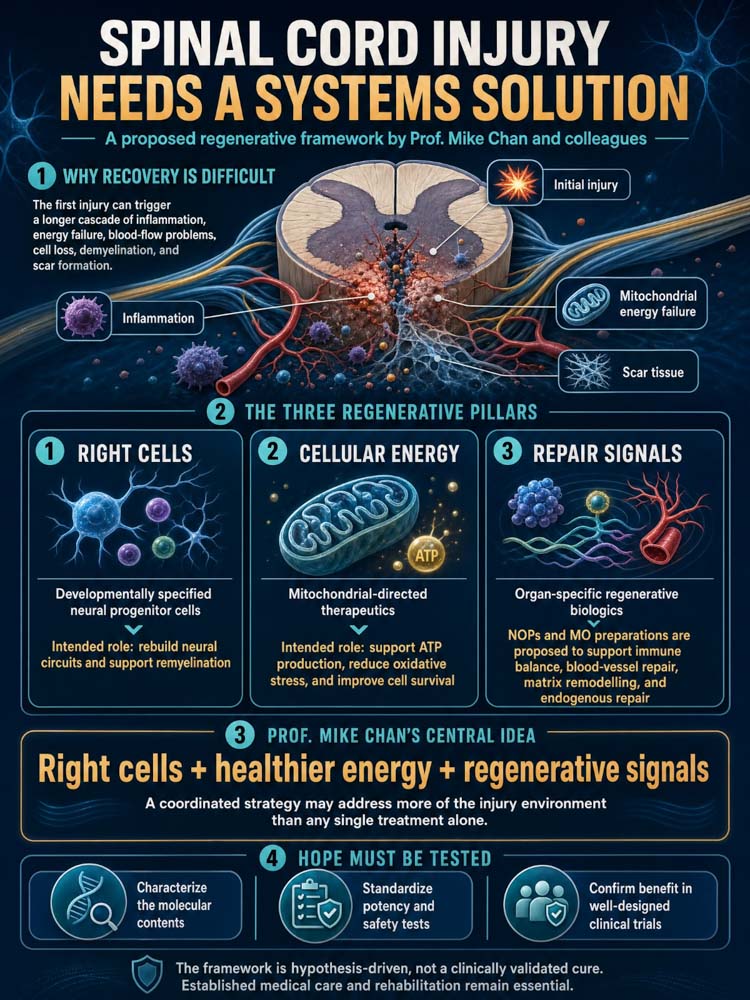
The study’s first important message is that spinal cord injury develops over time. The initial trauma may immediately damage neurons, support cells, blood vessels, and axons, but a second wave of biological events can continue to enlarge the injury. These events include excessive glutamate activity, calcium overload, oxidative stress, inflammation, loss of blood-spinal-cord barrier integrity, cell death, demyelination, and scar formation.
In everyday language, the first impact starts the problem, but the body’s reaction can keep the problem going. A useful example is a house damaged by a storm. The broken roof is the primary injury. Water entering through the roof, electrical failures, mould, and weakened foundations are secondary problems. Repairing only the roof may not restore the house if the wiring, walls, and internal environment remain damaged. The paper applies a similar logic to the injured spinal cord.
The authors give special attention to mitochondria, the small structures inside cells that help produce usable energy. Nerve cells need a great deal of energy to send signals, move materials along long axons, manage calcium, and maintain communication with other cells. After injury, damaged mitochondria can produce less energy and more harmful reactive oxygen species. They can also intensify inflammatory signalling.
This helps explain why a transplanted cell may look promising in a laboratory but perform poorly inside a chronically injured spinal cord. The new cell may have regenerative potential, but the surrounding tissue may not provide enough energy, blood supply, chemical support, or physical space for it to survive and connect properly.
“SCI represents a systems-level failure of tissue regeneration rather than a disorder that can be corrected through a single therapeutic modality.”
— Prof. Mike Chan
This is the study’s most important idea for a general audience. It shifts the question from What single treatment can fix paralysis? to What combination of conditions must be restored for repair to become possible?
The Three-part Answer Proposed by Prof. Mike Chan
Prof. Mike Chan’s solution, based on the attached paper, is an integrated systems-regeneration platform. Each part has a different job, and the authors argue that the parts should be studied together rather than treated as unrelated products.
| Proposed pillar | Plain-language meaning | What it is intended to address | Important limitation identified in the paper |
|---|---|---|---|
| Developmentally specified neural progenitor cells | Cells prepared with a neural identity suited to the spinal cord and its regional circuits | Replacing or supporting lost neurons and glial cells, remyelination, and circuit reconstruction | Cells still need to survive, mature, extend axons, form stable connections, and integrate with the host tissue |
| Mitochondrial-directed therapeutics | Interventions aimed at improving cellular energy production and mitochondrial quality control | Energy failure, oxidative stress, calcium dysregulation, secondary degeneration, and poor cell survival | They cannot replace lost neural cells on their own; dose, delivery, biodistribution, and target engagement require definition |
| Organ-specific regenerative biologics | Tissue-contextual signals derived from precursor or progenitor sources, including NOPs and MO preparations | Inflammation, angiogenesis, extracellular-matrix remodelling, mitochondrial adaptation, and endogenous repair | Molecular composition, active ingredients, potency, safety, consistency, and clinical efficacy remain incompletely characterized |
The first pillar addresses the missing building material. The paper favours neural progenitor cells whose developmental identity is matched to the region and function of the spinal cord, rather than relying only on generic cells. The reasoning is straightforward: a replacement part works best when it is designed for the machine in which it will be installed. Properly specified cells may have a better chance of producing appropriate neuronal and glial types, following suitable guidance cues, and helping form relay circuits.
The second pillar addresses the power problem. If mitochondria are the cell’s energy factories, mitochondrial medicine aims to make the injured environment less energy-starved and less damaging. In principle, stronger mitochondrial function could help protect surviving neurons, support transplanted cells, reduce oxidative stress, and improve the conditions needed for axonal growth. The paper is careful, however, to say that mitochondrial interventions cannot reconstruct a neural circuit by themselves.
The third pillar addresses the neighbourhood around the injury. Nano Organo Peptides, or NOPs, are described as low-molecular-weight peptide fractions derived from specific organs and intended to deliver coordinated biological signals. Mito Organelle, or MO, preparations are presented as a complementary approach focused on mitochondrial support. The authors propose that tissue-derived products may carry signals reflecting the developmental origin and function of their source tissue.
A simple analogy is urban repair. Neural progenitor cells are the workers and replacement components. Mitochondrial medicine helps keep the construction site powered. Organ-specific biologics are closer to the planning signals, transport links, safety systems, and local services that allow rebuilding to proceed. Sending in workers without electricity, access, or a safe site is unlikely to produce a functioning city.
The paper’s proposed solution is therefore not a promise that one injection or one product will restore movement. It is a research strategy: rebuild the cellular substrate, improve the energy environment, and restore the signals that make the tissue more permissive to repair.
“The greatest strength of the EW platform lies not in any individual biologic but in its integration of complementary regenerative mechanisms.”
— Prof. Mike Chan
The word integration matters. The authors are not claiming that the three components are automatically synergistic. They are saying that the biology of spinal cord injury makes a coordinated approach worth testing. The difference is important because a plausible framework still needs evidence.
What Must Happen Before Hope Becomes Evidence
The paper is strongest when it acknowledges what is not yet known. It describes the platform as hypothesis-driven and translational, not as a clinically validated standard of care. That distinction protects patients from confusing a promising biological rationale with demonstrated effectiveness.
The authors recommend a practical research pathway. First, the proposed biologics need rigorous molecular characterization. Modern proteomics, metabolomics, lipidomics, extracellular-vesicle profiling, and single-cell or spatial transcriptomics could help identify exactly what the preparations contain and which components may be biologically active. Without this information, a complex product is difficult to reproduce, compare, or improve.
Second, the field needs standardized potency assays. A potency assay is a laboratory test that asks whether a product consistently performs the biological task it is supposed to perform. For example, researchers might test whether a preparation changes inflammatory behaviour, supports mitochondrial function, promotes vascular repair, or improves the survival of neural progenitors. A label alone is not enough; the product’s activity must be measurable from batch to batch.
Third, researchers should establish pharmacokinetic and target-engagement data. In plain language, they need to know where a therapy goes, how long it remains active, what dose reaches the intended tissue, and whether it actually changes the biological process it is designed to change. Biomarkers could help identify which patients are biologically likely to respond and whether treatment is producing the intended effect.
Fourth, the combined platform must be tested in well-designed clinical trials. The complexity of using cells, mitochondrial-directed interventions, and organ-specific biologics makes trial design more demanding, not less. Researchers will need clear inclusion criteria, appropriate control groups, transparent safety monitoring, functional outcome measures, long-term follow-up, and enough participants to distinguish genuine benefit from natural variation and rehabilitation effects.
These recommendations also point to a broader lesson. Regenerative medicine should measure more than whether cells are present under a microscope. It should ask whether the patient has meaningful and durable improvements in movement, sensation, independence, pain, bladder and bowel function, respiratory capacity, or quality of life. Tissue changes matter, but patients ultimately need functional recovery.
The study also does not displace established care. Early stabilization, protection of spinal-cord perfusion, intensive rehabilitation, prevention of complications, and long-term multidisciplinary management remain central to spinal-cord-injury care. The proposed systems platform is presented as a possible addition to the therapeutic toolbox, not a reason to abandon current medical and rehabilitation practice.
“Successful regeneration following SCI will require coordinated restoration of the regenerative ecosystem rather than correction of any single pathological process.”
— Prof. Mike Chan
For the public, the most responsible interpretation is hopeful but measured. Prof. Mike Chan’s solution is a coherent way to organize future research around the whole regenerative ecosystem. Its importance lies in connecting problems that are often discussed separately: damaged neural circuits, failing cellular energy, inflammation, poor blood supply, scar-related barriers, and loss of tissue-specific communication.
The framework is valuable because it gives researchers a map. It says that the next generation of spinal-cord therapies may need to be designed as coordinated systems rather than isolated interventions. At the same time, the paper’s own cautions should remain in view: the active components of NOP and MO preparations need definition, their safety and consistency require proof, and the platform’s clinical benefit must be demonstrated in rigorous trials.
In short, Prof. Mike Chan’s answer to the problem of spinal cord injury is not a single miracle treatment. It is a coordinated strategy that combines the right cells, a healthier energy environment, and the right regenerative signals, followed by careful measurement and clinical testing. That is a meaningful scientific direction—and it is also a reminder that in medicine, the distance between an intelligent idea and a reliable treatment is crossed only by evidence.
Follow European Wellness:



Follow European Wellness Academy:
Follow Prof. Dato’ Sri Dr. Mike Chan:

Related Posts