Cellular ageing is often spoken about as though it were a single clock ticking down…
The Road Back to the Court Begins Before the Match
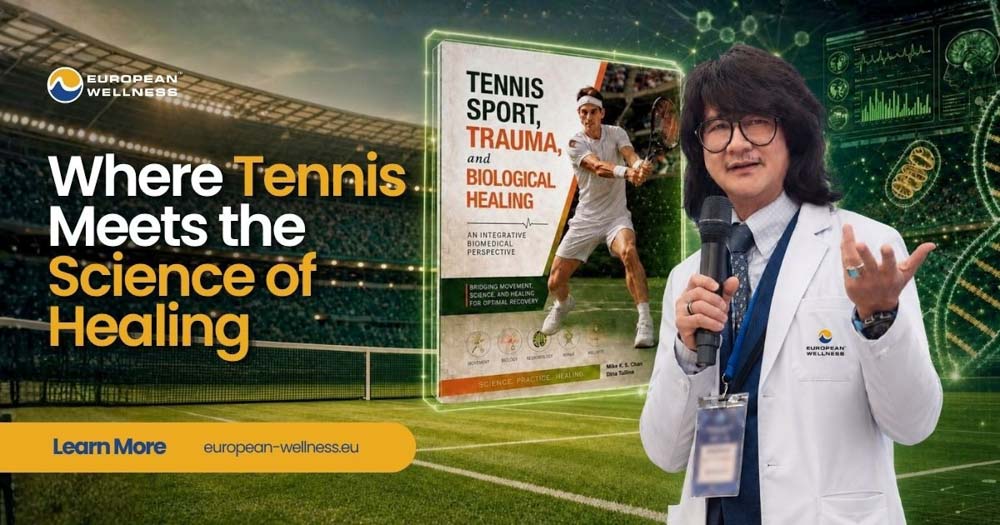
Tennis Sport, Trauma, and Biological Healing: An Integrative Biomedical Perspective is an ambitious attempt to answer a practical question that concerns every tennis player, from the weekend enthusiast to the touring professional: how can an injured body return to the court safely, and how can it stay there for the long term? Written as a bridge between sports medicine, biomechanics, cellular biology and physiotherapy, the book argues that recovery is not a single treatment. It is a carefully staged process in which diagnosis, movement, biology, psychology and prevention must work together.
The study is important because tennis injuries are often misunderstood. A painful shoulder may not be only a shoulder problem; it may reflect weakness in the shoulder blade, limited movement in the upper back, poor hip control or an excessive training load. A sore elbow may not be solved by resting for a few days if the player returns to the same grip, string tension, technique and workload that created the problem. The book’s central contribution is therefore its insistence on looking at the whole player rather than treating one painful spot in isolation.
Why Tennis Injuries Need More Than a Quick Fix
Tennis combines explosive serving, sudden stops, rapid changes of direction, repeated rotation and long periods of intermittent effort. That combination produces two broad types of trouble. An acute injury happens in a recognisable moment, such as an ankle rolling while a player reaches for a wide ball. An overuse injury grows quietly through repeated stress, such as the gradual development of tennis elbow or rotator-cuff pain.
This book brings these patterns into one framework. It discusses how the serve loads the shoulder, elbow, spine and abdominal wall; how court movement challenges the ankle, knee and hip; and how fatigue can turn a technically sound movement into a risky one. It also explains that previous injury is not just a historical footnote. It can change movement, strength and confidence, making a second injury more likely if the underlying problem is never corrected.
For a lay reader, the message can be expressed simply: the body adapts to the demands placed on it, but it also keeps a record of demands that exceed its capacity. Imagine a recreational player who increases from one social session a week to five intense sessions before a tournament. The player may feel fit, but the tendons and joints may not have had time to adapt. The problem is not necessarily one bad stroke. It may be a mismatch between the body’s current capacity and the total amount of work being asked of it.
“The goal is not simply to remove pain; it is to restore the player’s capacity to move, load, think and compete safely.”—Prof. Mike Chan, concise paraphrase of the book’s central argument
One of the book’s most useful ideas is that pain relief and healing are not identical. A player may feel better before a tendon, ligament or muscle has regained its full strength. Conversely, a player may experience some discomfort while a properly controlled rehabilitation programme is rebuilding capacity. That is why the book gives such importance to clinical assessment, functional testing and communication between the player, coach and medical team.
The study also deserves credit for its caution. It covers platelet-rich plasma, progenitor stem-cell approaches, peptides, mitochondrial strategies, hyperbaric oxygen and other advanced interventions, but it does not present them as magic solutions. The evidence is described as stronger for some conditions and preliminary for others. The authors repeatedly place these approaches beside, not above, established care such as progressive exercise and sport-specific rehabilitation.
| What the book examines | What it means in everyday language |
|---|---|
| Injury mechanism and risk factors | How the stroke, movement, fatigue, equipment and training load may contribute to injury |
| Imaging and functional testing | Why a scan alone is not enough; the player must also show what they can safely do |
| Tissue healing and regeneration | Why different tissues heal at different speeds and why biology matters |
| Physiotherapy and progressive loading | How the body is gradually rebuilt rather than simply rested |
| Return-to-play decision-making | Why a date on the calendar should not be the only reason to resume competition |
| Long-term prevention | How strength, movement quality, workload and equipment can reduce recurrence |
The Science Becomes Practical on the Court
Prof. Mike Chan’s solution based on this book is best understood as an integrated, biology-aware and criterion-based rehabilitation pathway. It begins with the right diagnosis, continues with controlled loading and targeted exercise, and ends only when the player has demonstrated readiness across physical, functional and psychological domains. Advanced therapies may have a role, but only when matched to the injury, supported by suitable evidence and delivered within a professionally supervised plan.
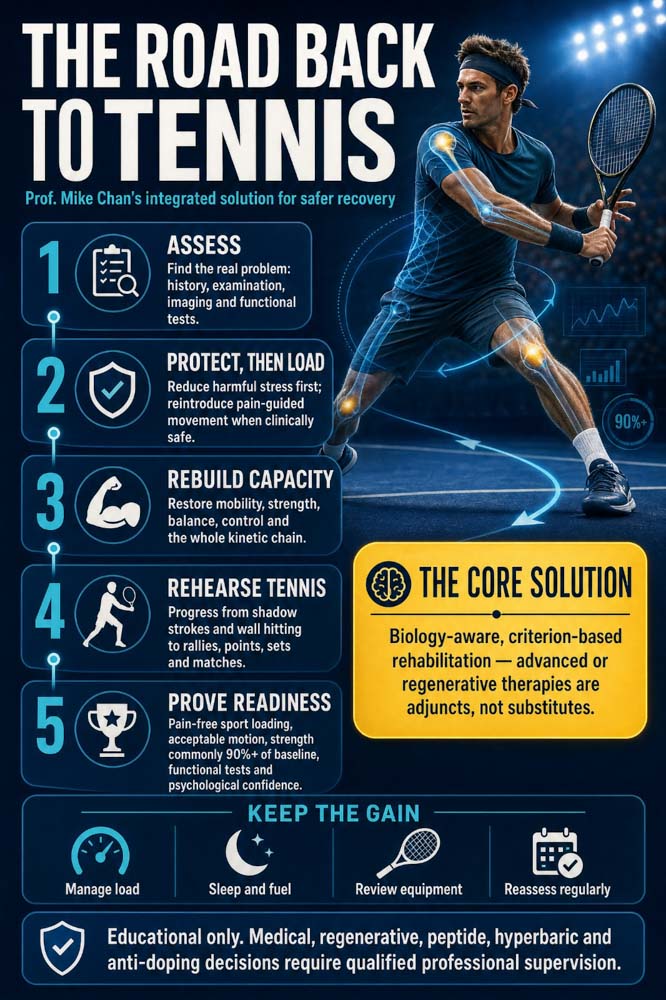
The first practical principle is protection without unnecessary immobilisation. In the earliest stage of an injury, the player should stop the activity that is causing harm and protect the affected area. Compression, elevation, symptom control and carefully selected use of ice may be appropriate for early management. But the book explains the evolution from complete rest toward optimal loading: once it is safe, gentle movement and carefully measured mechanical stress help the tissue maintain function and begin adapting again.
Consider a mild ankle sprain. The old instinct may be to keep the ankle completely still for as long as possible. The book’s more modern approach is to protect it initially, then restore pain-free movement, balance and strength, and finally reintroduce the side-to-side movements that make tennis different from ordinary walking. The player does not return because a certain number of days has passed. The player returns because the ankle can tolerate the demands of the sport.
The same logic applies to tennis elbow. Rest can calm symptoms, but the long-term answer usually requires progressive strengthening of the wrist and forearm, attention to the shoulder and trunk, and a review of technique and equipment. Grip size and string tension may matter. If a player repeatedly overloads the same tendon, a short period away from the court may only pause the cycle rather than end it.
The book divides rehabilitation into overlapping stages. The acute phase protects the injury and preserves safe movement. The early recovery phase restores range of motion and begins gentle strengthening. The intermediate phase rebuilds strength, balance and control, including eccentric or heavy-slow resistance work when appropriate. The advanced phase restores power, conditioning and tennis-specific movement. The return-to-play phase introduces live tennis gradually, moving from shadow strokes and wall hitting to partner-fed balls, controlled rallies, points, sets and matches.
This is where the book becomes especially useful for players and coaches. It translates complex biology into a sequence that can be observed. A shoulder rehabilitation plan, for example, may begin with scapular control and rotator-cuff strengthening, then progress to controlled stroke production and finally to a staged return to serving. A knee or ankle plan may add single-leg balance, landing mechanics, change-of-direction drills and court coverage. A lower-back plan may address core control, hip mobility and the rotational demands of the serve.
“Regenerative medicine is most useful when it works with rehabilitation, not when it is asked to replace it.”—Prof. Mike Chan, concise paraphrase of the book’s central argument
The discussion of regeneration is one of the book’s most forward-looking features. Platelet-rich plasma is presented as a possible option in selected tendon and joint conditions, with relatively stronger evidence in some cases of lateral epicondylopathy and patellar tendinopathy, while results vary according to preparation and diagnosis. Progenitor stem-cell therapies, exosomes, nano-organo peptides and mitochondrial interventions are treated as developing areas whose promise must be weighed against human evidence, safety, cost, regulation and product quality.
For a professional player, there is an additional issue: anti-doping rules. The book warns that some peptide or growth-factor-related products may be prohibited, and that players and their medical teams must verify the current status of any intervention before use. A treatment marketed as natural or regenerative is not automatically legal, effective or safe.
The same caution applies to advanced physiotherapy. Hyperbaric oxygen therapy and other modalities may have a biological rationale or a role in selected cases, but the book’s recurring recommendation is that they should support a foundational programme of exercise, loading and functional restoration. In plain language, a sophisticated treatment cannot compensate for a rehabilitation plan that never rebuilds the movements required on court.
A Recovery Plan Built for the Long Game
The most important recommendation in the book is its move from time-based recovery to criteria-based recovery. A player should not return simply because the calendar says six weeks have passed, nor should a famous athlete be rushed back because an important match is approaching. The decision should consider pain during rest and sport-specific activity, range of motion, strength, dynamic balance, agility, tennis-specific endurance, stroke quality and psychological confidence.
The book commonly uses a strength target of at least 90 percent of the opposite side or the player’s pre-injury baseline, alongside functional tests such as hop testing, the Y-Balance Test, change-of-direction drills and tennis-specific endurance assessments. These numbers are not a universal permission slip; they are examples of the objective information a qualified team may use in context. The player must also tolerate a graded increase in tennis load without symptoms returning.
“A return date is not a recovery plan; readiness must be demonstrated.”—Prof. Mike Chan, concise paraphrase of the book’s central argument
The book is also commendably broad about recovery. Sleep, hydration, adequate energy intake, protein, psychological support and sensible workload management are not presented as optional extras. They are part of the environment in which tissue heals. The study notes that injured players may experience fear of reinjury, anxiety, loss of confidence or a threat to their athletic identity. A player who is physically capable but afraid to commit to a movement may still need graded exposure and psychological support before full competition.
Its prevention message is equally practical. After returning to play, athletes should maintain the strength and mobility that were rebuilt during rehabilitation. Coaches and players should monitor sudden increases in training or match load, review movement quality periodically and address recurrent weaknesses before they become injuries. Equipment matters too: racquet characteristics, grip size, string tension, footwear and court surface may all influence loading.
The book’s solution can therefore be summarised in one sentence: restore the whole player, prove readiness step by step, and keep managing the factors that caused the injury in the first place. That is a more demanding answer than taking a pill or receiving an injection, but it is also a more durable one.
As a commentary, the book’s main limitation is that its scope is so broad that established practices and emerging theories sometimes sit close together. Readers should distinguish carefully between treatments with substantial clinical support and interventions that remain investigational or unevenly regulated. The authors’ educational disclaimer is important: the book is not a substitute for medical diagnosis or personalised treatment, and the right choice depends on the individual player.
For the general reader, however, this breadth is also the book’s strength. It teaches that an injury is not merely a damaged part; it is an interaction between tissue biology, technique, training load, equipment, recovery habits, confidence and the realities of competition. Prof. Mike Chan’s most valuable message is not that modern medicine can make athletes invulnerable. It is that better understanding can help players make better decisions, recover with greater patience and remain in the sport for more of their lives.
BUY OUR BOOK HERE:
Follow European Wellness:



Follow European Wellness Academy:
Follow Prof. Dato’ Sri Dr. Mike Chan:

Related Posts