
Immerse yourself in a glamorous landscape of emerging trends and lucrative opportunities at Cosmoprof Asia…
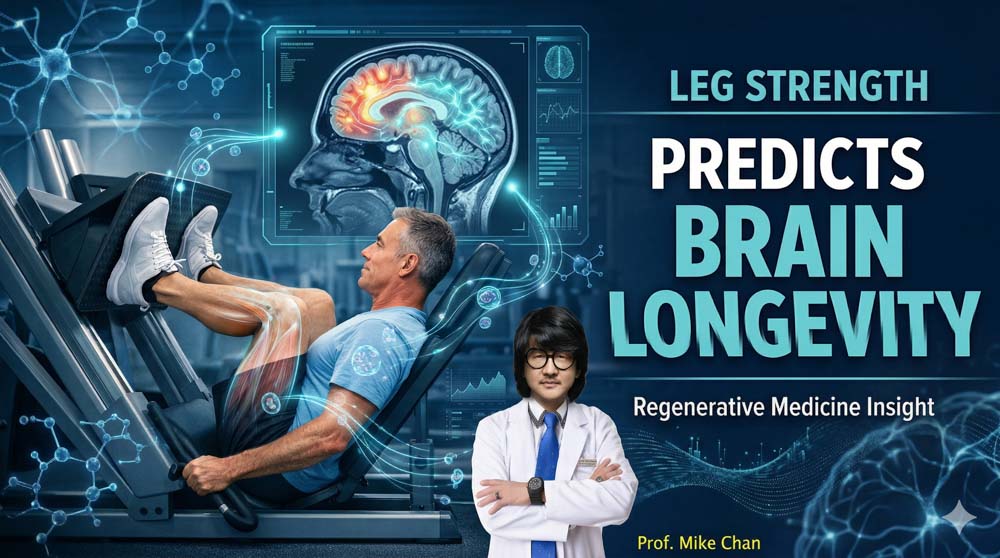
LEG STRENGTH Emerges as Powerful Predictor of Brain Longevity, Reinforcing Regenerative Medicine Insights
New research linking lower-body strength to cognitive resilience aligns closely with Prof. Mike Chan’s regenerative medicine framework, which positions muscle preservation as a cornerstone of brain health and longevity.
Sources:
Journal of Gerontology. (2022). Leg strength as a predictor of brain volume and cognitive health.
Frontiers in Aging Neuroscience. (2021). Lower body strength and long-term cognitive function.
https://pubmed.ncbi.nlm.nih.gov/26551663/
https://pmc.ncbi.nlm.nih.gov/articles/PMC4789972/
https://pubmed.ncbi.nlm.nih.gov/30272098/
NEW YORK, United States (April 7, 2026)—Growing scientific evidence suggests that leg strength in midlife may be one of the strongest predictors of long-term brain health, with implications that extend far beyond physical fitness. Longitudinal studies indicate that individuals with greater lower-body power retain more brain volume and cognitive function over time, independent of genetic and lifestyle factors.
These findings are strongly echoed in the work of Prof. Mike K.S. Chan, a pioneer in regenerative medicine, who has long emphasized the systemic link between skeletal muscle preservation and neurological longevity.
The emerging paradigm reframes skeletal muscle—particularly in the legs—as a dynamic endocrine and metabolic organ that directly influences brain ageing. Rather than viewing muscle as merely structural, researchers now recognize its role in regulating inflammation, vascular health, and neurochemical signaling.
Prof. Chan’s research reinforces this concept, highlighting that muscle health is inseparable from brain health. “Physical strength is not isolated to mobility,” he notes. “It reflects the vitality of circulation, metabolism, and cellular regeneration—systems that directly sustain the brain.”
Research Approach and Modality
A landmark twin study published in Gerontology demonstrated that leg power predicts cognitive aging over a 10-year period, even after controlling for shared genetics and environmental factors. Participants with stronger legs showed better memory retention and more preserved brain structure.
Complementing this, Prof. Mike Chan’s publications detail the biological mechanisms underlying this connection. He confirms that physical activity—especially resistance training—enhances cognitive performance both immediately and over time by stimulating neurotrophic pathways.
“Exercise increases brain-derived neurotrophic factor (BDNF) and fibroblast growth factors in the hippocampus,” Prof. Chan explains. “This leads to increased astrocyte density, improved structural plasticity, and the neurogenesis necessary for learning and memory.”
Prof. Chan emphasizes the urgency of maintaining muscle mass as part of a broader anti-ageing strategy:
“We all age at a rapid speed, and by the time we are 60 we are probably left with only 5% stem cells in our bodies. This explains why immunity drops disproportionately and the risk of mortality rises. Remember, all the 400+ cell types in our body have their own lifespan and regeneration timelines.”
Key Points
- Leg strength is a biomarker of brain ageing
Stronger lower-body muscles correlate with preserved cognition and brain volume, making leg power a practical predictor of neurological health. - Muscle activity drives neuroplasticity
Exercise stimulates BDNF and growth factors, enhancing brain repair, connectivity, and memory formation. - Sarcopenia accelerates cognitive decline
Loss of skeletal muscle mass contributes to systemic ageing, inflammation, and reduced neuroprotection.
“Resistance training is not optional in aging—it is essential. It preserves muscle recruitment, metabolic stability, and functional independence, all of which are directly linked to cognitive resilience,” Prof. Mike Chan adds.
Significance of the Findings
The implications are profound: maintaining leg strength may be one of the most accessible and actionable strategies for protecting brain health. As populations age globally, interventions that simultaneously target mobility and cognition could redefine preventive medicine.
Prof. Mike Chan’s work extends this further by framing aging as a systemic cellular decline. “The hallmark of aging is the loss of cellular resilience,” he notes, emphasizing that deterioration in muscle accelerates decline in other organs, including the brain.
Muscle–Brain Axis Restoration
The highlights of age-related cognitive decline and physical frailty are interconnected components of geriatric syndrome, requiring integrated intervention. Recommended approaches include targeted precursor stem cells for the brain, skeletal muscle, mesenchyme, heart, and endocrine systems, reflecting a whole-body regenerative strategy.
Additionally, neurodegenerative protocols target specific brain regions such as the cortex, frontal lobe, and cerebellum—areas responsible for memory, decision-making, and motor coordination—underscoring the link between movement and cognition.
Prof. Chan’s regenerative framework introduces several advanced interventions:
Mito Organelles (MO) Therapy for Skeletal Muscle
Aging muscles suffer mitochondrial dysfunction, leading to reduced energy (ATP), increased oxidative stress, and slower recovery.
“Muscle fatigue and weakness are not just mechanical—they are mitochondrial,” Prof. Chan explains.
Targeted MO therapy:
- Boosts ATP production for energy-demanding muscle cells
- Promotes regeneration of damaged muscle fibers
- Reduces reactive oxygen species (ROS), limiting cellular damage
By restoring mitochondrial efficiency in leg muscles, patients sustain the physical activity needed to trigger brain-protective neurotrophic signaling.
Integrated DDRR Protocol (Diagnose, Detox, Repair, Rejuvenate)
Prof. Chan’s signature four-step approach addresses systemic ageing:
- Diagnose: Identify cellular and organ-specific decline
- Detox: Eliminate oxidative stress and toxins
- Repair: Use targeted precursor stem cells
- Rejuvenate: Restore function across organs
A tailored protocol for muscle and brain preservation may include:
- Peripheral myoblast implantation for skeletal muscle regeneration
- Neural precursor cells targeting the hippocampus and frontal lobe
- Biohormonal optimization to restore anabolic balance
“Contemporary medicine focuses on disease eradication. Regenerative medicine focuses on repair, reversal, and regeneration of cells. That is the future of longevity.”
“The brain does not age alone. It ages with the muscle, the heart, the endocrine system, and the immune system. When we preserve skeletal muscle—especially the legs—we are preserving one of the most powerful drivers of brain longevity,” Prof. Chan concludes.
Reference List:
Proactive Ageing: Comprehensive Strategies for Muscle Preservation & Sarcopenia Resistance in Bioregenerative Medicine by Prof. Dr. Mike K.S. Chan & Dr. Simon Yefimov. https://european-wellness.eu/product/proactive-ageing/
Provides comprehensive protocols for maintaining muscle mass and leg strength during aging, combining exercise, nutrition, hormones, and cell-based therapies to directly counteract sarcopenia.
Enhancing Memory: Integrative Approaches with Innovative Solutions to BrainSpan in Longevity & Regenerative Medicine by Prof. Dr. Mike K.S. Chan & Dr. Dina Tulina. https://european-wellness.eu/product/enhancing-memory-integrative-approaches-with-innovative-solutions/
Presents cognitive-enhancement strategies, including how systemic health, physical activity, targeted CNS peptides, and lifestyle modifications improve memory and prevent cognitive decline.
Stem Cells in Regenerative Medicine: Carpe Diem – Carpe Vitam! by Prof. Dr. Mike K.S. Chan & Prof. Dr. Dmitry Klokol. https://european-wellness.eu/product/stem-cells-in-regenerative-medicine-carpe-diem-carpe-vitam
The definitive textbook explaining the science of targeted precursor stem cells, including their use in repairing skeletal muscle injury and combating untreatable neurodegenerative disorders.
A Comprehensive Guide to Biological Medicine and Wellness by Prof. Dr. Mike K.S. Chan & Prof. Dr. Dmitry Klokol. https://european-wellness.eu/product/a-comprehensive-guide-to-biological-medicine-and-wellness
Outlines the holistic DDRR (Diagnose, Detox, Repair, Rejuvenate) protocols necessary to optimize the body’s internal environment so that the muscular and nervous systems can effectively regenerate.
Follow European Wellness:



Follow European Wellness Academy:
Follow Prof. Dato’ Sri Dr. Mike Chan:

Related Posts