After more than a decade of digestive health concerns, Vinay Kapoor is looking for more…
Beyond a Single Treatment: Vinay Kapoor’s Personalised Wellness Journey
After more than a decade of digestive health concerns, Vinay Kapoor is looking for more than another isolated intervention. He wants an approach that connects his medical history with his present condition, explains the purpose of each treatment, and continues beyond his time at the clinic.
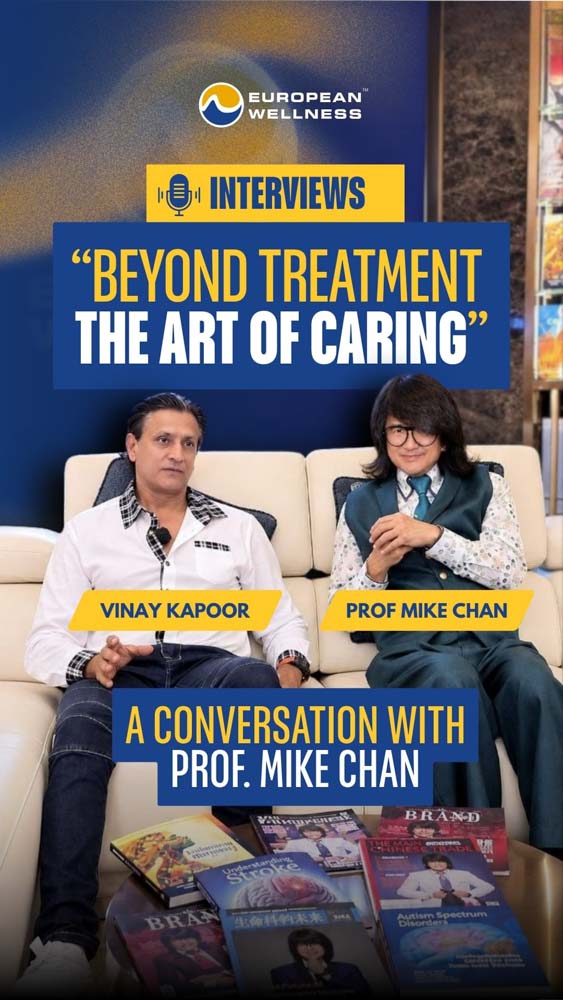
In an interview featuring Kapoor and Prof. Dato Sri Dr. Mike Chan, that search becomes the central story. Kapoor describes his experience at European Wellness, from diagnostic assessments and a personalised treatment programme to the reassurance he felt from the team. Prof. Mike Chan explains the thinking behind the centre’s DDRR framework, while Kapoor considers how his own experience could help communicate the organisation’s work to a wider audience.
His account is therefore not a completed recovery story. It is a portrait of a patient who feels encouraged by the care he has received, reports an early improvement in a separate shoulder complaint, and recognises that his longer-term health outcomes still need time and follow-up.
Starting With Diagnosis, Not Assumptions
Kapoor’s explanation of the programme begins before his arrival. He says he submitted blood, stool and urine results from the preceding two to three years, allowing the team to review his health history in advance. He also completed a medical questionnaire.
Once at the centre, he underwent further assessments. In his account, these covered organs and musculoskeletal health, helping the team identify the areas they intended to address. He mentions gut health and prostate-related concerns among the priorities discussed.
For Kapoor, this sequence matters because it gives treatment a defined starting point. Rather than choosing an intervention first and looking for a reason to use it, he values understanding what the team is trying to address.
Prof. Mike Chan explains that earlier medical reports do not remove the need for fresh assessments. Describing some of the additional checks, he says:
“We go and check the heavy metals, we check the gut health.”
He presents these checks, alongside assessments of particular organs, as part of the centre’s approach to building an individual treatment plan.
The interview does not include the underlying test results or detailed diagnostic findings. What it does show is the importance Kapoor places on having his history reviewed and receiving a programme presented as specific to his needs.
DDRR: A Structured Approach to Care
The framework organising the discussion is DDRR: diagnose, detox, repair and rejuvenate. Prof. Mike Chan also uses the term “regeneration” when describing its final stage.
He presents the sequence as a philosophy he has developed over decades. In his view, assessment should come first, followed by measures intended to address unwanted substances or other problems, then repair and finally regenerative treatment. His central argument is that a treatment should not be considered separately from the condition of the wider body.
Emphasising the stages he believes should precede regeneration, Prof. Mike Chan says:
“Diagnose, detox, repair. We have to do repair.”
Kapoor describes sauna sessions and a hyperbaric chamber among the activities he associates with the programme’s detox stage. He then recounts receiving treatment described in the interview as stem-cell therapy, which he understood to be targeted to the concerns identified during assessment.
These descriptions explain how the programme was presented and experienced. They do not, on their own, establish that its proposed detox mechanisms or treatment sequence produce the claimed clinical effects. The recording does not specify the cell product, its source, dosage or the evidence supporting each use.
Nevertheless, the structure itself is a significant part of Kapoor’s response. He appears reassured by a programme with a beginning, a sequence and a plan for continued care, rather than a single procedure offered without a broader explanation.
Gut Health and a Decade of Frustration
The personal stakes become clearer later in the interview, when Kapoor describes having digestive problems for approximately ten to twelve years. He reports irritable bowel syndrome, or IBS, and recounts consultations with gastroenterologists, endoscopy, colonoscopy, and the use of prebiotics and probiotics.
His assessment of those experiences is blunt:
“You name it, I’ve done it all.”
He says that nothing had really worked for him. That is his account of his own experience, rather than a conclusion about the effectiveness of those treatments for other patients.
Against this background, Kapoor explains why his conversations with Prof. Mike Chan gave him confidence. He felt persuaded by the explanation of how his gut concerns might be addressed, and by what he had read, heard and observed at the centre.
Prof. Mike Chan, meanwhile, places the gut at the centre of his discussion of biological wellness. “The microbiome is so important,” he says, referring to the community of microorganisms living in the digestive tract. He also describes post-treatment support involving gut health and enzymes. His emphasis is on continuing care rather than treating the clinic visit as the endpoint.
The distinction between confidence and outcome remains essential. Kapoor’s enthusiasm is clear, but he says the appropriate time to assess the results would be two to three months later. His hope for relief should not be confused with evidence that his IBS has already resolved.
Comfort as Part of the Patient Experience
One of the interview’s most concrete comparisons concerns the experience of receiving treatment.
Kapoor recalls a previous procedure in Thailand, approximately eight years earlier, which he describes as extremely painful. That memory shaped his expectations before the current treatment: he arrived anticipating a similarly difficult experience.
Instead, he says the procedure at European Wellness felt much easier. He credits the staff’s communication and the care they took, describing a level of comfort that surprised him.
His praise extends beyond the procedure. He speaks positively about the facility’s appearance, technology, hygiene, quality control and the attention he received from the team and Prof. Mike Chan personally. These are Kapoor’s impressions, not an independent inspection of the centre, but they explain an important part of his satisfaction.
The exchange highlights a dimension of care that can be overshadowed by discussion of medical technology. For this patient, how staff spoke to him and how comfortable he felt were central to the experience. That comfort is meaningful in its own right, even though it cannot establish a treatment’s safety or long-term effectiveness.
A Shoulder Complaint and an Early Reported Change
Near the end of the conversation, Kapoor introduces a separate concern: a shoulder injury that had been troubling him for six to eight weeks. He says previous therapy and peptides had not brought the improvement he wanted.
According to his account, an ultrasound examination at the centre identified an injury involving a ligament or tendon. He then received an injection after the treatment he describes as stem-cell therapy. The interview does not identify the contents of that additional injection.
Kapoor says a repeat ultrasound the following morning appeared to show a significant improvement. He also reports feeling a difference in the shoulder.
For him, this was an encouraging early sign. For an article based on the recording, however, it remains a reported observation. The interview does not supply the ultrasound images, a clinician’s imaging report, measurements of function or later follow-up. It therefore cannot confirm tissue regeneration within a day or establish which intervention caused the change.
Preserving that distinction does not require dismissing Kapoor’s experience. It means describing what he says he felt and saw without turning his interpretation into a verified clinical finding.
Follow-Up Is Part of the Story
Kapoor’s account repeatedly looks beyond the immediate visit. He describes plans for supplements and peptides over the following three months, followed by repeat blood-marker testing and further discussion with Prof. Mike Chan.
That expectation of continued support is one of the interview’s defining themes. Kapoor does not present the clinic stay as the end of his health journey. He sees it as the beginning of a programme whose results should become clearer over time.
Prof. Mike Chan also describes a role for the team after the initial treatment:
“The post-treatment is where we come in and then we will be giving Vinay something for his gut health.”
Blood-marker follow-up could provide additional information, but the interview does not identify the markers or define what would count as success. For his gut concerns, the questions still include whether symptoms improve and whether any benefit lasts. For his shoulder, sustained comfort and function would matter alongside clinical assessment.
This need to distinguish expectations from demonstrated outcomes is consistent with the International Society for Stem Cell Research’s emphasis on rigorous testing and evaluation of safety and effectiveness before stem-cell treatments are approved for use.
The most credible reading of the interview is therefore neither a declaration of success nor a dismissal of his optimism. It is an account of strong satisfaction with care, coupled with health outcomes that remain to be established.
From Personal Experience to Wider Advocacy
Kapoor also sees a potential role for himself beyond being a patient. He says he wants to become a strong supporter of Prof. Mike Chan and European Wellness, helping the organisation communicate its work internationally.
His argument is that his friends and family are interested in wellness and longevity, and will pay attention to his experience. He believes a positive outcome could make his account persuasive within that network.
He is also direct about what he considers a weakness: public relations and marketing. In his view, the organisation could do more to explain and package its work for a wider audience. He expresses a desire to help with that effort, while framing wider visibility as a way for more people to encounter the programme.
This gives the interview a dual character. Kapoor is describing care he has personally received, but he is also discussing prospective advocacy for the provider. His endorsement is useful for understanding his confidence and satisfaction; it should not be treated as independent evidence of clinical effectiveness.
Ultimately, the conversation is most compelling when it stays close to those human details: a long history of unresolved symptoms, the reassurance of a structured assessment, an unexpectedly comfortable treatment experience, and a patient willing to return and examine the results.
Kapoor’s own words provide the clearest ending:
“We’re beginning the journey.”
The next chapter will depend not simply on enthusiasm, but on what follow-up shows about his health over the months ahead.
Follow European Wellness:



Follow European Wellness Academy:
Follow Prof. Dato’ Sri Dr. Mike Chan:

Related Posts