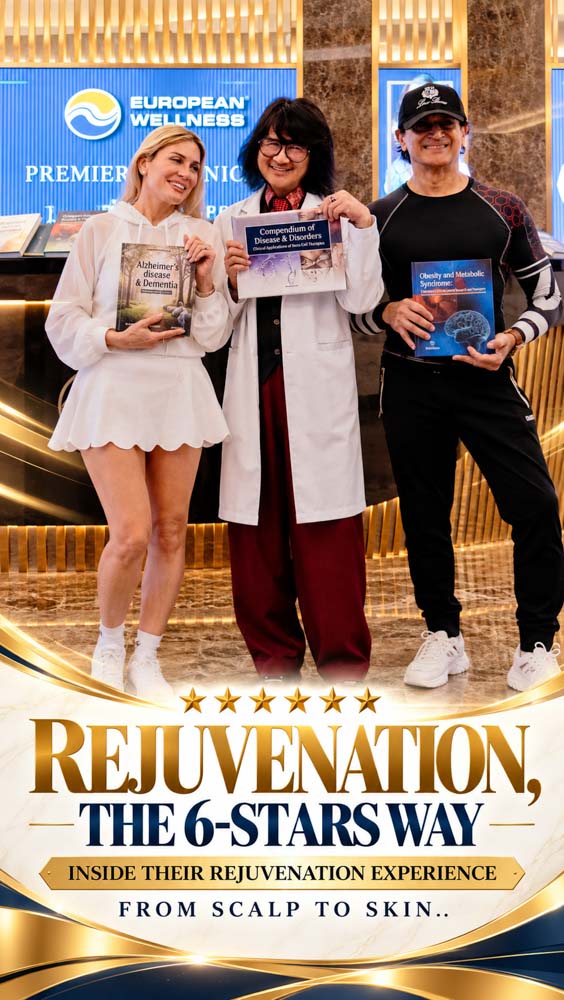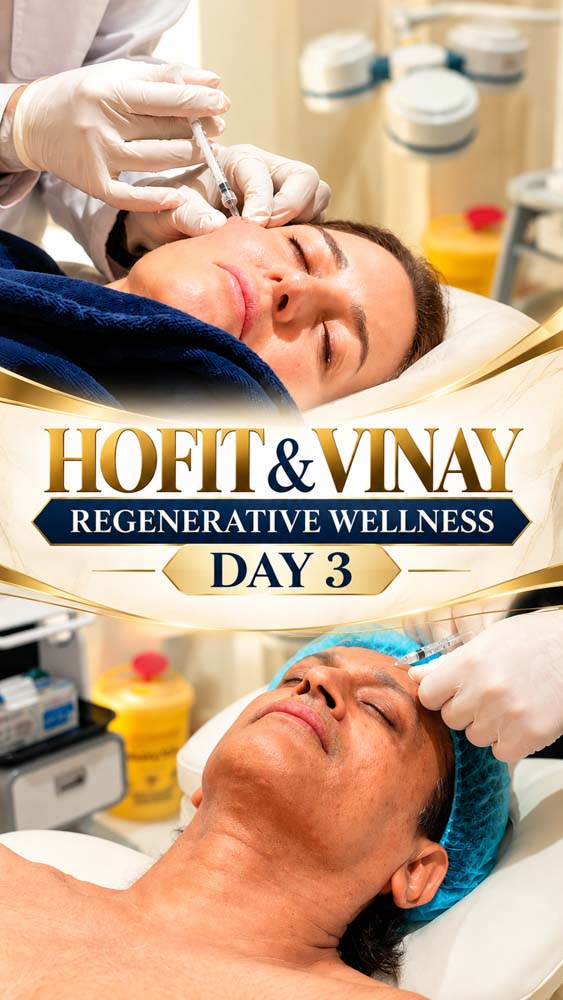
Immerse yourself in a glamorous landscape of emerging trends and lucrative opportunities at Cosmoprof Asia…
NANOPARTICLES BREAKTHROUGH Validates Prof. Mike Chan’s Bio-Regenerative Research
Nano-peptide principles behind today’s Alzheimer’s mouse studies were identified by Prof. Dato’ Sri Dr. Mike Chan more than 20 years ago.
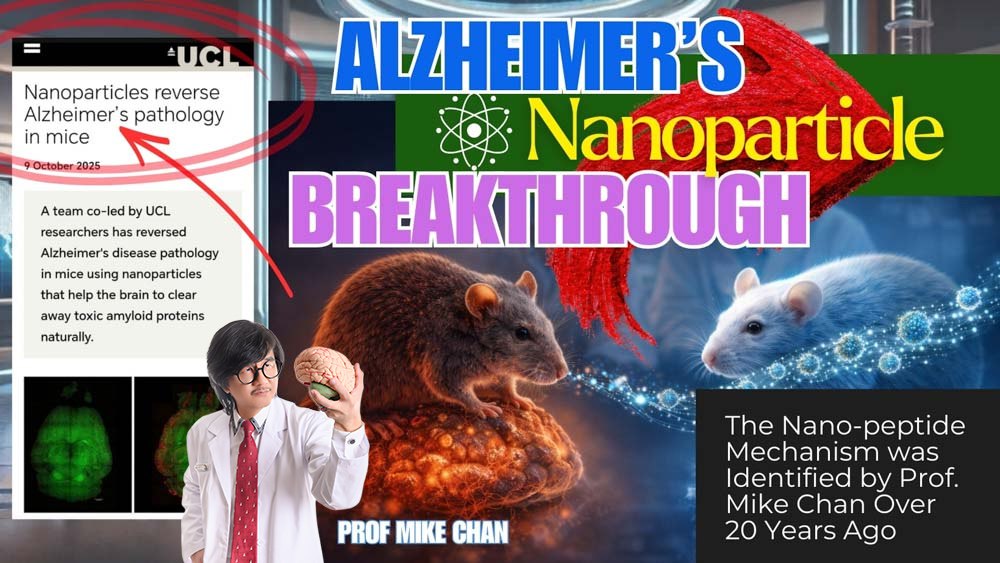
Article Source: https://www.ucl.ac.uk/news/2025/oct/nanoparticles-reverse-alzheimers-pathology-mice
LONDON, (Dec 26, 2025) — A bold experiment by scientists at University College London (UCL) has reignited one of the most consequential debates in modern neuroscience: should Alzheimer’s disease be treated by suppressing symptoms, or by restoring the brain’s ability to clean and repair itself?
In laboratory mouse models, UCL researchers reported that a single injection of engineered nanoparticles reduced toxic amyloid-beta proteins in the brain by up to 60 percent within one hour, reversing memory impairment and pathological brain changes.
The findings, published in Signal Transduction and Targeted Therapy, suggest a radically different therapeutic logic, one that prioritizes biological clearance and vascular repair over direct neuronal attack.
For Prof. Dato’ Sri Dr. Mike Chan, a veteran regenerative medicine scientist and founder of European Wellness Biomedical Group, the results are both encouraging and familiar.
“This is a powerful proof of concept,” Prof. Chan said, “But the principle itself is not new. If you do not clear the biological blockage first, regeneration cannot begin. Healing only starts when the environment is corrected.”
Repairing the System, Not Just the Neuron
Unlike decades of Alzheimer’s drug development that focused narrowly on destroying amyloid plaques, the UCL study took a systemic approach. The nanoparticles did not attack neurons directly. Instead, they repaired the blood–brain barrier, restoring the brain’s natural waste-clearance pathways and allowing toxic proteins to be flushed out organically.
That distinction matters, researchers say, because Alzheimer’s is increasingly understood as a multi-system disorder — involving vascular dysfunction, immune dysregulation, chronic inflammation, and impaired cellular communication.
“Alzheimer’s is not simply a disease of neurons,” Prof. Chan explained. “It is a failure of clearance, circulation, immune signaling, and cellular coordination. When those systems are repaired, the brain responds. Neurons are not passive victims — they are suppressed by a toxic environment.”
The findings arrive amid mounting frustration over pharmaceutical setbacks. Despite billions invested, most amyloid-targeting drugs have delivered modest benefits at best, often accompanied by safety concerns.
The UCL work suggests that repairing biological infrastructure may be more important than attacking debris.
From Mice to Human Medicine
UCL researchers caution that the study remains pre-clinical. Human trials are still years away, and long-term safety must be established. However, Prof. Chan argues the conceptual leap has already been crossed in clinical regenerative medicine.
“What is being demonstrated now in mice,” he said, “we have been applying clinically in humans for over 20 years — using biological nano-agents rather than synthetic ones.”
With nearly four decades of experience in bio-regenerative science, Prof. Chan traces his protocols to early European research in organ-specific regeneration, refined through German and Swiss biomedical programs and translated into clinical applications across Asia and Europe.
“The difference is not scale,” he said. “It is logic. Biology heals biology. You restore the environment first, then cells recover.”
Precision Over Generalization
One of Prof. Chan’s most consistent critiques of failed neurological trials is anatomical imprecision.
“You cannot treat the brain as one structure,” he said. “It contains more than fifty functional regions and dozens of specialized cell populations. Each disease affects different areas.”
In Alzheimer’s disease, Prof. Mike Chan noted, degeneration is concentrated in the hippocampus, the brain’s memory center. Parkinson’s disease targets the substantia nigra, while hormonal and sleep-related neurological disorders often involve the pituitary gland.
“This is why so many trials fail,” he said. “They are biologically vague. You cannot deliver a general therapy and expect a precise outcome.”
This philosophy underpins Prof. Chan’s work on the Human Cytology Atlas, a comprehensive mapping of more than 400 human cell types that supports organ-specific regenerative protocols.
Biological Nano-Tools: Peptides, Exosomes, Precursor Cells
While the UCL team used engineered nanoparticles, Prof. Chan’s clinical work relies on biological nano-scale agents — including signaling peptides, exosomes, mitochondrial organelles, and organ-specific precursor stem cells. “These are not foreign materials,” he said. “They are biological messengers. They speak the language of the cell.”
In publications such as Stem Cells & Regenerative Medicine: High-Efficacy Treatment Protocols and The Dawn of New Medicine – Stem Cell Therapy: Old Dogma, New Hope, Prof. Chan describes how nano-peptides and exosomes regulate inflammation, immune balance, and cellular repair, while precursor stem cells initiate regeneration at the nuclear level.
“General stem cells knock on the door,” he said. “Precursor cells enter the nucleus and restart the program.” That distinction, he argues, is critical in neurodegenerative disease, where restoring function requires genetic reactivation and metabolic reset, not merely the presence of new cells.
Why Delivery Matters
Prof. Chan is also critical of conventional intravenous stem-cell delivery.
“Most IV-delivered cells never reach the brain,” he said. “They are trapped in the lungs — the pulmonary trap. That is well documented.”
His protocols instead favor strategic deep intramuscular delivery, allowing biological agents to migrate or “home” to damaged brain regions through natural signaling pathways.
“Delivery determines destiny,” he said. “If the therapy does not arrive, it cannot work.”
For Prof. Chan, the UCL findings represent validation. “This is not about who discovered what first,” he said. “It is about biology being understood correctly. Mainstream science is now confirming what regenerative medicine has long observed in practice.”
The study also reinforces his emphasis on early intervention.
“The brain is not fragile, it is suppressed. Once neurons are completely lost, regeneration becomes far more difficult,” he said. “But when toxicity and inflammation are removed early, the brain shows remarkable resilience.”
A Turning Point in Alzheimer’s Thinking
UCL scientists stress caution. Human translation remains uncertain. Prof. Chan agrees, but sees a clear trajectory. “This is not a cure tomorrow,” he said. “But it proves Alzheimer’s is not biologically irreversible.”
As global Alzheimer’s cases rise, projected to triple by mid-century and pharmaceutical pipelines continue to struggle, the nanoparticle study may mark a turning point in how the disease is conceptualized.
“The future of Alzheimer’s care will not be one magic drug,” Prof. Mike Chan said. “It will be intelligent sequencing: cleanse the environment, restore signaling, then regenerate.”
That sequencing mirrors the Diagnose, Detox, Repair, Rejuvenate (DDRR) framework long used in regenerative medicine — an approach designed to correct biological dysfunction before attempting repair.
For patients and families confronting a disease long considered unstoppable, that shift offers something rare: credible, cautious hope. “The brain wants to heal,” Prof. Chan said. “We just have to stop poisoning it.”
Key Publication Sources:
Prof. Mike Chan’s regenerative medicine framework draws on decades of published research and international scientific presentations examining organ-specific cellular repair, neuroregeneration, and precision biological signaling.
His work spans peer-recognized publications on stem cell therapy, pathogenetically based integrative treatment strategies, and targeted peptide and exosome applications, alongside keynote addresses delivered at major medical conferences in Asia, Europe, and the Middle East.
Collectively, these contributions focus on mechanism-driven approaches to restoring biological function in complex neurodevelopmental and degenerative disorders.
In conclusion, Prof. Chan’s reaction serves to highlight that while modern research (like the UCL study) is beginning to validate the concept of using nano-particles for brain clearance in mice, his bio-regenerative medicine group claims to have successfully utilized biological nano-peptides and precursor cells to treat the hippocampus and specific brain regions in humans for over 20 years.
Selected Publications, Papers, and Scientific Presentations
Books & Peer-Recognized Publications
- Mike KS Chan, Klokol, D., & Wong, M. Stem Cells & Regenerative Medicine: High-Efficacy Treatment Protocols for Autism Spectrum Disorders.
- Mike KS Chan, The Dawn of New Medicine – Stem Cell Therapy: Old Dogma, New Hope.
- Mike KS Chan, Pathogenetically Based Integrative Therapeutic Strategies in the Management of Autism Spectrum Disorders.
Scientific Conference Presentations
- Mike KS Chan, “Stem Cells, Peptides & Exosomes in Anti-Aging & Aesthetic Medicine.” Aesthetic Medicine & Surgery Conference (AMSC), Hong Kong, December 16, 2024.
- Mike KS Chan, “Targeted Organ-and Brain-Specific Peptides & Exosomes with NAD in Regenerative Medicine.” Middle East Congress for Regenerative Medicine, Dubai, November 1–2, 2024.
Institutional Research & Reference Resources
- Genesis Biomedical Research Institute. Human Cytology Classification and Quantitative Cell Landscape with Numbers, Types and Functional Diversity.
https://www.genesispub.org/human-cytology-classification-and-quantitative-cell-landscape-with-numbers-types-and-functional-diversity - European Wellness. Exploring the Complexity of the Human Brain: Cell Types, Numbers and Lobar Functions.
https://european-wellness.eu/events/our-brain-limitless-potential/
Follow European Wellness:



Follow European Wellness Academy:
Follow Prof. Dato’ Sri Dr. Mike Chan:

Related Posts