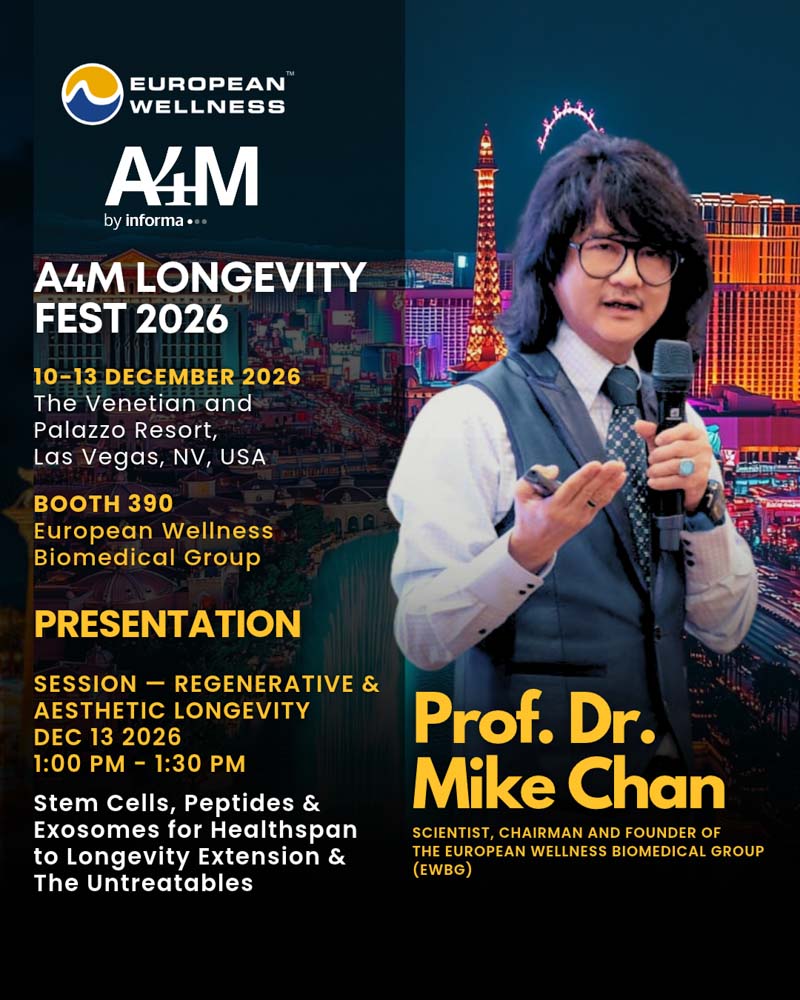
Get ready for a thrilling showcase of innovation and discovery! European Wellness is excited to…
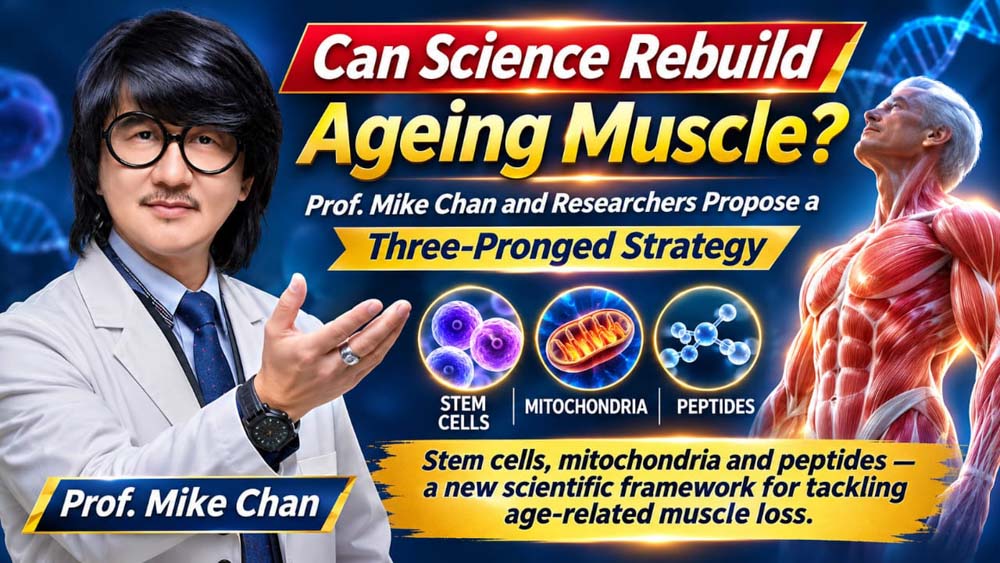
Can Science Rebuild Ageing Muscle? Prof. Mike Chan and Researchers Propose a Three-Pronged Strategy
PARIS (Nov 19, 2026) — A new scientific review outlines a three-pronged regenerative framework for age-related muscle loss, or sarcopenia, while warning that experimental cell and peptide therapies have yet to prove they can restore everyday physical strength in older adults.
Published in the Journal of Stem Cell Research by Mike K.S. Chan and colleagues, the paper examines how aging weakens skeletal muscle not merely through shrinking fibers, but through breakdowns across muscle stem cells, cellular energy powerhouses known as mitochondria, nerve connections, and signaling molecules.
Sarcopenia–marked by declining muscle strength, function, and quality–raises the risk of falls, fractures, loss of independence, and death in aging populations. Today, resistance exercise and protein-rich nutrition remain the main proven treatments, as no regenerative drug or cell therapy is approved to reliably rebuild aged muscle.
“Sarcopenia is not simply a matter of losing muscle bulk–it reflects a breakdown across an interconnected system of stem cells, energy production, nerves, and tissue signals,” said Prof. Mike Chan, co-author of the review.
Beyond Muscle Size to Functional Strength
Researchers increasingly stress that muscle strength and mobility matter more than muscle size alone. Older adults can lose force-generating power faster than muscle mass drops, driven by fat buildup in muscle, scarring, weaker nerve-to-muscle signaling, and sluggish cellular repair.
Boosting muscle size alone does not guarantee better movement, walking speed, or balance if the surrounding tissue environment and nerve links remain impaired.
“Adding muscle mass by itself does not automatically translate into stronger, more resilient movement if the underlying cellular environment and nerve connections are not restored,” said Prof. Chan.
A Three-Part Regenerative Blueprint
The authors propose a “systems-regeneration” framework that pairs three experimental approaches:
- Muscle progenitor cells: Precursor cells aimed at supporting tissue repair and myogenic differentiation, though researchers note their exact role—whether direct tissue building or releasing helpful signals—depends on cell type and viability.
- Mitochondrial therapies: Approaches targeting cellular energy metabolism, ranging from mitochondrial-derived peptides such as MOTS-c and Humanin to experimental Mito Organelle preparations.
- Peptide signaling: Tissue-derived Nano Organo Peptides and defined peptides intended to influence muscle growth, breakdown pathways, and the surrounding tissue niche.
The review also examines the European Wellness platform as one proposed example of combining these three tracks, while stressing a sharp line between biological plausibility and clinical proof.
“Combining cell, mitochondrial, and peptide approaches makes biological sense on paper, but each component and combination still has to earn its evidence step by step,” said Prof. Chan.
High Hurdles Before Clinical Use
Much of the supporting data cited in the review comes from laboratory cell work, animal models, or early-stage studies rather than large clinical trials in older people with sarcopenia. The authors say future research must clearly characterize each product, test combinations against single treatments, and measure real-world physical function–such as gait speed, chair-rise performance, and walking endurance–alongside safety.
For now, the authors emphasize that novel biologics should be viewed only as potential add-ons in future research, not replacements for exercise and nutrition.
“Our goal is durable, functional muscle that helps older people stay strong and independent, and that requires rigorous proof rather than assumptions,” said Prof. Chan.
Reference Sources
- Primary Paper: Chan MKS, Wong MBF, Klokol D, Casazza K, Lakey JRT. Reconstructing Skeletal Muscle in Sarcopenia: A Systems-Regeneration Framework Integrating Myogenic Progenitors, Mitochondrial Therapeutics, and Tissue-Specific Peptide Signaling. Journal of Stem Cell Research, Vol. 8, Issue 2 (JSCR-8(2)-111). https://european-wellness.eu/publications/reconstructing-skeletal-muscle-in-sarcopenia/
- Key Supporting Studies Cited in the Review:
- Yan R, et al. (2025) comparative effectiveness review/network meta-analysis on exercise and protein-based interventions in sarcopenia (J Nutr Health Aging).
- Kumagai H, et al. (2024) and Elhusseiny R, et al. (2026) on mitochondrial-derived peptides (MOTS-c and Humanin) in muscle models (iScience; Physiol Rep).
- Gonzalez Trotter D, et al. (2025) on GDF8 and activin A blockade in a randomized Phase I trial (Nat Commun).
- von Haehling S, et al. (2025) on sarcopenia trial endpoints and regulatory considerations (J Cachexia Sarcopenia Muscle).
Follow European Wellness:



Follow European Wellness Academy:
Follow Prof. Dato’ Sri Dr. Mike Chan:

Related Posts