Immerse yourself in a glamorous landscape of emerging trends and lucrative opportunities at Cosmoprof Asia…
Beyond the Swing: A Deep Dive into Understanding and Healing Golf Injuries
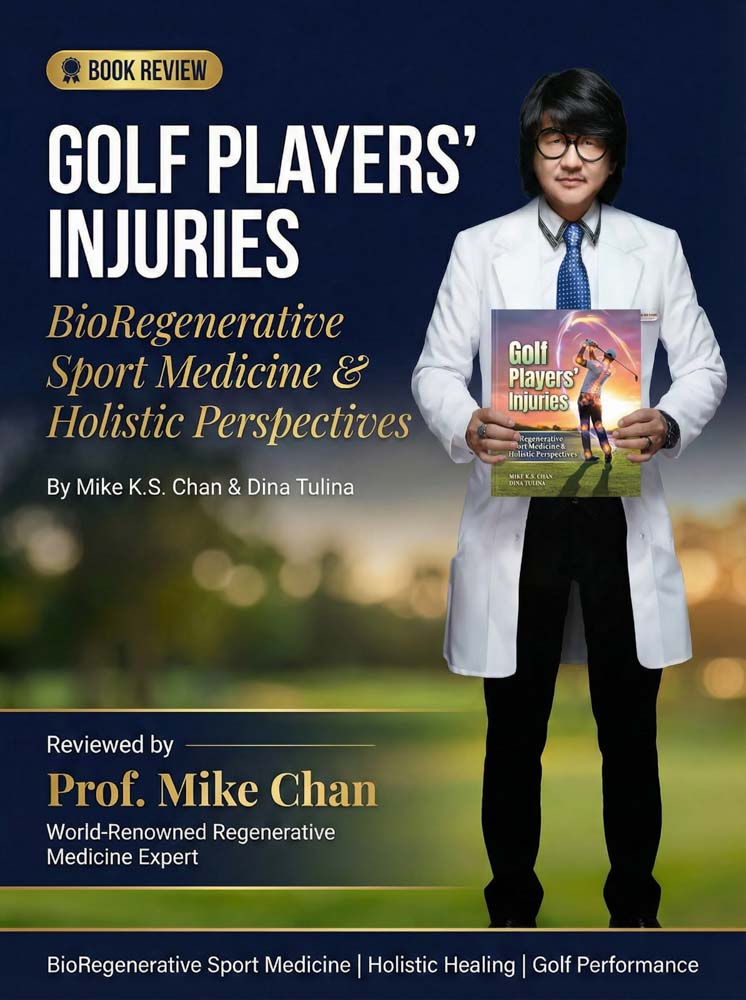
Golf is often perceived as a leisurely, low-impact sport — a relaxing walk across beautifully manicured greens. However, beneath this tranquil surface lies a physically demanding activity that places immense stress on the human body. In the comprehensive book Golf Players’ Injuries: BioRegenerative Sport Medicine & Holistic Perspectives, Prof. Dato Sri Dr. Mike Chan, alongside co-author Dina Tulina, offers a profound exploration into the biomechanics, conventional treatments, and advanced bio-regenerative solutions for golf-related injuries. This study is essential reading for anyone looking to understand the true physical cost of the sport and how modern medicine is evolving to keep players on the course.
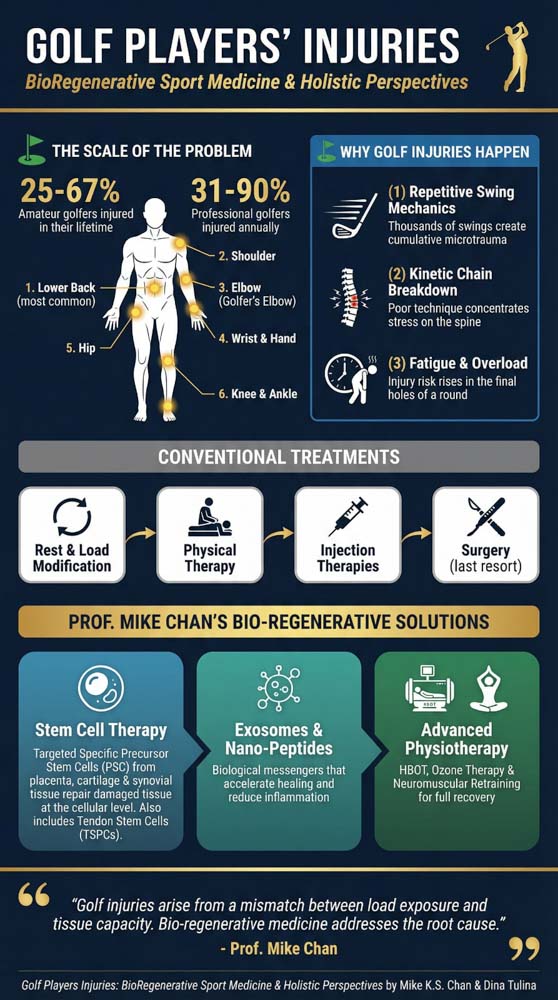
The book opens with a striking set of statistics that immediately challenges the popular notion of golf as a safe sport. Between 25% and 67% of amateur golfers will sustain a golf-related injury during their playing careers. Among professional golfers, who train and compete at far higher intensities, that figure climbs to between 31% and 90% annually. These numbers are not merely academic. They represent millions of players worldwide — from weekend enthusiasts to elite tour professionals — who are sidelined by pain, limited mobility, and prolonged recovery periods. With over 55 million golfers across 206 countries, the global burden of these injuries is enormous.
The Hidden Toll of the Perfect Swing
To the untrained eye, a golf swing appears fluid and effortless. Yet, from a biomechanical standpoint, it is an explosive movement that demands rapid acceleration, complex rotational torque, and substantial energy transfer across the body’s kinetic chain. Prof. Mike Chan emphasizes that the downswing and follow-through phases are particularly demanding. During these fractions of a second, the spine undergoes intense lateral bending and axial rotation simultaneously — a combination that generates enormous compressive and shear forces on the intervertebral discs and facet joints.
For amateur golfers, the risk is even greater. Without the refined technique of professionals, amateurs often compensate for limited hip or shoulder mobility by overusing their lower back. This compensatory movement concentrates mechanical stress on the lumbar spine rather than distributing it across multiple body segments. To put it simply, imagine trying to wring out a thick, wet towel using only your wrists instead of your whole body — the concentrated force would quickly cause strain. The same principle applies to the spine of a golfer with poor technique.
“Golf-related injuries often arise not from isolated weakness but from a mismatch between load exposure and tissue capacity.” — Prof. Mike Chan
This mismatch is a central theme throughout the book. Injuries in golf rarely stem from a single traumatic event. Instead, they are the result of cumulative microtraumas — repetitive stresses that gradually exceed the body’s ability to repair itself. Whether it is golfer’s elbow from repetitive grip strain, shoulder impingement from altered swing mechanics, or knee pain from prolonged walking on uneven terrain, the root cause is consistently a failure to balance physical load with adequate recovery. The book meticulously maps the most common injury sites, with the lower back being the most prevalent, followed by the shoulder, elbow, wrist and hand, hip, and knee and ankle.
Prof. Mike Chan also draws attention to a critical but often overlooked factor: fatigue. As a round of golf progresses and neuromuscular fatigue sets in, movement quality deteriorates. Coordination breaks down, compensatory patterns emerge, and the risk of injury rises sharply. This explains why many golfers report that their pain or discomfort tends to worsen during the final holes of a round rather than at the beginning.
Moving Beyond Traditional Treatments
When injuries occur, the conventional medical response typically involves rest, pain management, and physical therapy. While these methods remain foundational, Prof. Mike Chan is candid about their limitations. Traditional approaches often focus on symptom relief rather than addressing the underlying cellular damage and biomechanical inefficiencies that caused the injury in the first place.
For instance, corticosteroid injections may provide rapid pain relief for an inflamed tendon, allowing a golfer to return to play quickly. However, as the book details, repeated use of such injections can compromise tissue integrity over time, making the tendon more susceptible to future tears. Similarly, manual therapies and bracing are useful for temporary support but do not fundamentally alter the tissue’s long-term resilience. Surgery, while necessary in select cases involving structural failure such as rotator cuff tears or severe ligamentous damage, is rightly positioned as a last resort.
“Rehabilitation does not seek to impose swing changes but may highlight physical constraints that influence movement options.” — Prof. Mike Chan
Prof. Mike Chan advocates for a more dynamic and individualized approach to rehabilitation. Rather than simply resting an injured area, golfers should engage in targeted neuromuscular retraining and endurance-based exercises tailored to the specific demands of the sport. For example, instead of performing isolated bicep curls to strengthen the arm, a golfer recovering from elbow tendinopathy might practice controlled rotational movements on an unstable surface. This challenges the entire kinetic chain — from the feet through the hips, trunk, and into the arms — building the coordinated strength and fatigue resistance needed to sustain proper mechanics throughout a full round.
The book also highlights the importance of motor learning principles in rehabilitation. Exercises should not simply be repeated mechanically but should be varied and task-oriented, promoting adaptable movement strategies rather than rigid patterns. This approach builds a more robust and resilient athlete, one who can maintain efficient movement even under the physical and cognitive demands of competitive play.
| Conventional Approach | Limitations | Prof. Mike Chan’s Recommendation |
| Rest & Activity Modification | Addresses symptoms, not root cause | Graded loading and return-to-play protocols |
| Corticosteroid Injections | May weaken tissue with repeated use | Reserve for acute flare-ups; combine with rehab |
| Manual Therapy & Bracing | Temporary relief; may foster dependency | Use as enabler, not primary treatment |
| Standard Physical Therapy | May lack sport-specific context | Neuromuscular retraining with golf-specific tasks |
| Surgery | Invasive; reserved for structural failure | Last resort after comprehensive conservative care |
The BioRegenerative Path to Lasting Recovery
The most compelling and forward-looking aspect of this study is its deep dive into bio-regenerative sports medicine. Prof. Mike Chan introduces a meaningful shift in how we view and treat sports injuries, moving from simple mechanical repair to cellular regeneration. When conventional treatments fall short, bio-regenerative therapies offer a way to heal tissues at the microscopic level — addressing the actual cellular damage that underlies chronic pain and functional limitation.
The book explores the role of targeted specific Precursor Stem Cells (PSC) in repairing damaged musculoskeletal tissues. These PSCs, specifically derived from the placenta, cartilage, and synovial tissue, offer a highly specialized approach to healing. When activated, they can differentiate into the specific cell types needed for repair — whether bone, cartilage, tendon, or muscle. In the context of golf injuries, targeted specific PSCs deployed to a chronically inflamed tendon or damaged joint do not merely mask the pain; they actively rebuild the tissue architecture, restoring its mechanical strength and flexibility. Tendon-Derived Stem/Progenitor Cells (TSPCs) function in a similar manner, specifically targeting tendon repair with remarkable precision.
Beyond stem cells, Prof. Mike Chan highlights the therapeutic potential of exosomes — tiny vesicles released by cells that carry biological signals, including growth factors, proteins, and microRNAs. Think of exosomes as microscopic text messages sent between cells, instructing them to reduce inflammation, increase blood vessel formation, and accelerate repair. By harnessing these cellular communicators, clinicians can create a more favorable healing environment without the need for invasive procedures.
The book also introduces nano-peptides and mito-organelle support as emerging tools in the bio-regenerative toolkit. Nano-peptides are small protein fragments that can penetrate deep into tissues, modulating cellular behavior at the molecular level. Mitochondrial support, meanwhile, addresses the energy production capacity of cells — ensuring that the metabolic machinery required for repair and regeneration is functioning optimally. For an older golfer whose recovery times have lengthened with age, this cellular energy optimization can make a tangible difference in how quickly and completely they heal.
“Optimizing cellular function represents a multi-level strategy to preserve coordination, prevent compensatory injury, and sustain performance across prolonged play.” — Prof. Mike Chan
Complementing these cellular therapies, Prof. Mike Chan recommends a suite of advanced physiotherapy modalities. Hyperbaric Oxygen Therapy (HBOT) involves breathing pure oxygen in a pressurized chamber, dramatically increasing the amount of oxygen dissolved in the blood and delivered to damaged tissues. This enhanced oxygen supply accelerates cellular metabolism and supports the regenerative process. Ozone oxygen therapy similarly enhances tissue oxygenation while also exerting anti-inflammatory and antimicrobial effects. Transcranial Direct Current Stimulation (tDCS) offers a non-invasive means of modulating neurological function, supporting the recovery of motor control and cognitive focus that are essential for consistent golf performance.
Prof. Mike Chan’s holistic approach recognizes that the body is an interconnected system. An injury to the elbow, for instance, is not merely a local problem; it reflects and influences the function of the entire kinetic chain, from the grip of the club to the stability of the lower limbs. By addressing injuries at the cellular, biomechanical, and systemic levels simultaneously, this bio-regenerative framework offers golfers a more complete and durable path to recovery — and to sustained performance.
Summary of Prof. Mike Chan’s Key Solutions and Recommendations
| Solution | Mechanism | Benefit for Golfers |
| Stem Cell Therapy (Targeted Specific PSCs, TSPCs) | Cellular regeneration and tissue repair | Rebuilds damaged tendons, cartilage, and muscle |
| Exosome Therapy | Paracrine signaling to accelerate healing | Reduces inflammation; promotes tissue remodeling |
| Nano-Peptides | Molecular modulation of cellular behavior | Targeted repair at the microscopic level |
| Mitochondrial Support | Optimizes cellular energy production | Faster recovery; improved fatigue resistance |
| Hyperbaric Oxygen Therapy (HBOT) | Increases oxygen delivery to tissues | Accelerates metabolic repair processes |
| Ozone Oxygen Therapy | Anti-inflammatory and oxygenating effects | Reduces chronic inflammation in overuse injuries |
| Neuromuscular Retraining | Restores coordinated movement patterns | Prevents re-injury; improves swing mechanics |
| tDCS (Brain Stimulation) | Modulates neurological function | Supports motor control and cognitive performance |
Golf Players’ Injuries: BioRegenerative Sport Medicine & Holistic Perspectives is a thorough, clinically grounded, and ultimately optimistic work. It does not simply catalogue what can go wrong on the golf course; it charts a clear and scientifically informed path toward healing and prevention. Prof. Mike Chan, who has spent decades treating athletes, celebrities, and heads of state around the world, brings both the depth of academic expertise and the practical wisdom of clinical experience to every page. For golfers, healthcare professionals, and sports scientists alike, this book is an invaluable resource that makes a compelling case for a more holistic, biology-driven approach to sports medicine.
Book reviewed: Golf Players’ Injuries: BioRegenerative Sport Medicine & Holistic Perspectives by Mike K.S. Chan & Dina Tulina. Published by Gatekeeper Press, 2026. ISBN: 9781662974298.
Follow European Wellness:



Follow European Wellness Academy:
Follow Prof. Dato’ Sri Dr. Mike Chan:

Related Posts