Immerse yourself in a glamorous landscape of emerging trends and lucrative opportunities at Cosmoprof Asia…
Beyond the Broken Bone – Prof. Mike Chan’s Blueprint for Rebuilding the Whole Healing System
A broken bone may look like a simple engineering problem: align the pieces, hold them steady, and wait. That approach works for many fractures. Yet an estimated 5–10% heal slowly or fail to join, especially when infection, severe tissue damage, poor circulation, smoking, diabetes, obesity, aging, or mechanical instability interferes with repair.
The review led by Prof. Mike Chan argues that these difficult cases should not be viewed only as failures to make new bone. They are better understood as failures of an entire healing system. Bone repair depends on several processes working together: repair cells must arrive and mature; inflammation must settle at the right time; new blood vessels must grow; cells must produce enough energy; and molecular signals must coordinate the work. A weak link in one area can weaken the others.
This is the publication’s most important contribution. Prof. Mike Chan shifts the question from how to stimulate more bone toward how to rebuild the conditions that allow organized, living and mechanically strong bone to form. Just as importantly, the paper is a scientific review and a proposed framework. It does not report a completed human clinical trial of the combined approach, and it does not establish the platform as a proven fracture treatment.
Healing Succeeds When the Whole Repair System Works
Fracture healing is a coordinated biological project. First comes a carefully controlled inflammatory response that clears damaged material and calls repair cells to the site. Skeletal precursor or progenitor cells then help form cartilage and bone. New blood vessels deliver oxygen and nutrients while also sending signals that support bone formation. Mitochondria, the energy-producing structures inside cells, must meet the heavy energy demands of collagen production, tissue growth and mineralisation. Peptides and other local signals help tell cells when to grow, mature, remodel tissue or reduce inflammation.
The central therapeutic problem in difficult fracture healing is therefore not simply stimulation of osteoblast activity, but reconstruction of the biological conditions under which endogenous or administered skeletal PSCs can complete organized bone regeneration.
— Prof. Mike Chan and colleagues
A practical example makes this easier to understand. Consider an older adult with diabetes and poor circulation who sustains a complex leg fracture. The fracture may be held in the correct position, yet the local repair cells could still face low oxygen, persistent inflammation and inadequate energy. Adding only a bone-forming signal may be like asking builders to work harder while the site has no reliable power supply or delivery road. The analogy is imperfect, but it shows why treating one biological problem may not be enough.
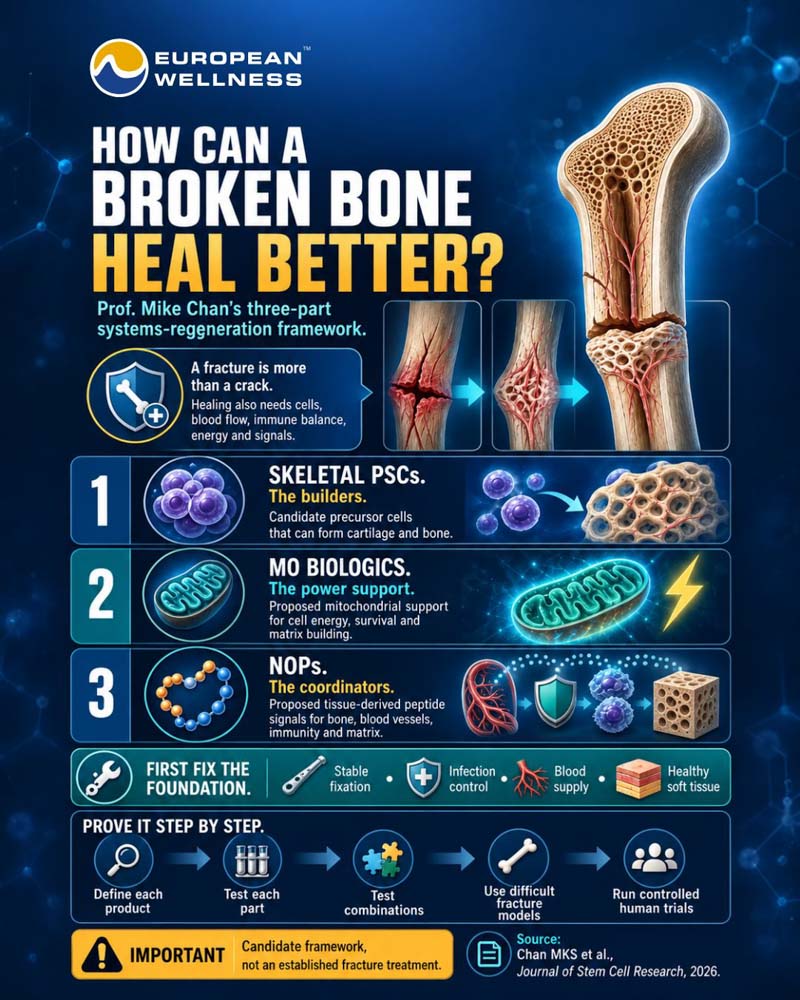
The review also reminds readers that advanced biologics cannot replace the basics. An open fracture with infection and unstable fixation first needs proper debridement, infection control, stable mechanical support and attention to blood supply and soft tissue. Prof. Mike Chan is explicit that no regenerative product can compensate for gross instability or uncontrolled infection.
Prof. Mike Chan Proposes Three Complementary Forms of Support
Prof. Mike Chan’s proposed solution is the PSC–MO–NOP framework, a candidate systems-regeneration strategy that combines three distinct forms of support. Skeletal precursor/progenitor cells, or PSCs, are intended to provide the cellular foundation. Mito Organelle biologics, or MO biologics, are proposed to support mitochondrial and metabolic competence. Nano Organo Peptides, or NOPs, are proposed to supply tissue-contextual signals that influence bone formation, blood-vessel growth, immune activity and extracellular-matrix organisation.
| Component | Plain-language role | What it is intended to address | What must still be demonstrated |
|---|---|---|---|
| Skeletal PSCs | The builders | A shortage or dysfunction of injury-appropriate cells that can form cartilage and bone | Defined skeletal identity, safe and controlled differentiation, mineralisation, genomic stability and contribution to strong functional bone |
| MO biologics | The power support | Insufficient energy and metabolic flexibility in repair cells, blood-vessel cells or immune cells | Exact composition, cell uptake, respiratory function, ATP production, redox effects and a direct link to better bone repair |
| NOPs | The coordinators | Disrupted communication among bone, vascular, immune and matrix systems | Molecular composition, batch consistency, dose response, tissue specificity, target engagement, safety and in-vivo fracture benefit |
The logic is that these components address nonredundant bottlenecks. PSCs cannot build effectively if the injury site is inflamed, poorly supplied with blood or metabolically exhausted. Better mitochondrial function cannot replace missing bone-forming cells. Peptide signals cannot produce a stable union if the fracture remains mechanically unstable. The potential value lies in coordination rather than in any one component acting as a universal cure.
Imagine a large bone defect after severe trauma. A cell-only approach may introduce potential builders, but many could fail to survive or mature in a hostile, poorly vascularised environment. In the proposed framework, PSCs would supply the candidate building cells, MO biologics would aim to improve their energy capacity, and NOPs would aim to improve the local instructions. The concept is scientifically coherent, but coherence is not the same as clinical proof.
The current EW evidence base is best regarded as conceptual and translational rather than definitive for fracture healing.
— Prof. Mike Chan and colleagues
That sentence is crucial. The paper identifies biological precedents for skeletal progenitor activity, mitochondrial support and peptide signalling, but it also warns that evidence for a defined peptide or an experimental mitochondrial mechanism cannot automatically be transferred to a complex branded preparation. Tissue origin alone does not prove that a product is tissue-specific. Giving three components together does not prove that they work synergistically. Each claim needs direct measurement.
The Roadmap from an Attractive Idea to a Dependable Therapy
The review offers a detailed development plan rather than a shortcut to clinical use. Its recommendations can be summarised as a sequence of increasingly demanding tests.
First, define every product precisely. PSC preparations should be characterised by source, viable-cell composition, molecular identity, differentiation capacity, genomic stability and safety. MO preparations should be classified according to whether they contain intact mitochondria, organelle fractions, proteins, peptides, membranes, metabolites or a mixture. NOP preparations should undergo high-resolution mass spectrometry, peptide sequencing, source authentication, stability testing and quantitative batch fingerprinting.
Second, show that each component reaches and changes its intended target. Researchers should not settle for broad claims such as improved vitality or antioxidant activity. They should measure relevant outcomes such as mitochondrial respiration, ATP production, osteogenic differentiation, mineralisation, endothelial function, immune resolution, receptor engagement and delivery to the fracture environment.
Third, test the components separately and together. A factorial design should compare PSCs alone, MO biologics alone and NOPs alone, followed by each pair and the full three-part combination. This approach can reveal whether the components are independent, merely additive, or genuinely synergistic. It also prevents a positive result from being credited to the full platform when only one component produced the effect.
Fourth, use models that resemble the patients most likely to need help. Testing should include aged or diabetic biology, poor circulation, critical-size bone defects, ischemic injury and appropriately selected infection models. A therapy that works only in an uncomplicated young model may not solve the problem of difficult nonunion.
Finally, measure meaningful healing before moving into controlled human trials. A larger callus on a scan is not enough. The regenerated bone should be anatomically integrated, supplied with blood and able to withstand mechanical loading. Human studies should then examine time to union, nonunion rates, repeat operations, pain, function and return to activity.
For a lay reader, the message is refreshingly disciplined. Prof. Mike Chan proposes an ambitious biological solution while also specifying the evidence needed to challenge it. The paper’s value therefore lies in both the framework and its built-in test: identify every ingredient, prove what each one does, compare the combinations, and judge success by durable functional bone rather than by promising laboratory markers.
Claims of systems regeneration should therefore remain contingent on demonstration of functional tissue restoration rather than mechanistic plausibility alone.
— Prof. Mike Chan and colleagues
The strongest conclusion is not that the PSC–MO–NOP platform has already solved fracture nonunion. It is that difficult bone repair deserves a more complete scientific model. Prof. Mike Chan offers a three-domain candidate solution that aims to rebuild the cells, energy and signalling environment together, while preserving the essential roles of stability, infection control and blood supply. If rigorous product characterisation, factorial experiments, difficult-fracture models and controlled clinical trials support the hypothesis, the approach could help move regenerative orthopaedics from isolated stimulation toward coordinated tissue reconstruction. Until then, it should be presented accurately as a promising and testable framework, not an established therapy.
Editorial note: This commentary explains a scientific review for general readers. It is not medical advice and should not be used to choose treatment for a fracture or nonunion.
Read the full publication:
https://european-wellness.eu/publications/reconstructing-bone-repair/
Follow European Wellness:



Follow European Wellness Academy:
Follow Prof. Dato’ Sri Dr. Mike Chan:

Related Posts