
Immerse yourself in a glamorous landscape of emerging trends and lucrative opportunities at Cosmoprof Asia…
Prof. Mike Chan: Parkinson’s Disease May Begin in the Kidneys, Not the Brain, Studies Suggest
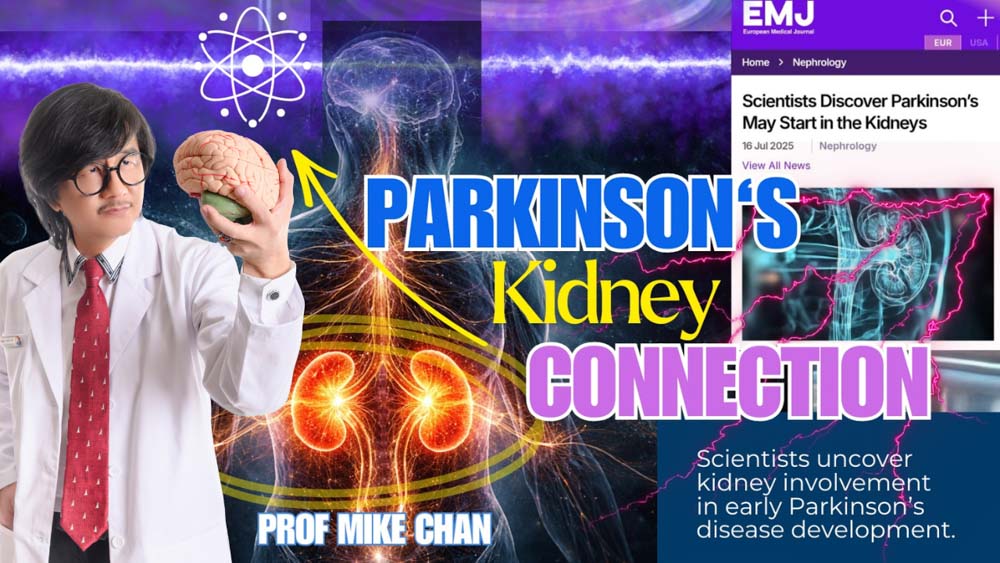
Article Source: https://www.emjreviews.com/nephrology/news/scientists-discover-parkinsons-may-start-in-the-kidneys
PARIS, Dec 28, 2025 — For decades, Parkinson’s disease has been framed as a neurological problem — a slow, irreversible breakdown of dopamine-producing cells in the brain.
But new scientific evidence is challenging that long-standing belief and pointing to a surprising new origin: the kidneys. Researchers now report that toxic, misfolded proteins linked to Parkinson’s may first accumulate in kidney cells, years or even decades before the first tremor appears.
From there, these proteins can spread through the body, eventually reaching the nervous system and triggering the familiar motor and cognitive symptoms associated with the disease.
If confirmed, the discovery could radically change how Parkinson’s is understood, detected and treated — shifting medicine’s focus from late-stage symptom control to early-stage prevention.
“This is exactly what regenerative medicine has been saying for years,” said Prof. Dato’ Sri Dr. Mike Chan, founder of European Wellness Biomedical Group. “Disease does not start where symptoms appear. It starts where the body first loses its ability to repair and detoxify.”
A silent beginning…
Parkinson’s affects more than 10 million people worldwide, yet by the time symptoms appear, up to half of key neurons may already be lost. This has long puzzled scientists.
The new research offers a possible explanation.
Kidneys act as the body’s primary filtration system, removing toxins, metabolic waste and abnormal proteins from circulation. When this system weakens, harmful proteins — including alpha-synuclein can accumulate rather than being cleared.
Over time, these proteins may migrate along nerve pathways or through the bloodstream, ultimately damaging brain cells.
“What we are seeing is a delayed disease,” Prof. Chan explained. “The pathology begins quietly in the organs. The brain only shows the damage much later.”
Large population studies already support this idea, showing that people with chronic kidney disease face a significantly higher risk of developing Parkinson’s. Autopsy findings have also detected Parkinson’s-related proteins in peripheral organs long before neurological diagnosis.
Why Kidney Health Matters
According to Prof. Chan, biology itself offers an important clue.
“The average functional lifespan of the kidney is about 55 years, while the brain can function for 70 years or more,” he said.
“If you don’t protect vital organs, especially the kidneys — degeneration starts there first.”
In his published work, Prof. Chan has consistently warned that long-term medication use, environmental toxins and metabolic stress place a heavy burden on kidney filtration.
When that filtration weakens, systemic inflammation and oxidative stress increase conditions strongly linked to neurodegeneration.
“Every medication has a renal price,” he said. “When filtration fails, toxic proteins don’t disappear. They travel.”
Managing Symptoms to Treating the Root Cause
Most current Parkinson’s treatments focus on replacing dopamine or stimulating brain circuits. While helpful for symptoms, they do not slow the disease.
Prof. Chan’s approach, detailed across his books and scientific papers, follows a different logic. Known as the DDRR model — Diagnose, Detox, Repair, Rejuvenate — it treats Parkinson’s as a multi-organ condition rather than an isolated brain disorder.
“For Parkinson’s, you must do two things,” he explained. “Repair the brain region that produces dopamine, and repair the organ that allowed toxicity to accumulate in the first place — the kidney.”
Clinically, this means combining substantia nigra–specific stem cells to support dopamine pathways with kidney-specific stem cells to restore filtration and detoxification.
“Targeted organ-specific therapy is not optional,” Prof. Chan added. “It is the only way to interrupt the disease cascade.”
Early Detection and Prevention
If kidney-based origins are confirmed, Parkinson’s could one day be detected far earlier, through renal biomarkers, protein screening or systemic inflammation profiles — long before irreversible brain damage occurs.
“This gives real hope,” Prof. Chan said.
“Not just to slow Parkinson’s, but to prevent it from ever reaching the brain.”
For patients and families, the shift reframes Parkinson’s from an unavoidable neurological fate into a systemic condition that may be intercepted early, treated precisely and managed proactively.
References & Key Takeaways
The following research materials, books, and scientific papers are drawn from Prof. Mike Chan’s published scientific works, peer-reviewed papers, keynote lectures, and long-standing clinical research in regenerative medicine.
Together, they form the scientific foundation of his whole-system, organ-specific approach, which emphasizes early detection, detoxification, and targeted cellular repair — principles that directly align with emerging research linking Parkinson’s disease to kidney dysfunction and systemic degeneration rather than isolated brain pathology.
Holistic Advances for Parkinson’s Disease
Key takeaway: Addressing the root biological dysfunctions that drives the progression of the disease and an insight to improving outcomes and restoring the quality of life for those with Parkinson’s.
The Dawn of New Medicine: Stem Cell Therapy – Old Dogma, New Hope
Key takeaway: Challenges the belief that neurodegenerative diseases are irreversible and introduces regenerative medicine as a viable strategy for repairing damaged tissues.
Biological Wellness (DDRR Paradigm)
Key takeaway: Introduces the Diagnose–Detox–Repair–Rejuvenate framework, emphasizing early detection and organ-level intervention before symptoms appear.
“Study on the Reversal of Kidney Disease”
Key takeaway: Demonstrates that kidney degeneration, once considered irreversible, can be biologically repaired — a critical insight if kidneys are a trigger point for Parkinson’s.
Stem Cells in Regenerative Medicine
Key takeaway: Details the importance of organ-specific stem cells, supporting targeted therapies for kidneys, brain regions and other vital systems.
“Pathogenetically Based Integrative Therapeutic Strategies”
Key takeaway: Explores how oxidative stress, immune dysfunction and systemic toxicity contribute to chronic neurological and degenerative diseases.
European Wellness Biomedical Group – Clinical Protocols & Keynote Publications
Key takeaway: Applies precision, organ-specific regenerative therapies in clinical settings, translating systemic disease theory into real-world treatment models.
Follow European Wellness:



Follow European Wellness Academy:
Follow Prof. Dato’ Sri Dr. Mike Chan:

Related Posts