New Scientific Publication! Could regenerative medicine open new possibilities in the future of kidney disease…
When the Retina Runs Out of Power: Prof. Mike Chan on a Metabolic View of Age-Related Eye Disease
From palliation to prevention — a new textbook on bioregenerative ophthalmology asks whether the failing eye should be treated as a failing energy system, and what would change if it were.
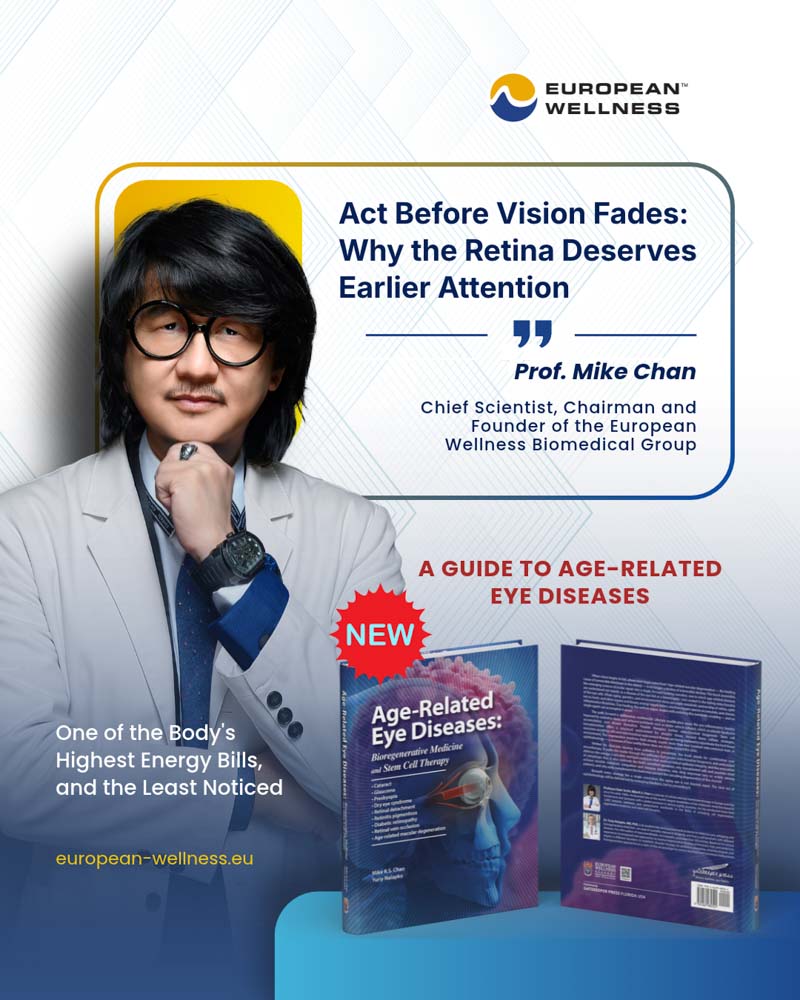
KUALA LUMPUR, Malaysia (Nov 25, 2026) – Age-related macular degeneration is still introduced to patients in the language of destination. It is the leading cause of irreversible blindness in older adults, roughly eighty per cent of cases present in an atrophic form for which no universally effective treatment exists, and the neovascular form can be stabilised with repeated injections but not repaired. A 2026 textbook, Age-Related Eye Diseases: Bioregenerative Medicine and Stem Cell Therapy, co-authored by regenerative medicine specialist Prof. Mike Chan, Chief Scientist of the European Wellness Biomedical Group, and Dr. Yuriy Nalapko, argues that this framing has itself become part of the problem. Its subject is not a new drug. It is a different account of what has gone wrong.
The scale is not in dispute. Vision impairment and blindness affect an estimated 2.2 billion people worldwide, and global modelling cited in the volume puts age-related macular degeneration at 196 million people in 2020, rising to 288 million by 2040 as populations age. What the authors contest is the clinical reflex that has grown up around those numbers.
A Different First Question
The book opens with the question its authors say they have been asked in clinics, at conferences and at the bedside:
“When the retina fails, does the answer lie in replacing what has been lost — or in learning to restore what was never given a chance?”
For most of the history of ophthalmology, they write, that question carried a quiet resignation: “The retina, we were taught, does not regenerate.” Clinical effort went accordingly — contain the vascular catastrophe, delay the decline, prepare the patient for what cannot be undone. Anti-VEGF agents such as ranibizumab and aflibercept improved outcomes substantially in vascular retinopathy, but they remain palliative tools delivered by repeated intravitreal injection, with endophthalmitis, retinal detachment and questions about long-term neuronal toxicity attached to the route itself. Dry macular degeneration, the more widespread form, has long been met with antioxidant supplementation and watchful waiting.
The authors are blunt about why they wrote the book: “This book exists because that is no longer an acceptable answer.”
The Retinal Metabolic Partnership
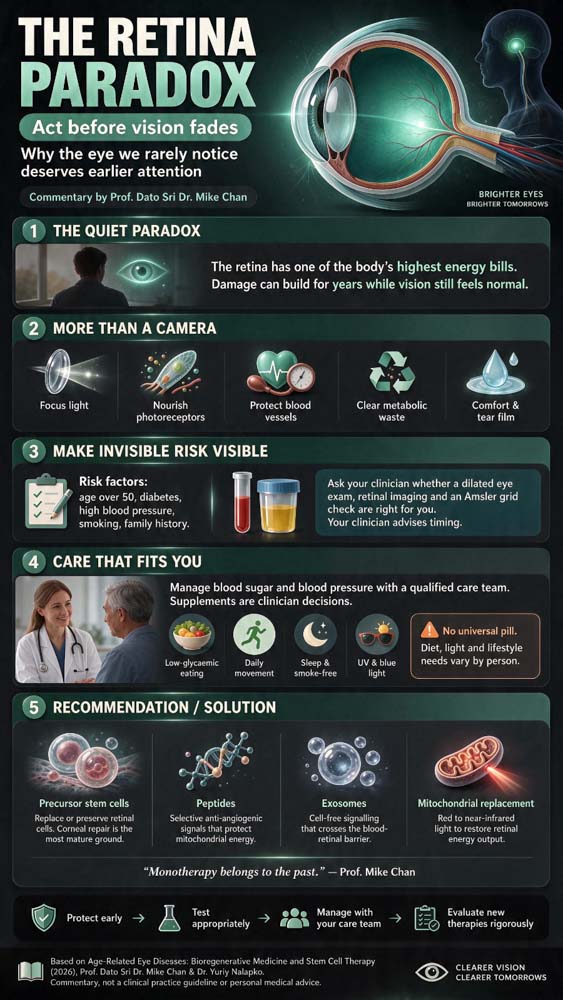
The organising idea is stated early and then applied without exception. The eye is not treated as an isolated organ but as a metabolic ecosystem with an unusually high energy bill.
“Within the healthy retina, the pigment epithelium lives a strongly oxidative life, fueled by mitochondria, while the photoreceptors it serves rely on aerobic glycolysis; the two are bound in a metabolic ecosystem in which each cell type’s waste is the other’s nourishment. In aging, this coupling unravels.”
What follows is a specific and testable account of decline: mitochondrial quality control fails, fission and fusion dynamics become dysregulated, and the epithelial cells “drift toward a glycolytic mode of metabolism that starves the very cells it exists to protect.” Oxidative stress, senescence-associated inflammation, complement overactivation, impaired autophagy and a thickening Bruch’s membrane then compound one another until photoreceptors — which have no meaningful capacity to regenerate — are lost.
This is why the volume covers nine conditions rather than one. Presbyopia, dysfunctional lens syndrome, cataract, glaucoma, age-related macular degeneration, diabetic retinopathy, retinitis pigmentosa, retinal vein occlusion, retinal detachment and dry eye are treated as separate chapters but convergent processes, sharing oxidative stress, chronic inflammation, complement dysregulation, mitochondrial failure and extracellular matrix change. And it is why the book sets a single test for every intervention it examines:
“Every therapeutic strategy examined in this volume — lifestyle, peptide, cellular, or mitochondrial — is evaluated against this standard: does it restore the metabolic ecosystem of the retina, lens, or cornea?”
Four Pillars, One Standard
The third part of the book works through the bioregenerative toolkit in order, and each chapter is anchored in the same question.
Precursor stem cells. The book separates organ-specific precursor cells — retinal, optic nerve and occipital lobe progenitors among them — from mesenchymal stem cells, and treats the two as different instruments rather than interchangeable options. Corneal repair is the most mature ground, because limbal stem cells renew the corneal epithelium every seven to fourteen days and their depletion produces a well-characterised deficiency that cultivated epithelial sheets and simple limbal epithelial transplantation can address. Dental pulp stem cells delivered on contact lenses have restored corneal epithelium in ex vivo human and porcine burn models. In the retina, the book separates cell replacement from cell preservation, and traces pluripotent stem cell-derived retinal pigment epithelium into clinical trials, with retinal organoid protocols now reaching roughly sixty per cent CRX-positive photoreceptors. Mesenchymal stem cells — under 0.1 per cent of marrow cells, expandable ex vivo — are presented mainly as paracrine actors: in one early series, a single intravitreal injection in three patients with retinitis pigmentosa and two with cone-rod dystrophy produced no structural or functional toxicity over ten months, and four of five advanced eyes gained one line of best corrected visual acuity that held through follow-up.
Peptides. Organ-specific retinal peptides are described as regulators of the transcriptional programmes that drive pathological neovascularisation, with selectivity that small molecules struggle to achieve. The book follows an eleven-amino-acid anti-angiogenic fragment, KV11, from repeated intravitreal dosing into exosome loading, a delivery strategy intended to convert a frequent injection into a durable signal. It counts more than thirty-five retinal peptides able to block receptor–ligand interactions relevant to chemokine receptor 3 in the choroid, and gives space to the galanin family, whose receptor modulation suppresses inflammasome activation in models of progressive degenerative retinopathy. The chapter’s summary judgement is that peptides “emerge as remarkable protectors of mitochondrial bioenergetics, increasing mtDNA copy number, supporting mitochondrial transcription factor A, and shielding retinal epithelial cells from oxidative death and senescence.”
Exosomes. Vesicles of roughly 40 to 150 nanometres, carrying proteins, lipids, microRNAs and metabolites, are treated as the cell-free version of the same biology — able to cross the blood-retinal barrier, low in immunogenicity, and easier to manufacture and dose than living cells. The authors describe the strategy precisely: “not replacing the cells, but persuading the surviving eye tissues to sustain themselves.”
Mitochondrial replacement. The youngest pillar, and the book says so. Photobiomodulation in dry AMD is presented as the least invasive route, targeting cytochrome c oxidase with low-intensity red to near-infrared light to raise mitochondrial membrane potential and ATP output in retinal cells. Direct organelle transfer is described as promising but unsettled: “still young and contentious,” holding the promise of “resetting the bioenergetic clock of the aging outer retina.”
Where the Book Draws Its Own Line
What distinguishes the volume from the promotional literature around regenerative ophthalmology is how often it argues against itself.
It concedes that cell therapy is stage-dependent, and that the dependence is steep:
“MSC efficacy depends strongly on disease stage: once macular geographic atrophy or other conditions have destroyed large portions of retinal architecture, cell rescue is limited and clinical responses become highly variable, ranging from slight improvements to no detectable benefit.”
It records the harms as well as the gains. Intravitreal mesenchymal stem cell administration has produced transient functional improvement alongside vision-threatening events — haemorrhagic retinopathy, vitreous haemorrhage, preretinal fibrosis, ocular hypotonia and tractional retinal detachment — and the book uses those events to argue about route and timing rather than to dismiss the field. It notes that in retinal vein occlusion “robust randomized evidence” for several adjuncts is still lacking, and that in retinal detachment any biological intervention is delivered into a surgically altered environment rather than a pristine subretinal space. And it is candid that more than two hundred registered interventional trials in regenerative ophthalmology measure activity, not proof.
The clinical conviction that survives all of this is stated once, plainly: “monotherapy belongs to the past,” because “the complex etiology of age-related eye disorders dictates that future protocols must target more than one aspect of their pathobiology.”
Lifestyle as Substrate, Not Afterthought
A full third of the book is given to interventions that require no syringe, and the authors are careful about their status:
“We do not present these as supplements to be taken lightly, but as the substrate on which every regenerative strategy must be built.”
The evidence assembled there is specific. Prudent and Mediterranean-style patterns protect against macular degeneration while Western patterns high in rapidly digested starch, fat and sugar accelerate it; moving from a high-glycaemic to a low-glycaemic diet improves retinal outcomes even after exposure has begun, which the authors treat as the most clinically useful single finding in the chapter. Long-chain omega-3 fatty acids from marine fish supply the DHA that photoreceptor membranes are built from; lutein and zeaxanthin raise macular pigment optical density. Physical activity is quantified rather than asserted: cataract risk falls by approximately two per cent for every additional six metabolic equivalents per day, roughly an hour of jogging or cycling. The gut-retina axis gets its own section, including the observation that microbiota transplanted from normally fed mice reduced choroidal neovascularisation by about thirty-five per cent in high-fat-fed animals.
The environmental argument is equally concrete. Airborne pollutants and volatile organic compounds accelerate lipofuscin accumulation and drusen formation; ozone inhibits tear enzymes; blue light and ultraviolet radiation drive photochemical oxidative damage in the outer retina. Smoking is treated as a measurable ocular exposure rather than a general health warning. And because most of this damage accumulates before symptoms, the book closes on screening — noting, among other inequities, that roughly two-thirds of blind individuals worldwide are women.
Key Takeaways for Readers
- Reframing, not replacement: Age-related eye disease is presented as a bioenergetic failure — a breakdown in the metabolic partnership between retinal pigment epithelium, photoreceptors, optic nerve and brain — rather than as an isolated defect of one tissue.
- One standard for every therapy: Lifestyle, peptides, cells, exosomes and mitochondrial support are judged by whether they restore that metabolic ecosystem, not by whether they are novel.
- Combination over monotherapy: The authors argue that the complexity of these diseases makes single-agent protocols inadequate by design.
- Stage matters: Cell-based rescue works best before architecture is destroyed; the book states the limit as plainly as the promise.
- Fundamentals are not optional: Diet quality, exercise, smoke and pollution avoidance, and regular examination are described as the substrate on which any regenerative strategy depends.
Get Your Copy Today
Age-Related Eye Diseases: Bioregenerative Medicine and Stem Cell Therapy
References
- Chan, M. K. S., & Nalapko, Y. (2026). Age-Related Eye Diseases: Bioregenerative Medicine and Stem Cell Therapy. European Wellness Academy. ISBN: 978-1-6629-8252-1 (hardcover), 978-1-6629-8253-8 (eISBN); LCCN: 2026955545; DOI: https://doi.org/10.69669/vm2422.
- Ahmed, I., Johnston, R. J., Jr., & Singh, M. S. (2021). Pluripotent stem cell therapy for retinal diseases. Annals of Translational Medicine, 9(15), 1279. https://doi.org/10.21037/atm-20-4747.
- Rubner, R., Li, K. V., & Canto-Soler, M. V. (2022). Progress of clinical therapies for dry age-related macular degeneration. International Journal of Ophthalmology, 15(1), 157-166. https://doi.org/10.18240/ijo.2022.01.23.
- Delanghe, J. R., Beeckman, J., Beerens, K., Himpe, J., Bostan, N., Speeckaert, M. M., Notebaert, M., Huizing, M., & Van Aken, E. (2023). Topical application of deglycating enzymes as an alternative non-invasive treatment for presbyopia. International Journal of Molecular Sciences, 24(8), 7343. https://doi.org/10.3390/ijms24087343.
- Jiang, H., Wang, L.-N., Liu, Y., Li, M., Wu, M., Yin, Y., Ma, L., & Wu, C.-R. (2020). Physical activity and risk of age-related cataract. International Journal of Ophthalmology, 13(4), 643-649. https://doi.org/10.18240/ijo.2020.04.18.
- Akpek, E. K., Amescua, G., Farid, M., et al. (2019). Dry Eye Syndrome Preferred Practice Pattern. Ophthalmology, 126(1), P286-P334. https://doi.org/10.1016/j.ophtha.2018.10.023.
Follow European Wellness:



Follow European Wellness Academy:
Follow Prof. Dato’ Sri Dr. Mike Chan:

Related Posts