Immerse yourself in a glamorous landscape of emerging trends and lucrative opportunities at Cosmoprof Asia…
THE THYMUS: Why This Essential Immune Organ Could Hold the Key to Healthspan and Longevity
New research challenges decades of medical thinking—and reinforces why every organ matters.
Landmark Research
Health Consequences of Thymus Removal in Adults
The New England Journal of Medicine (2023): https://www.nejm.org/doi/full/10.1056/NEJMoa2302892
A Landmark Study Challenges Medical Dogma
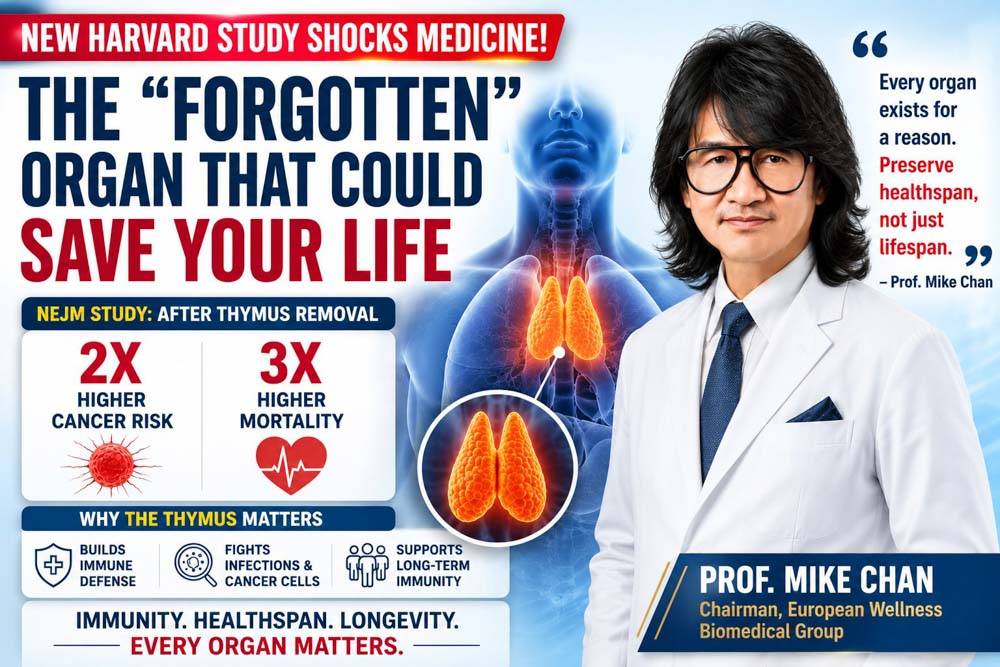
For decades, the thymus was regarded as one of the body’s most expendable organs. Located behind the breastbone, it is responsible for producing T lymphocytes—the immune system’s frontline defenders against infections, abnormal cells, and cancer. Because the gland naturally shrinks after puberty, many clinicians believed it became largely inactive, leading surgeons to routinely remove it during certain heart operations without expecting significant long-term consequences.
That long-held belief is now being challenged.
A landmark study published in The New England Journal of Medicine found that adults who underwent thymectomy experienced nearly twice the risk of developing cancer and almost three times the risk of dying from any cause within five years compared with similar patients whose thymus was preserved. Researchers also reported significantly lower production of new T cells and higher inflammatory markers, suggesting that the thymus continues to support immune health throughout adulthood.
Although the study does not establish that thymectomy directly causes these outcomes—and thymus removal remains medically necessary for selected conditions—it provides compelling evidence that this small organ continues to play an important biological role long after childhood.
“The thymus is not an optional organ. It is essential for building and maintaining a healthy immune system. People can live without an appendix, but you cannot ignore the thymus if you want to preserve immunity and healthy aging,” says Prof. Mike Chan.
The Thymus Exists for a Reason
For Prof. Dato’ Sri Dr. Mike Chan, chairman of European Wellness Biomedical Group, the findings reinforce a philosophy he has championed for more than four decades.
“For decades, the thymus has been underestimated simply because it becomes smaller with age. That assumption is now being challenged. The thymus remains one of the body’s most important immune organs and should be preserved whenever medically possible.”
“The future of medicine is not simply extending lifespan. It is preserving healthspan—the years we remain physically, mentally, hormonally, and immunologically healthy.”
According to him, longevity should not be measured by years alone.
“What is the point of living to 100 if the final decades are spent battling chronic disease? Our goal should be to preserve organ function long before irreversible degeneration occurs.”
Why the Thymus Still Matters
As we age, the thymus undergoes a natural process called thymic involution, where active tissue is gradually replaced by fat. This reduces the body’s ability to produce new naïve T cells, narrowing immune diversity and weakening protection against infections, cancer, and abnormal cells.
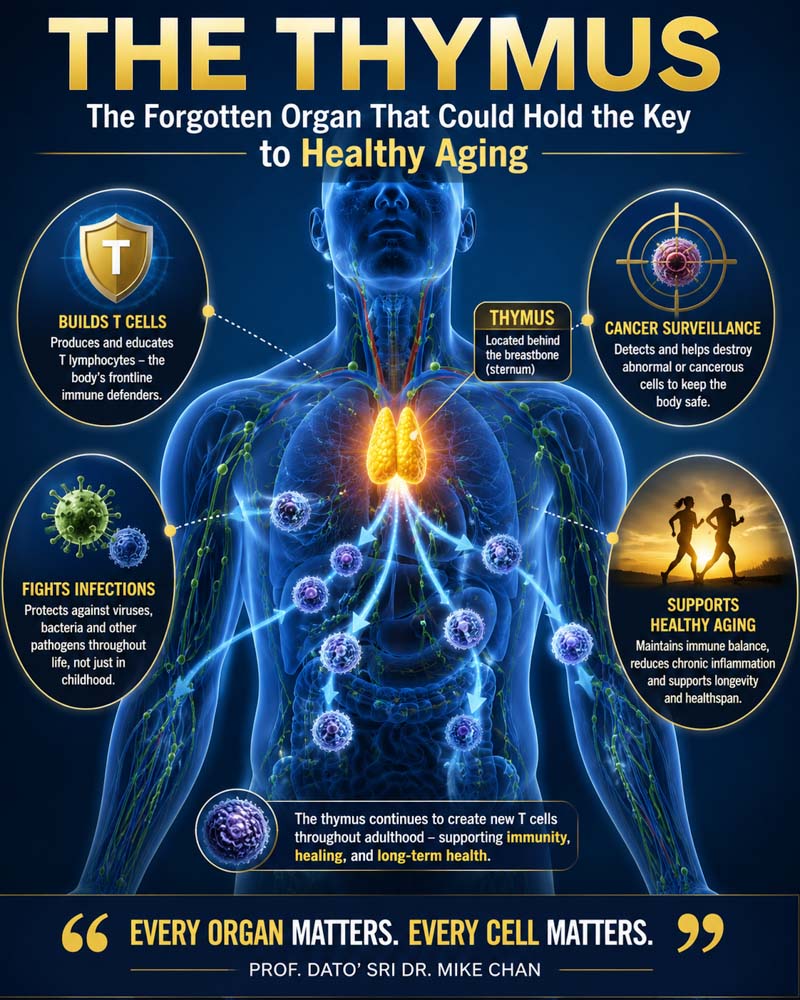
“The thymus is the command center of immune education. Once its function declines, the body’s ability to produce new T-cells also diminishes, reducing immune resilience over time.”
Scientists now recognize this decline as one of the contributors to immunosenescence—the gradual deterioration of the immune system; and inflammaging, the chronic low-grade inflammation associated with biological aging.
Prof. Chan explains that immunity is far more than protection against viruses.
“Your immune system is one of the body’s greatest regenerative systems. It coordinates healing, repair, inflammation, and surveillance throughout the body. Once immune resilience declines, every organ becomes more vulnerable.”
“Medicine should not wait until the immune system has already deteriorated. We should protect and support the thymus long before irreversible decline occurs.”
Precision Regenerative Medicine
The new findings also align with Prof. Chan’s long-standing advocacy for precision regenerative medicine.
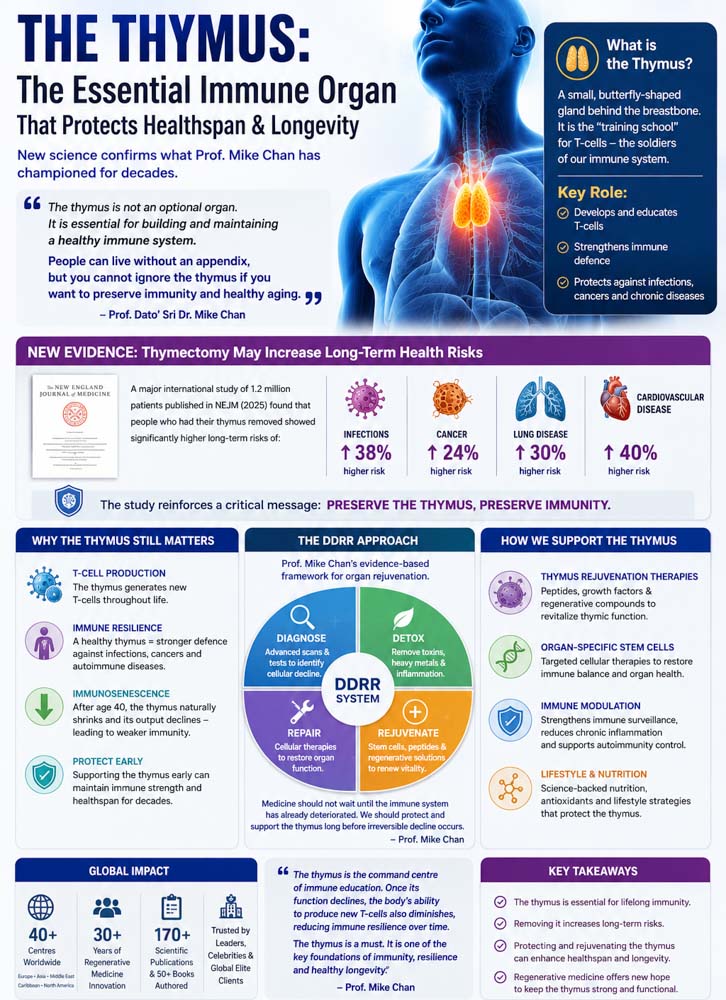
“Medicine should not wait until the immune system has already deteriorated. We should protect and support the thymus long before irreversible decline occurs.”
At European Wellness, this philosophy is reflected in the Diagnose, Detox, Repair, and Rejuvenate (DDRR) framework.
Prof. Chan explains that successful regeneration begins with understanding the body’s biological terrain.
“If inflammation, oxidative stress, toxicity, and metabolic dysfunction are not addressed first, the body’s regenerative potential becomes compromised.”
Only after careful assessment are personalized regenerative strategies considered.
These may include organ-specific peptide support, Mito Organelles (MO), Nano Organo Peptides (NOP), and organ-specific precursor cell therapies designed to support the body’s natural biological processes.
“Precision medicine begins by respecting the biological identity of every organ. The brain is different from the pancreas. The pancreas is different from the thymus. Every tissue has its own regenerative requirements.”
Clinical Experience and Immune Support
Over several decades, published clinical research involving thymic peptides has reported encouraging findings in areas including immune recovery following chemotherapy, recurrent respiratory infections, and certain autoimmune disorders.
Prof. Chan believes these observations support a broader understanding of immune health.
“Restoring immune competence may influence far more than infection alone. Immune balance affects inflammation, tissue repair, metabolism, and ultimately healthy aging.”
While additional research is needed to further evaluate regenerative therapies in different clinical settings, he believes the scientific direction is becoming increasingly clear.
A New Era of Healthspan Medicine
For Prof. Chan, the NEJM publication is not simply about one small gland.
He believes medicine is entering a new era where preserving organ function becomes as important as treating disease.
“The greatest breakthrough in longevity will not come from adding years to life. It will come from preserving every organ that allows us to enjoy those years. Every organ matters. Every cell matters. That is the future of regenerative medicine.”
Resources
Recommended Reading
Readers interested in learning more about thymic regeneration, regenerative medicine and biological longevity may explore the following publications by Prof. Dato’ Sri Dr. Mike K.S. Chan and collaborators:
- Thymus Therapy: The Past, Present, and Future. By Prof. Dr. Mike K.S. Chan & Prof. Dr. Michelle B.F. Wong
A comprehensive review of thymus-derived peptides, immune rejuvenation, and clinical applications of thymus therapy.
- Stem Cells in Regenerative Medicine: Carpe Diem – Carpe Vitam! By Prof. Dr. Mike K.S. Chan & Prof. Dr. Dmitry Klokol
A detailed reference on precursor stem cells, organ-specific regenerative medicine, and their clinical applications.
- A Comprehensive Guide to Biological Medicine and Wellness. By Prof. Dr. Mike K.S. Chan & Prof. Dr. Dmitry Klokol
An overview of the European Wellness DDRR (Diagnose, Detox, Repair, and Rejuvenate) philosophy and personalized biological medicine.
- The Human Cytology Atlas. By Prof. Dato’ Sri Dr. Mike K.S. Chan and collaborators
A scientific reference mapping more than 400 human cell types and supporting the concept of organ-specific precision regenerative medicine.
👉 Click on the link to purchase book or find out more:
https://european-wellness.eu/product/thymus-therapy-the-past-present-and-future/
Thymus Therapy: The Past, Present and Future
Follow European Wellness:



Follow European Wellness Academy:
Follow Prof. Dato’ Sri Dr. Mike Chan:

Related Posts