Get ready for an exhilarating gathering of groundbreaking discoveries! European Wellness is proud to participate…
Exosomes: The Next Frontier in Regenerative Medicine
From cellular debris to molecular messengers — Prof. Mike Chan and his fellow authors explore an emerging frontier in cellular science.
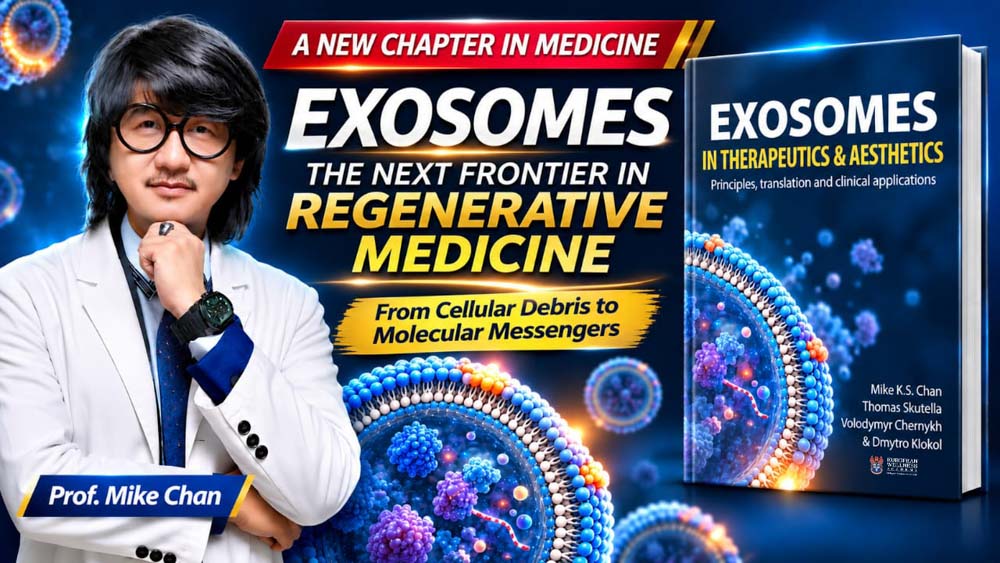
KOTA KINABALU, Sabah (Nov 19, 2026) – Dismissed for decades as mere “cellular debris” or “biological rubbish,” microscopic messengers known as exosomes are now at the center of a fierce scientific and commercial tug-of-war as regenerative medicine shifts from replacing damaged tissue to instructing the body to heal itself.
A newly published 2026 textbook, Exosomes in Therapeutics & Aesthetics: Principles, Translation and Clinical Applications, co-authored by regenerative medicine pioneer Professor Dato’ Sri Dr. Mike K.S. Chan alongside Heidelberg neuroanatomist Professor Dr. med. Thomas Skutella, aesthetic dermatologist Dr. Volodymyr Chernykh, and surgeon-scientist Dr. Dmytro Klokol, aims to separate hard biological evidence from booming commercial hype.
From Cellular Scraps to Biological Messengers
For most of the 20th century, vesicles measuring roughly 30 to 150 nanometers across—so tiny that a thousand lined up side by side would barely span a human hair—remained beyond the limits of light microscopy or were brushed aside as leftovers when first glimpsed. Over the past four decades, researchers gradually uncovered their true role: cells package proteins, lipids, messenger RNA, and microRNA inside lipid-bound parcels to coordinate behavior across neighboring and distant tissues.
As the book notes in its opening framing, the field’s central ambition has shifted away from simply substituting broken parts toward restoring the cellular dialogue that allows tissues to repair themselves.
Precision Over a One-Size-Fits-All Cure
In a prominent opening message to readers, Prof. Mike Chan challenges the widespread assumption that stem cells—or the exosomes they release—act as a universal remedy across organs and diseases. Drawing on more than four decades of research in cellular and regenerative medicine, Chan argues for organ-specific targeting rather than relying solely on multipotent mesenchymal stem cells (MSCs).
“Not all stem cells are the same, and not all of them work in the same way. In my experience of 40 over years of research, effective regeneration requires targeted, organ- and brain-specific precursor stem cells, not just mesenchymal stem cells (MSCs) alone.”
Chan emphasizes that while specialized cells throughout the body share the same underlying DNA, each cell type carries its own distinct functional profile, epigenetic landscape, and molecular machinery:
“This is why, in my view, a regenerative signal must reach not only the surface of a cell or the cellular membrane for the membrane stimulation, but the machinery that governs it—the nucleus (the ‘CPU of the cell’) and the mitochondria (the ‘Power house of the cell’)—and must reach the specific cells of the specific organ in need, rather than simply stimulating the cell membrane.”
Using a precision analogy to explain targeted biological repair across organs and age-related decline, Chan adds:
“The Precision in Age-Reversal Longevity Medicine and increasing the Lifespan through the Healthspan that can be achieved through the Cellspan can be pictured almost as a mathematical model. Each target organ including brain or any disease has its own address: A1 is for A1 disease or the target organ regeneration, B6 – for B6, G8 – for G8, K9 – for K9, Z10 – for Z10-and each requires its own matching key, in an almost endless algorithm of cellular diversity. What it never requires is a single type of mesenchymal stem cell, or the exosomes of a single cell type, applied to every disease and every organ: never one A for every condition from A to Z.”
Reflecting on his broader perspective on longevity and clinical care, Chan also writes:
“Lifespan, as I see it, is extended through healthspan, and healthspan through what might be called cellspan: the health of the specific cells on which each organ depends. Over more than four decades I have seen conditions regarded as untreatable improve, to a meaningful degree, when precision was applied. Experience of that kind is not proof, and this book is careful to distinguish the two.”
And in a closing line underscoring that precision framing, he states:
“The untreatable are treatable, I have witnessed that many times to a certain extent if precision is applied.”
Promise Versus Clinical Proof
While the book highlights compelling laboratory and preclinical findings—ranging from wound healing, tendon and cartilage recovery, and cardiac protection to skin rejuvenation and neuroprotection—the authors maintain a sobering distinction between biological plausibility and proven human efficacy.
An analysis of Clinical Trials.gov registrations between 2010 and 2025 cited in the volume counts 355 clinical studies involving human-derived extracellular vesicles, with 58.3 percent observational (largely diagnostic or biomarker studies) and 41.7 percent interventional—and only three studies having reached Phase III. Moreover, the text stresses that no exosome product has received approval from the U.S. Food and Drug Administration for treating disease, warning readers to scrutinize source-cell characterization, manufacturing consistency, and controlled clinical evidence before accepting commercial claims.
Manufacturing and Rehabilitation Still Matter
Across chapters on cellular biology, longevity, sports injuries, combination therapies, dermatology, and organ-specific secretomes, the book repeatedly warns that two vials bearing the same label can behave very differently depending on donor cells, culture conditions, isolation methods, and potency testing. In musculoskeletal care especially, the authors stress that biological messengers cannot substitute for structured mechanical loading and rehabilitation—and that personal or anecdotal recovery, including a candid account of self-administered exosome therapy for shoulder injuries, illustrates questions rather than proving clinical outcomes.
Key Takeaways for Readers
- Communication over replacement: Exosomes function as molecular messengers carrying proteins, lipids, and regulatory RNAs that help coordinate cellular repair rather than acting as replacement tissue.
- Context is everything: Exosome cargo reflects the identity and state of the parent cell—meaning vesicles from a healthy regenerative source and those from a stressed or malignant cell deliver very different instructions.
- Early clinical stage: Most human studies remain early-phase or diagnostic/observational, with no FDA-approved exosome therapeutics for disease treatment.
- Manufacturing decides quality: Strict characterization, Good Manufacturing Practice (GMP), and MISEV standards are essential because identical product names do not guarantee identical preparations.
- Fundamentals remain indispensable: In tissue repair and longevity, biological signals work alongside—not in place of—proper rehabilitation, mechanical loading, and healthy lifestyle habits.
References
- Chan, M. K. S., Skutella, T., Chernykh, V., & Klokol, D. (2026). Exosomes in Therapeutics & Aesthetics: Principles, Translation and Clinical Applications. Gatekeeper Press / European Wellness Academy. ISBN: 978-1-6629-8325-2 (hardcover), 978-1-6629-8326-9 (eISBN);
DOI: https://doi.org/10.69669/cf9440 - Selected foundational and field studies cited within the book:
- Harding, C., Heuser, J., & Stahl, P. (1983). Receptor-mediated endocytosis of transferrin and recycling of the transferrin receptor in rat reticulocytes. Journal of Cell Biology, 97(2), 329–339.
- Pan, B. T., & Johnstone, R. M. (1983). Fate of the transferrin receptor during maturation of sheep reticulocytes in vitro: selective externalization of the receptor. Cell, 33(3), 967–978.
- Johnstone, R. M., Adam, M., Hammond, J. R., Orr, L., & Turbide, C. (1987). Vesicle formation during reticulocyte maturation. Association of plasma membrane activities with released vesicles (exosomes). Journal of Biological Chemistry, 262(19), 9412–9420.
- Raposo, G., Nijman, H. W., Stoorvogel, W., et al. (1996). B lymphocytes secrete antigen-presenting vesicles. Journal of Experimental Medicine, 183(3), 1161–1172.
- Valadi, H., Ekström, K., Bossios, A., Sjöstrand, M., Lee, J. J., & Lötvall, J. O. (2007). Exosome-mediated transfer of mRNAs and microRNAs is a novel mechanism of genetic exchange between cells. Nature Cell Biology, 9(6), 654–659.
- Lai, R. C., Arslan, F., Lee, M. M., et al. (2010). Exosome secreted by MSC reduces myocardial ischemia/reperfusion injury. Stem Cell Research, 4(3), 214–222.
- Welsh, J. A., Goberdhan, D. C. I., O’Driscoll, L., et al. (2024). Minimal information for studies of extracellular vesicles (MISEV2023): from basic to advanced approaches. Journal of Extracellular Vesicles, 13(2), e12404.
- S. Food and Drug Administration. (2019, December 6). Public Safety Notification on Exosome Products. Silver Spring, MD: FDA.
Follow European Wellness:



Follow European Wellness Academy:
Follow Prof. Dato’ Sri Dr. Mike Chan:

Related Posts