Immerse yourself in a glamorous landscape of emerging trends and lucrative opportunities at Cosmoprof Asia…
Mitochondrial Peptides: A Fresh Perspective on Restoring Female Fertility
Infertility is a growing global concern, affecting approximately 10 to 15 percent of reproductive-aged women worldwide. As someone who has traveled around the world treating celebrities, heads of state, sports athletes, and highly influential individuals, I have seen firsthand the profound emotional and physical toll that reproductive challenges can take on women and families. For decades, the medical community has relied heavily on conventional approaches such as hormonal therapies and Assisted Reproductive Technologies (ART), including In Vitro Fertilization (IVF). While these methods have helped many, they often act as a workaround rather than addressing the root cause of the problem.
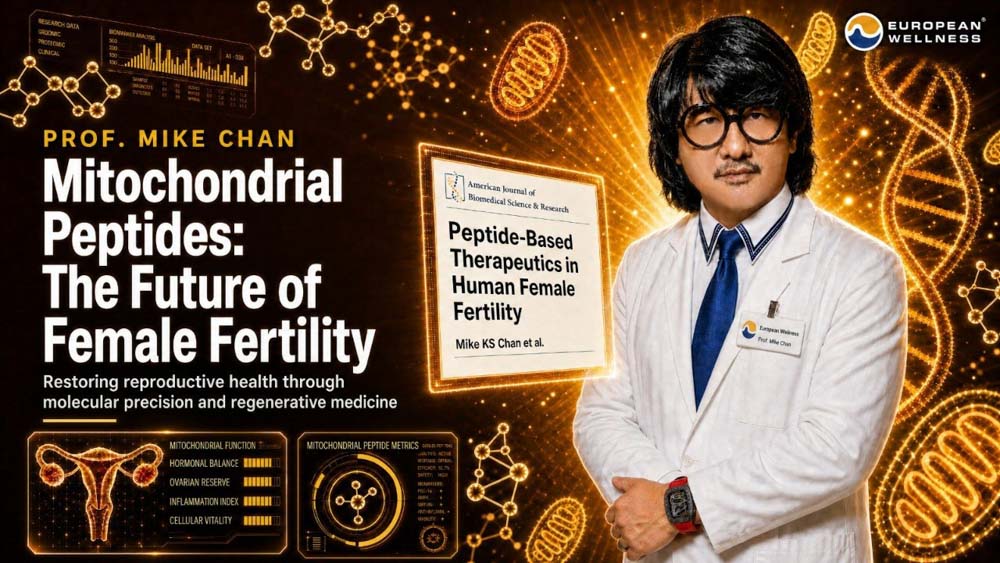
In our recent peer-reviewed study, Peptide-Based Therapeutics in Human Female Fertility: Molecular Mechanisms, Translational Evidence, and Clinical Prospects, published in the American Journal of Biomedical Science & Research (2026), my co-authors and I explore a different approach. Instead of merely bypassing reproductive dysfunction, this commentary focuses on how mitochondrial peptides and related biologically targeted therapies may help support the body’s natural reproductive balance from within.
The Hidden Causes of Infertility That Most People Never Hear About
To understand why traditional treatments sometimes fall short, we need to look closely at what actually causes female infertility. It is not simply a matter of a single organ failing. Rather, it is a complex, systems-level disorder involving multiple interconnected biological processes.
“Female infertility arises from complex interactions among endocrine dysregulation, mitochondrial dysfunction, oxidative stress, inflammation, vascular impairment, metabolic disturbance, and reproductive aging.” — Prof. Mike Chan
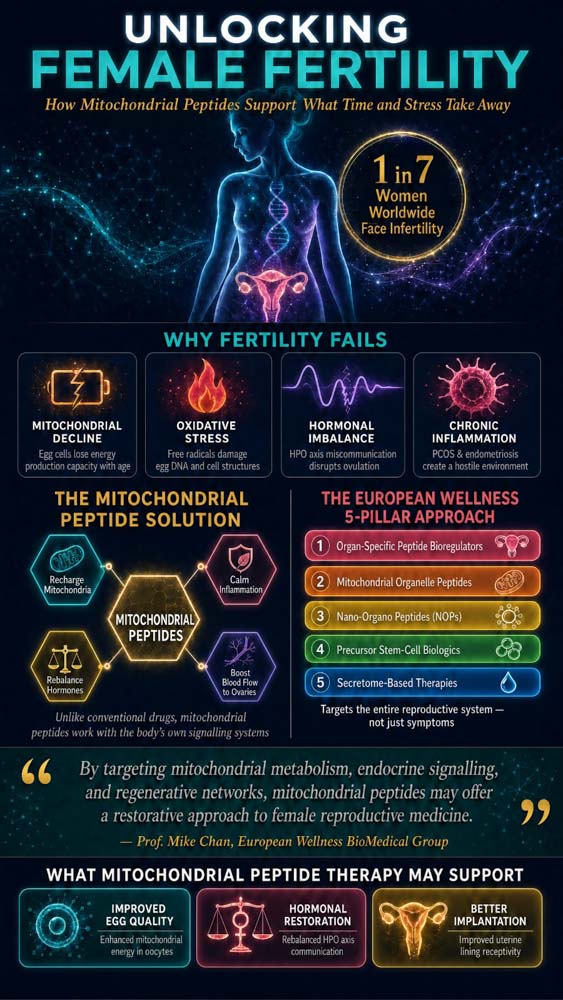
One of the most significant yet underappreciated culprits is the decline in mitochondrial function. Think of mitochondria as the tiny power plants inside our cells. Egg cells, known as oocytes, contain the highest concentration of mitochondria of any cell in the human body — and for good reason. They require enormous amounts of energy to mature properly, to be fertilized, and to develop into a healthy embryo. When these power plants start to fail — often due to aging, oxidative stress, or environmental toxins — the quality of the eggs drops significantly. This is a primary reason why women over 35 often face greater difficulties conceiving.
To put this in everyday terms: imagine trying to charge your phone with a battery that is already 80 percent depleted. The phone may switch on, but it will not perform at its best. Similarly, an egg cell with compromised mitochondria may be fertilized, but it is far less likely to develop into a healthy embryo.
Beyond mitochondrial decline, chronic low-grade inflammation also plays a major role. Conditions such as Polycystic Ovary Syndrome (PCOS), endometriosis, and obesity all generate inflammatory signals that disrupt the delicate hormonal communication network — known as the Hypothalamic–Pituitary–Ovarian (HPO) axis — that governs ovulation, egg maturation, and implantation. Environmental factors compound the problem further. Exposure to endocrine-disrupting chemicals found in plastics, pesticides, and heavy metals has been linked to impaired ovarian reserve, menstrual dysfunction, and implantation failure.
The conclusion is clear: female infertility is not a simple hormonal deficiency. It is a multi-system breakdown, and it demands a multi-system solution.
Mitochondrial Peptides as the Body’s Own Messengers of Repair
This is precisely where mitochondrial peptides come into focus. These short chains of amino acids, produced within or closely linked to mitochondrial signalling, can act as highly specific biological messengers within the body. Unlike broad-acting pharmaceutical drugs that can affect multiple systems indiscriminately, mitochondrial peptides may influence targeted cellular pathways associated with energy regulation, oxidative-stress responses, repair, and restoration.
“Peptide-based therapeutics represent a promising class of biologic regulators capable of modulating many of these interconnected systems simultaneously.” — Prof. Mike Chan
Consider the role of Mitochondrial-Derived Peptides (MDPs) such as MOTS-c and humanin. These naturally occurring peptides have been shown in experimental studies to activate key energy-regulating pathways — including AMPK and PGC-1α — that essentially tell the cell to produce more energy, reduce oxidative damage, and repair itself. For an aging egg cell, this is the equivalent of installing a new, more efficient battery.
Other peptides target the vascular system, stimulating the production of Vascular Endothelial Growth Factor (VEGF) to improve blood flow to the ovaries and uterine lining. Just as a garden needs a steady water supply to flourish, the ovaries and uterus need adequate blood flow to maintain a healthy environment for egg development and embryo implantation. Peptides that enhance this microvascular support can meaningfully improve the conditions for conception.
Organ-specific peptide bioregulators derived from ovarian, hypothalamic, pituitary, and placental tissues are also being studied for their ability to restore hormonal balance at the cellular signaling level. Rather than flooding the body with synthetic hormones — which can produce side effects and disrupt natural feedback mechanisms — these peptides work with the body’s existing regulatory networks to encourage more balanced, physiological hormone production.
The analogy here is instructive. Traditional IVF is like trying to plant a seed in depleted, poorly watered soil and hoping it grows. A mitochondrial peptide–centred strategy, by contrast, is like enriching the soil, restoring the water supply, and creating the optimal environment for the seed to thrive naturally.
A Holistic Solution for Restoring Reproductive Health
At the European Wellness (EW) Biomedical Group, Prof. Mike Chan and his team advocate for a comprehensive, multi-modal approach to female reproductive restoration. Mitochondrial peptides form an important component within this broader framework, which addresses the entire biological system rather than treating the reproductive organs in isolation.
“The EW approach conceptualizes peptide therapeutics not as isolated hormonal substitutes but as signaling-level modulators capable of restoring physiological regulatory networks governing reproductive homeostasis.” — Prof. Mike Chan
The EW framework integrates five key therapeutic pillars, each targeting a different dimension of reproductive dysfunction:
| Therapeutic Component | Primary Target | Mechanism |
|---|---|---|
| Organ-Specific Peptide Bioregulators | Ovaries, pituitary, hypothalamus | Restore HPO axis signaling and steroidogenesis |
| Mitochondrial Organelle Peptides (MOPs) | Oocyte energy metabolism | Activate AMPK, PGC-1α, TFAM pathways |
| Nano-Organo Peptides (NOPs) | Cellular delivery and targeting | Enhanced bioavailability via nano-delivery systems |
| Precursor Stem-Cell Biologics | Ovarian tissue regeneration | Cellular repair and microenvironment restoration |
| Secretome-Based Therapies | Endocrine and immune signaling | Cell-free regenerative biologics |
For example, a woman in her late thirties experiencing age-related decline in ovarian reserve might benefit from a multi-factorial peptide formulation (MF+) that simultaneously targets her ovaries, pituitary gland, hypothalamus, adrenal glands, and placental pathways. This integrated approach aims to improve her overall hormonal balance, cellular vitality, and ovarian responsiveness — not just stimulate ovulation artificially.
Similarly, a younger woman with PCOS-related infertility might respond well to peptide formulations that reduce chronic inflammation, improve insulin sensitivity, and restore the regular hormonal communication between the brain and the ovaries. By addressing the underlying metabolic and inflammatory drivers of PCOS, rather than simply inducing ovulation with medication, the goal is to help her body function more naturally and sustainably.
The EW model also emphasizes the integration of peptide signaling with precursor stem-cell and secretome-based therapies. Secretomes — the collection of signaling molecules secreted by stem cells — have shown promise in experimental studies for improving hormonal balance, ovarian responsiveness, and tissue vitality in women experiencing reproductive aging or menopausal transition.
It is important to note that while the translational evidence is encouraging, the field is still maturing. Current findings are largely based on experimental models and observational studies. Rigorous clinical trials, standardized peptide characterization, and long-term safety evaluations remain essential next steps before these therapies can be fully integrated into mainstream reproductive medicine. Safety considerations, including potential immunogenicity and the possibility of epigenetic effects on developing embryos, must be carefully evaluated.
Nevertheless, the direction is clear. By moving away from a symptom-management model and toward one that seeks to restore the body’s own biological intelligence, peptide therapeutics offer a scientifically compelling and clinically meaningful path forward for women facing the complex challenge of infertility.
In Prof. Mike Chan’s Own Words
Beyond the pages of the published study, Prof. Mike Chan has spoken candidly about what this research truly means — and why it matters now more than ever. In a series of personal voice commentaries recorded in response to this article, he offered three illuminating observations that cut to the heart of the matter.
Prof. Chan is emphatic that not all peptides are the same, and that this distinction is one the public urgently needs to understand. He points out that there are essentially two categories in the peptide world today. The first comprises natural peptides — specifically the mitochondrial organelle peptides and the nano-ised organic peptides that form the scientific backbone of his research. The second comprises synthetic, man-made peptides that have generated enormous commercial excitement and media attention in recent years. It is this second group, Prof. Chan notes, that is driving the current wave of hype in the market. His work, by contrast, is firmly rooted in the first — natural, biologically derived compounds that work in harmony with the body’s own signalling systems rather than substituting or overriding them.
Prof. Chan is equally specific about where these natural peptides are directed. He identifies the key organ systems targeted by his formulations as the pituitary, hypothalamus, placenta, ovary, adrenal cortex, and liver — a list that maps precisely onto the hormonal and metabolic command chain governing female reproductive health. This is not a narrow, single-organ intervention. It is a deliberate, whole-body strategy that recognises infertility for what it truly is: a multi-system breakdown requiring a multi-system solution. By coordinating mitochondrial and organ-specific peptide signals across these interconnected organs through the Multi-Factorial Plus (MF+) framework, Prof. Chan’s approach aims to support the body’s reproductive intelligence from the top of the hormonal axis all the way down to the cellular level.
Perhaps the most telling observation Prof. Chan makes is also the simplest. He notes that while everyone today seems captivated by synthetic chemical peptides, the natural mitochondrial and nano-ised peptides that his team has spent years developing remain almost entirely unknown — even within scientific and medical circles. There is a quiet but unmistakable conviction in this observation. Prof. Chan is not lamenting a lack of recognition for its own sake. He is pointing to a genuine and consequential gap between what the market is celebrating and what the science actually supports. The peptides generating the most noise are not necessarily the ones offering the most meaningful biological benefit. And the ones that do — the natural, organ-targeted, mitochondrially active peptides at the core of his research — have yet to receive the attention they deserve.
Taken together, these reflections reveal a researcher who is not merely publishing findings, but actively calling attention to a direction that mainstream medicine has been slow to follow. Prof. Chan’s message is clear: the mitochondrial peptide approach worth paying attention to is not the synthetic one generating commercial hype, but the natural, biologically intelligent research direction that his work has been quietly and methodically building, organ by organ and pathway by pathway.
About the Author
Prof. Dato Sri Dr. Mike Chan is a co-founder of the European Wellness BioMedical Group and European Wellness Academy, based in Edenkoben, Germany, and is affiliated with Lincoln University College, Selangor, Malaysia. He has dedicated his career to advancing regenerative and biological medicine, with a particular focus on cellular health, aging, and reproductive medicine.
Reference
Chan MKS, Wong MBF, Klokol D, Casazza K, Lakey JRT. Peptide-Based Therapeutics in Human Female Fertility: Molecular Mechanisms, Translational Evidence, and Clinical Prospects. Am J Biomed Sci & Res. 2026; 31(5). DOI: 10.34297/AJBSR.2026.31.004075
Follow European Wellness:



Follow European Wellness Academy:
Follow Prof. Dato’ Sri Dr. Mike Chan:

Related Posts